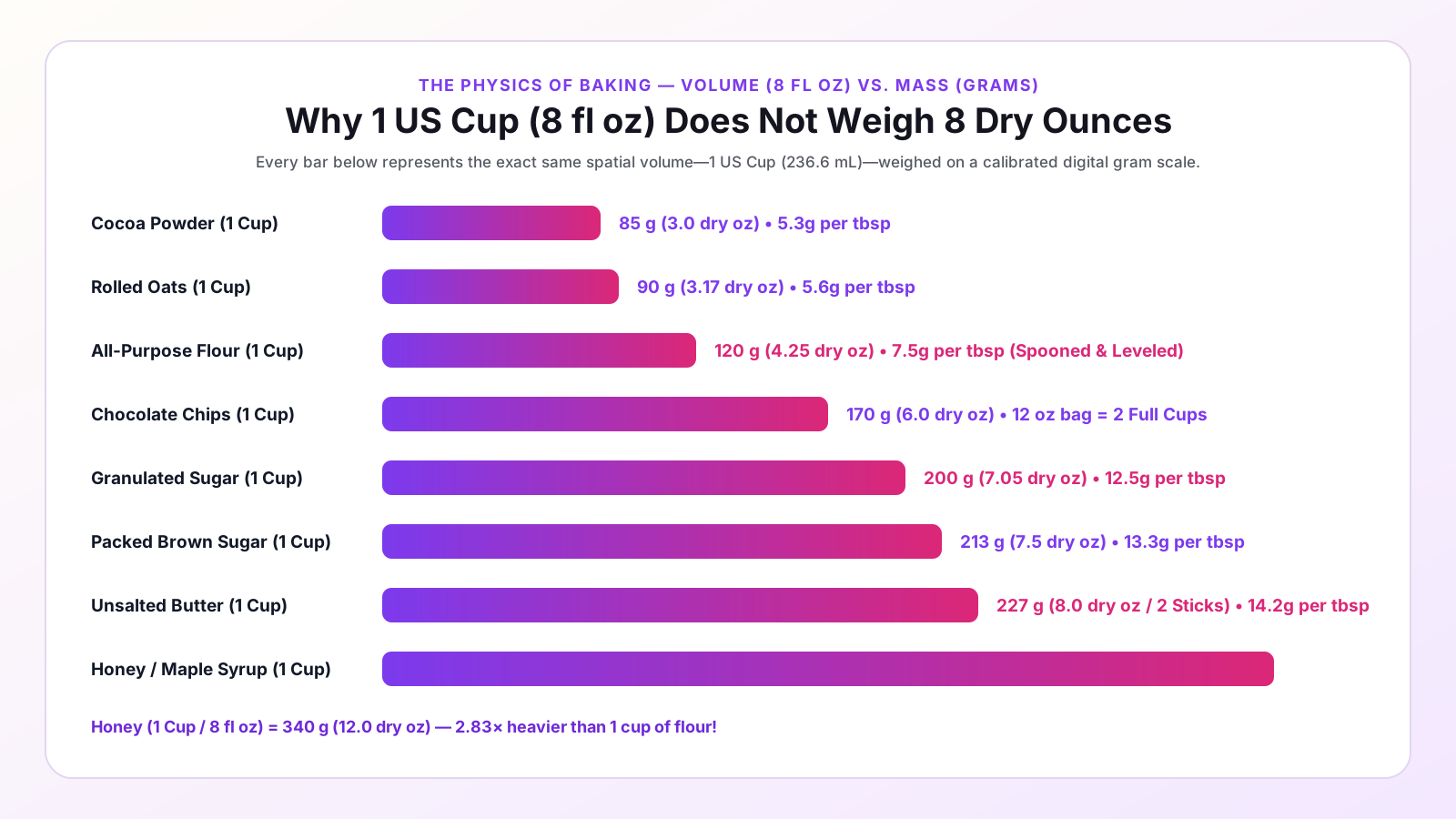
Why does weighing flour at 120g per US cup matter so much in cookie recipes?
Scooping a measuring cup into a flour bag packs 145g to 160g per cup instead of the USDA 120g standard—adding up to 90g of extra flour in a 2 1/4 cup chocolate chip cookie recipe, which stops cookies from spreading and makes them dry and cakey.
How do I change a cookie recipe from thin and crispy to soft and chewy?
Per 226g (2 sticks) of butter, thin-and-crispy cookies use 250g flour and mostly white granulated sugar (200g white + 65g brown), whereas soft-and-chewy cookies increase flour to 275g, invert the sugars to 165g packed brown sugar + 100g white sugar, and chill the dough for 45 minutes.
What makes thick 150g bakery-style cookies stay tall in the center?
Thick bakery cookies use 340g flour plus 15g cornstarch per 226g cold cubed butter, rely on 6g baking powder alongside brown sugar, chill portioned dough mounds at 4°C for 60 minutes, and bake hotter at 190°C Conventional (170°C Fan / 375°F) for 13 to 15 minutes.
How do I stop cutout sugar cookies and gingerbread from losing their shape in the oven?
Use a zero-brown-sugar formulation for sugar cutouts (360g flour, 226g butter, 200g white sugar, 1 egg, 5g baking powder), roll the dough to 5mm thickness between parchment sheets before chilling the flat slabs at 4°C for 60 minutes, and bake at 175°C Conventional (155°C Fan).
How much chocolate chunks or nuts should I fold into a 275g-flour cookie batch?
Weigh 300g to 340g (roughly 110% to 125% of the flour weight, or two standard 170g / 6 oz bags) of chopped dark chocolate chunks and toasted nuts so every cookie scoop holds an even ratio of dough to inclusions.
Are the cookie dough presets affiliated with Martha Stewart or any other brand?
No—all cookie formulations and sugar-spread ratios in this calculator are independent food-science references grounded in USDA FoodData Central gram densities, with no celebrity or brand affiliation.