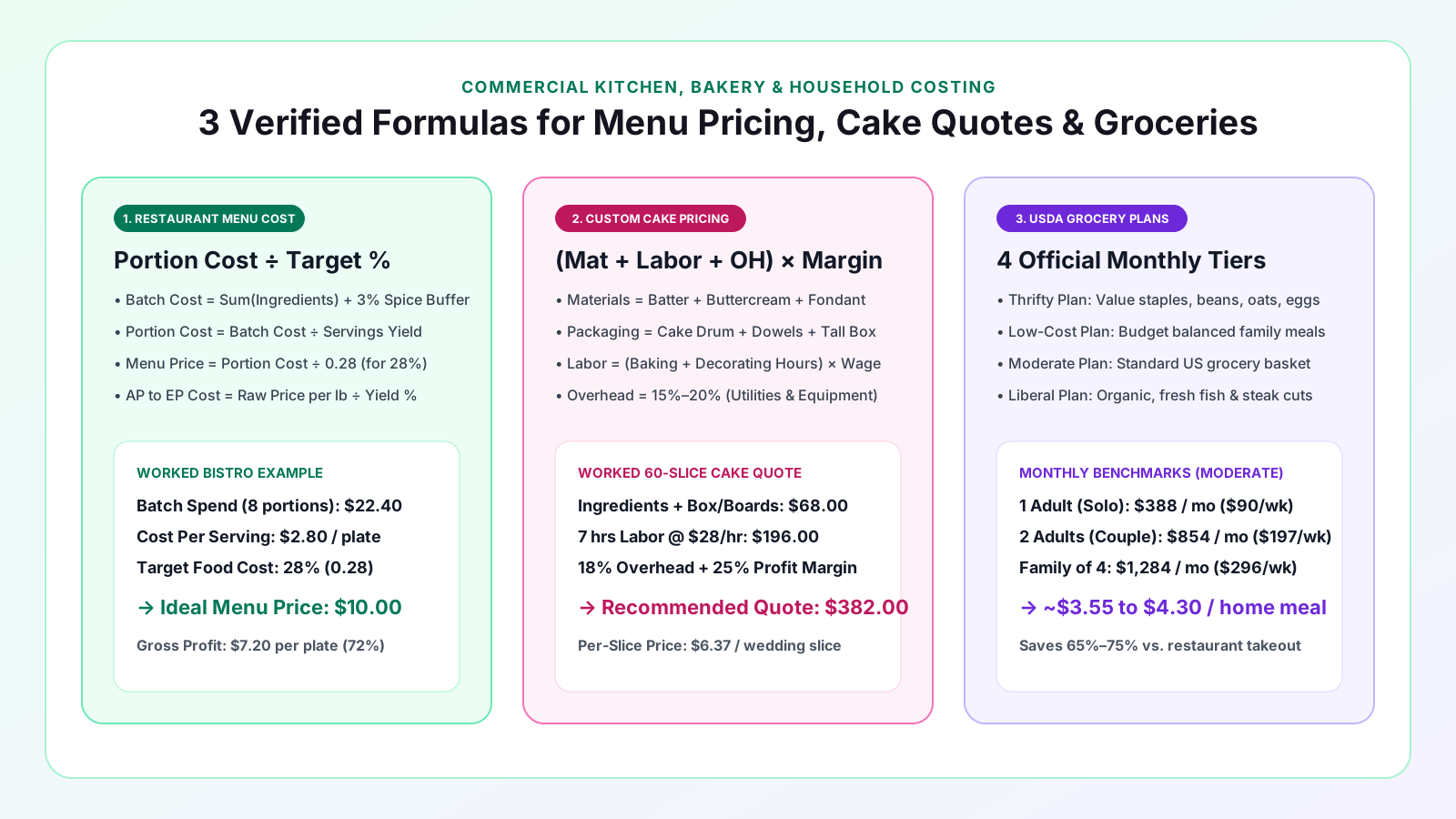
Adding a 3% spice/oil buffer brings portion cost to $2.80; dividing by 0.28 sets a $10.00 menu price with $7.20 gross profit per plate.
FOOD COST PERCENTAGE • RECIPE & MENU COSTING • CAKE PRICING • GROCERY BUDGET
Food Cost, Cake Pricing & Grocery Budget Calculator
Calculate recipe batch cost, cost per serving, restaurant food cost percentage (28%–33% target), custom wedding & birthday cake pricing, and USDA household grocery budgets.
Portion Cost: $6.71 · Ideal Menu Price: $23.96
COMPLETE RESTAURANT FOOD COST %, CAKE PRICING & GROCERY BUDGET GUIDE
What Is a Food Cost Calculator & How Do You Price Recipes, Cakes & Groceries?
Whether you are calculating restaurant recipe cost per serving and ideal menu price at a 28%–33% food cost percentage, pricing a custom wedding or birthday cake with labor and overhead, or estimating your monthly household grocery budget against USDA Food Plans, our 3-in-1 calculator does the math.
A food cost calculator—also searched as a recipe cost calculator, cost per serving calculator, restaurant food cost percentage formula, cake pricing calculator, or monthly food budget calculator—is a financial modeling tool that turns raw ingredient prices, yield ratios, labor hours, and household demographics into clear dollar figures. In both commercial foodservice and home kitchen management, small unmeasured costs (trim loss, cooking oil, packaging boxes, decorating hours, and grocery inflation) quickly erode margins and budgets.
In commercial restaurants, cafes, and food trucks, profitability is anchored to the Food Cost Percentage Formula: Food Cost % = (Total Batch Ingredient Cost ÷ Number of Servings) ÷ Menu Selling Price × 100. Most profitable independent restaurants target a 28% to 33% plate food cost, leaving 67% to 72% gross margin to cover kitchen labor (~30%), occupancy/overhead (~20%), and net profit (10%–15%). To find the Ideal Menu Selling Price for any dish, divide your Cost Per Serving by your Target Food Cost Decimal: Menu Price = Portion Cost ÷ Target Food Cost % (for example, a $3.50 pasta portion ÷ 0.28 = $12.50 menu price).
For home cottage bakers and retail pastry shops, pricing a custom birthday cake or tiered wedding cake by '3× ingredient cost' is a recipe for working below minimum wage. A professional cake pricing calculator sums four distinct buckets: Raw Baking & Frosting Ingredients + Packaging/Boards/Dowels/Boxes + Hourly Labor (Baking + Stacking + Decorating + Delivery × Hourly Wage) + Overhead % (15%–20% for utilities, mixer wear, and insurance), and then applies a 20% to 35% business profit margin on top.
For individuals and families planning home meals, our third mode benchmarks your weekly and monthly grocery budget against the four official USDA Food Plans—Thrifty, Low-Cost, Moderate-Cost, and Liberal—adjusted for the exact number of adults, teenagers, and children in your household, your cooking frequency, and specialty dietary needs.
Worked Menu Pricing, Cake Costing & USDA Grocery Examples
See how professional chefs, custom cake decorators, and households calculate exact food costs:
$68 materials + $196 labor + $41.72 overhead = $305.72 base cost; adding a 25% profit margin yields a $382.15 quote for 60 slices.
Applies the USDA 4-person household economy-of-scale discount; ranges from $975/mo (Thrifty) to $1,560/mo (Liberal).
DIRECT ANSWERS & WORKED BENCHMARKS
How to Calculate Food Cost (Calcul Food Cost) & Cost a 12-Serving Cake
To calculate food cost (often searched internationally as 'calcul food cost'), add up the Edible Portion (EP) cost of every ingredient in your batch, divide by the number of servings to find Portion Cost, and divide Portion Cost by your target Food Cost Percentage (typically 0.28 to 0.33) to get your Ideal Menu Selling Price. For custom bakery cakes, add ingredients, cake boards/boxes, and decorating labor hours (Hours × Wage), apply a 15%–20% studio overhead buffer, and multiply by 1.25 to 1.30 for business profit.
Worked Example: Costing a 12-Serving Custom Birthday Cake Step by Step
Suppose you bake an 8-inch 3-layer vanilla berry cake that yields 12 generous party servings. Your raw ingredients (flour, butter, sugar, 4 eggs, vanilla bean paste, heavy cream, fresh berries) cost $16.80, and your 10-inch cake drum, tall cake box, and parchment cost $4.20, bringing Direct Materials to $21.00. You spend 2.5 hours baking, leveling, crumb-coating, piping, and cleaning at a fair baker's wage of $25.00/hour ($62.50 labor). Base Direct Cost is $21.00 + $62.50 = $83.50. Adding 15% studio overhead ($12.53 for oven electricity, mixer wear, and insurance) brings Total Production Cost to $96.03. Applying a 25% profit margin ($24.01) yields a recommended custom cake price of $120.00—or $10.00 per slice (with a 17.5% raw material cost).
Quick-Answer Costing Table: Menu Food Cost %, 12-Serving Cake & USDA Grocery Plans
| Costing Scenario / Formula | Direct Math Equation | Worked Dollar Input | Verified Output Price / Budget |
|---|---|---|---|
| Recipe Cost Per Serving | (Batch Ingredients + 3% Spice Buffer) ÷ Servings | $18.54 batch ÷ 6 servings | $3.09 cost per serving |
| Food Cost Percentage (%) | (Cost Per Serving ÷ Menu Selling Price) × 100 | $3.09 cost ÷ $11.00 menu price | 28.1% Actual Food Cost |
| Ideal Menu Selling Price (28% Target) | Cost Per Serving ÷ 0.28 | $3.09 portion ÷ 0.28 | $11.04 ($11.00–$11.50 menu) |
| AP to EP Trim Yield Cost | Raw Purchase Price per Lb ÷ Edible Yield % | $12.00/lb salmon ÷ 0.80 yield | $15.00/lb usable plate cost |
| 12-Serving Custom Celebration Cake | (Materials + [2.5 hrs × $25] + 15% OH) × 1.25 | $21 mat + $62.50 labor + $12.53 OH | $120.00 Cake ($10.00/slice) |
| 75-Slice 3-Tier Wedding Cake | (Materials + [9 hrs × $28] + 18% OH) × 1.30 | $84 mat + $252 labor + $60.48 OH | $515.00 Cake ($6.87/slice) |
| USDA Grocery Budget (1 Adult / Mo) | Thrifty / Low-Cost / Moderate / Liberal | Solo adult (+20% 1-person factor) | $294 / $342 / $420 / $510 per month |
| USDA Grocery Budget (Family of 4 / Mo) | 2 Adults + 2 Children (4-person baseline) | Moderate-Cost USDA Food Plan | $1,210 / month ($279 / week) |
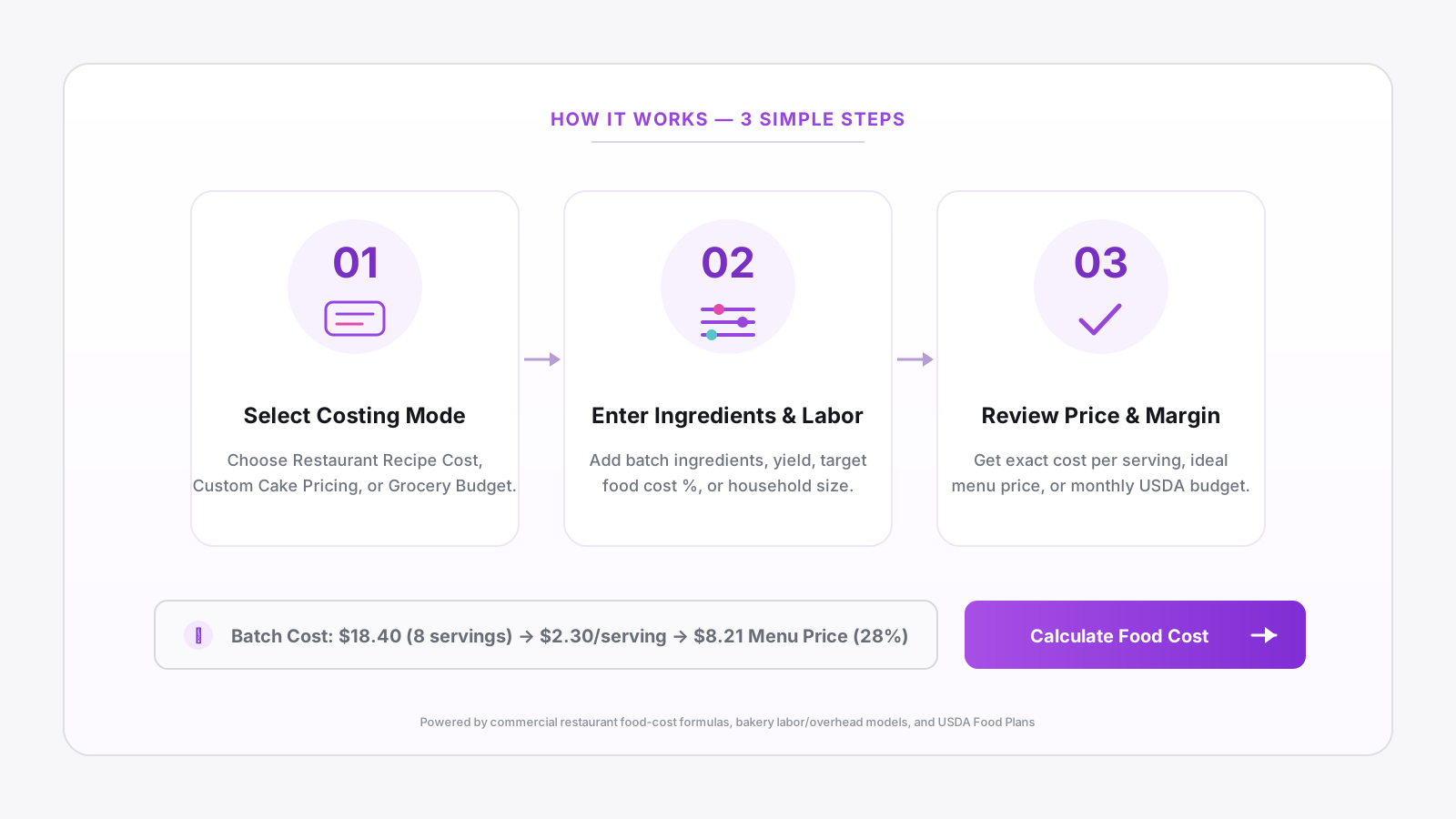
HOW IT WORKS — 3 SIMPLE STEPS
How Our 3-in-1 Food Cost, Cake & Grocery Calculator Works
Switch between Restaurant Recipe Costing, Custom Cake Pricing, and Household Grocery Budgeting in a single click.
Select Your Costing Mode
Choose Mode 1 (Restaurant & Recipe Plate Costing), Mode 2 (Bakery & Custom Cake Pricing), or Mode 3 (Household Monthly & Weekly Grocery Budget).
Enter Costs, Yield or Household
Add your recipe ingredient line costs and batch yield, enter cake decorating hours and packaging costs, or select adult/child counts and USDA food tier.
Compare Price, Margin & Per-Serving
Review exact Cost Per Serving, Ideal Menu Price at 25%–35% food cost, recommended Custom Cake Quote and Per-Slice Price, or Weekly/Monthly Grocery Budget.
If you buy raw salmon at $12.00/lb and lose 20% to skinning and pin-bone trimming (80% yield), your true Edible Portion cost is $12.00 ÷ 0.80 = $15.00 per pound ($0.94 per oz).
WHY THIS CALCULATOR IS DIFFERENT
What Makes Our Food & Cake Cost Calculator Different
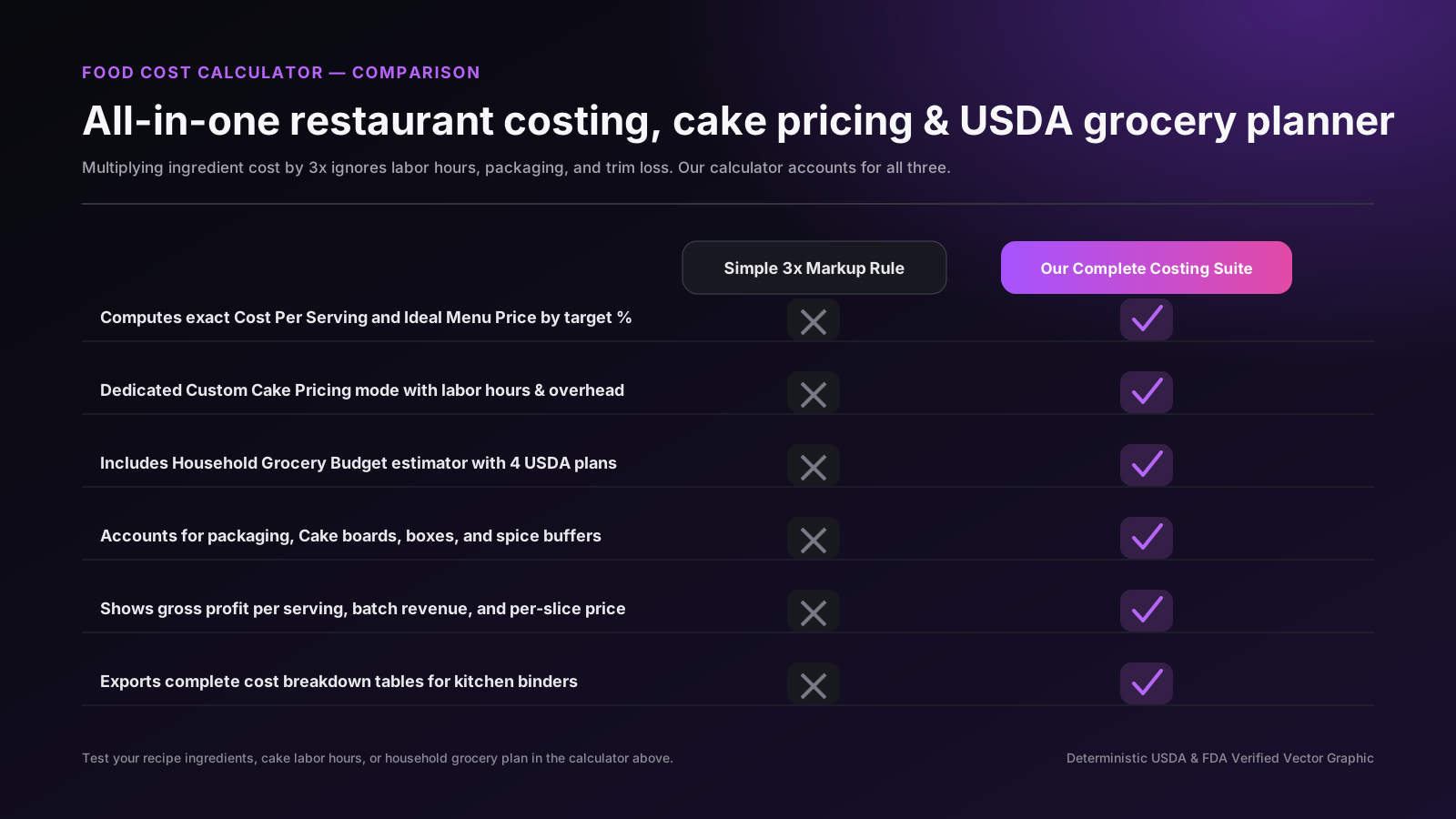
Instead of forcing you to build fragile spreadsheets from scratch, our suite unites restaurant plate costing, bakery labor pricing, and household grocery planning in one tool.
True Restaurant Food Cost % & Menu Price solver
Calculates both ways: find your Food Cost % from an existing menu price, or solve for the exact Menu Selling Price required to hit a 25%, 28%, 30%, or 33% target.
Built-in spice, oil & waste buffer (0%–10%)
Automatically adds a configurable Q-factor buffer for pan spray, kosher salt, black pepper, parchment paper, and tasting spoons.
Complete Custom Cake & Bakery pricing model
Separates cake batter/buttercream ingredients, cake drums/boxes/dowels, baking & decorating hours, hourly wage, overhead %, delivery fee, and net business profit.
Official 4-Tier USDA Household Grocery Planner
Benchmarks 1-person to 6+-person households across the Thrifty, Low-Cost, Moderate-Cost, and Liberal USDA monthly food plans.
Household economy-of-scale adjustments
Applies official USDA household-size multipliers (+20% for single-person households buying smaller packages; −5% to −10% bulk discount for 5+ person families).
Gross profit & batch revenue breakdown
Shows exact dollar gross profit per serving, total batch revenue, and cost per meal so you know your unit economics immediately.
VERIFIED CULINARY & NUTRITION METHODOLOGY
The Financial Math of Restaurant Plate Costing, AP/EP Yield & Cake Labor
In hospitality accounting, Prime Cost—the sum of Total Cost of Goods Sold (Food + Beverage Cost) plus Total Payroll/Labor Cost—must stay below 60% to 65% of gross sales for a food business to thrive. Because labor in full-service restaurants and custom bakeries typically consumes 30% to 35% of revenue, keeping raw Food Cost Percentage between 28% and 32% is essential.
Every ingredient line on a professional recipe costing card starts with the Edible Portion (EP) Cost Formula: EP Cost per Unit = As-Purchased (AP) Price per Unit ÷ Yield Percentage. For example, if whole yellow onions cost $1.20/lb and peeling roots and skins removes 12% of the weight (88% yield), chopped onion actually costs $1.20 ÷ 0.88 = $1.36/lb in the pot. Adding a 3%–5% 'Q-Factor' buffer to total recipe cost covers frying oil absorption, salt, pepper, and plate garnish.
In custom cake decorating, labor—not flour or sugar—is the primary cost driver. A sculpted 3-tier wedding cake for 80 guests may use only $75 of butter, flour, eggs, fondant, and cake boards, yet require 8 to 10 hours of baking, crumb-coating, stacking, piping, and venue delivery. Pricing by (Ingredients + Packaging + [Hours × Wage] + Overhead) × (1 + Profit Margin %) ensures the baker earns both a fair hourly craft wage and a sustainable business return.
What the deterministic engine verifies on every calculation
- Sums all batch ingredient line costs and applies the selected Spice/Oil/Waste Buffer percentage.
- Divides Adjusted Batch Cost by Servings Yield to determine exact Cost Per Serving.
- Divides Cost Per Serving by Target Food Cost Decimal (e.g., 0.28 or 0.30) to compute Ideal Menu Selling Price.
- Computes Bakery Total Base Cost = Ingredients + Packaging + (Labor Hours × Hourly Rate) + Overhead % + Delivery.
- Multiplies Bakery Base Cost by (1 + Profit Margin %) and divides by slice count for Per-Slice Pricing.
- Applies USDA monthly per-person food plan baselines and household-size economy-of-scale factors.
Benchmark check: High-margin categories like coffee, tea, pasta, pancakes, and bakery cookies typically run 15%–22% food cost, which helps offset higher 35%–40% food cost on center-of-plate steaks and fresh seafood.
MODES, FORMATS & BENCHMARKS
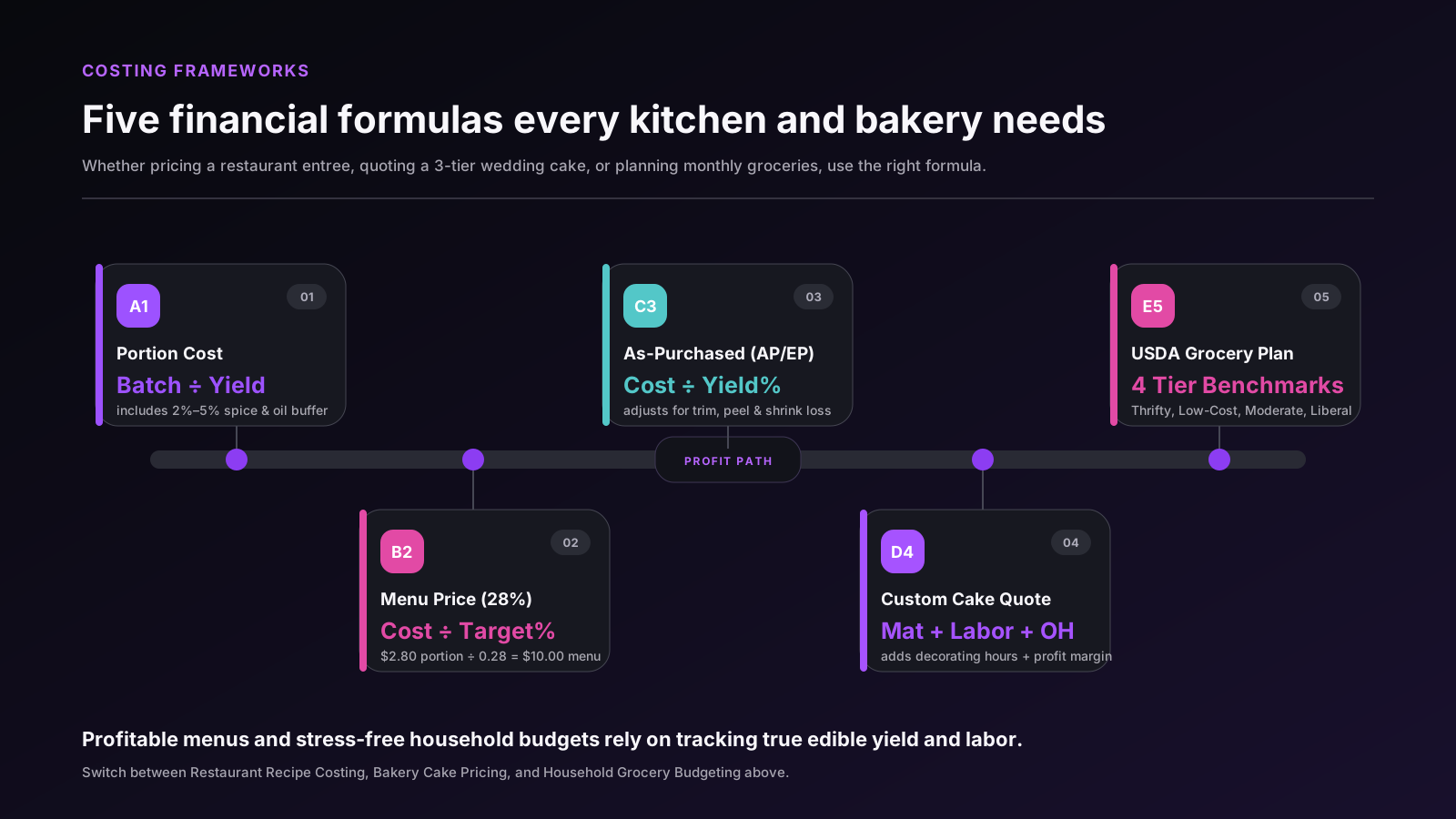
Five Financial Costing Frameworks Every Kitchen & Bakery Needs
Compare the five core costing models built into our calculator suite:
Recipe Cost Per Serving (Batch ÷ Yield)
Calculates the exact dollar cost of a single bowl, slice, or entree plate after adding a 2%–5% buffer for cooking oil, spices, and prep waste.
$18.40 Batch ÷ 8 Servings = $2.30 / ServingTarget Food Cost % Menu Pricing (28%–33%)
Divides your portion cost by your target food cost percentage to establish a menu price that protects your gross margin.
$2.80 Portion Cost ÷ 0.28 (28%) = $10.00 Menu PriceCustom Cake & Bakery Labor Formula
Combines raw baking ingredients, cake drums/boxes, decorating hours × hourly rate, studio overhead, and business profit margin.
$65 Mat + $180 Labor + $35 OH + 25% Profit = $350 CakeUSDA 4-Tier Household Grocery Budget
Estimates weekly and monthly grocery spending across Thrifty, Low-Cost, Moderate, and Liberal plans with household-size scaling.
Family of 4 (Moderate Plan) = ~$1,280/mo ($295/wk)REAL-WORLD APPLICATIONS
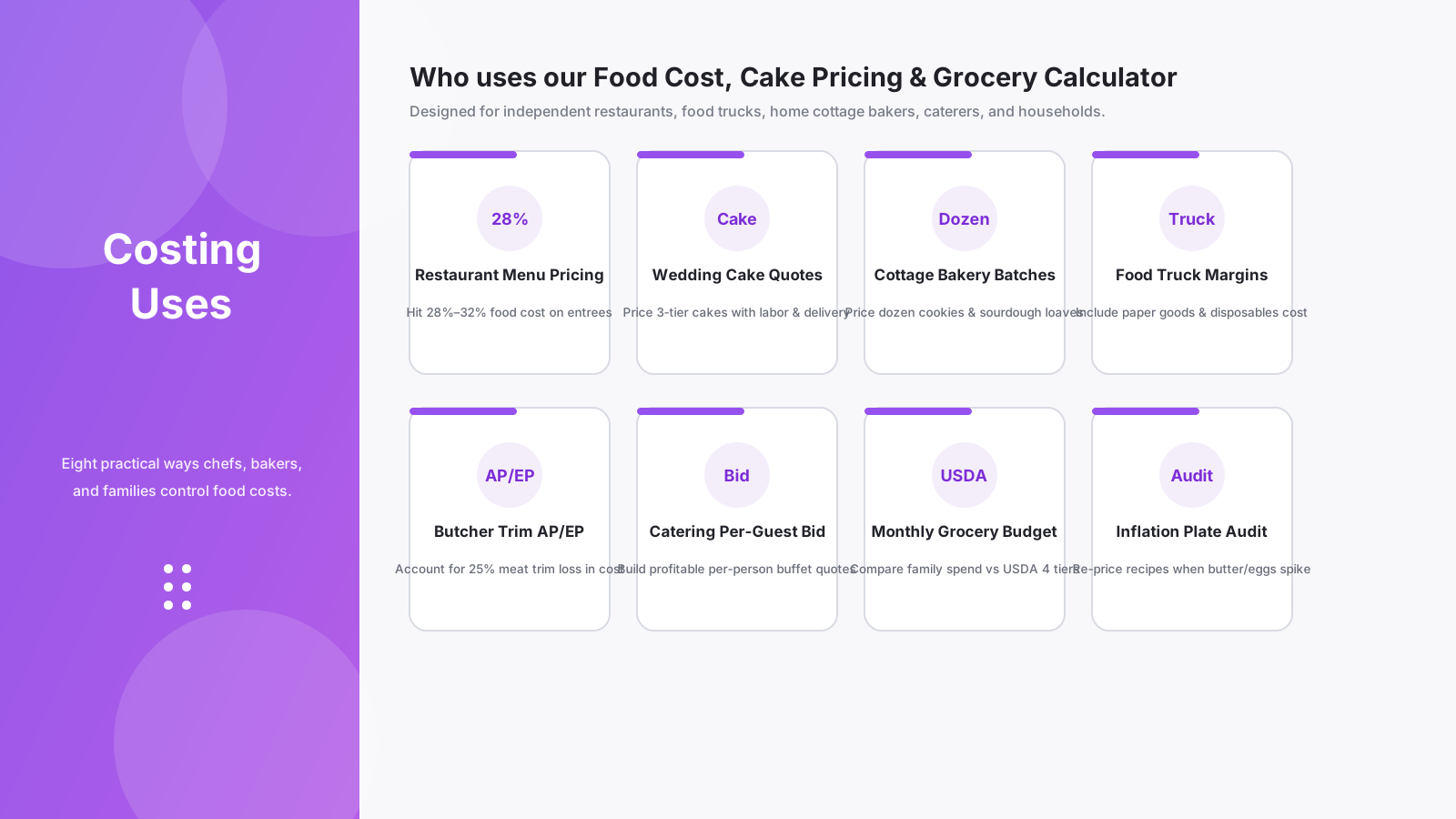
Eight Practical Ways Chefs, Bakers & Families Use This Calculator
From engineering a profitable bistro menu and quoting tiered wedding cakes to cutting family grocery bills, here are eight common applications:
Restaurant & cafe menu engineering
Audit every appetizer, entree, and dessert on your menu to ensure your blended kitchen food cost stays under 30%.
Custom wedding & birthday cake quotes
Generate transparent, profitable per-cake and per-slice quotes that pay you fairly for every hour of piping and fondant work.
Cottage bakery cookie & sourdough pricing
Price dozen-cookie boxes, cinnamon roll pans, and artisan sourdough loaves including clam-shell packaging and farmers-market booth overhead.
Food truck & ghost kitchen unit economics
Factor biodegradable containers, napkins, utensils, and delivery-app commission buffers into your per-order food cost.
Butcher & seafood AP/EP trim cost audits
Calculate true usable plate cost after trimming beef tenderloin, skinning salmon, or peeling shrimp.
Catering per-person proposal bidding
Build accurate per-guest buffet and plated dinner bids with built-in food, disposables, and staffing margins.
Monthly family grocery budget planning
Compare your current supermarket spending against official USDA Thrifty, Low-Cost, Moderate, and Liberal benchmarks.
Ingredient inflation & vendor price checks
Test immediately how a 25% spike in butter, eggs, chocolate, or beef prices affects your per-serving margin.
VERIFIED DATA BENCHMARKS
Master Restaurant Food Cost %, Cake Pricing & USDA Grocery Benchmark Table
Reference this industry benchmark table for target food cost percentages by category, custom cake slice pricing, and monthly USDA grocery plans:
| Category / Costing Benchmark | Target Food Cost % / Tier | Typical Unit Cost | Recommended Selling Price / Budget | Gross Margin / Culinary Note |
|---|---|---|---|---|
| Fine Dining / Steakhouse Entree | 34% – 38% Food Cost | $11.50 plate cost | $32.00 – $34.00 menu price | Higher raw protein cost offset by wine/beverage sales |
| Casual Dining / Bistro Entree | 28% – 32% Food Cost | $4.50 plate cost | $15.00 – $16.00 menu price | Industry gold-standard target for full-service kitchens |
| Fast Casual / Food Truck Bowl | 25% – 28% Food Cost | $3.10 bowl + $0.45 box | $12.50 – $14.00 menu price | Always include paper/compostable packaging in unit cost |
| Pizza, Pasta & Grain Dishes | 18% – 22% Food Cost | $2.20 batch portion | $11.00 – $12.50 menu price | High-margin menu workhorses that lower blended food cost |
| Coffee, Espresso & Specialty Drinks | 12% – 18% Food Cost | $0.65 beans/milk/cup | $4.25 – $5.50 menu price | Include 12 oz cup, lid, sleeve, and syrup pumps |
| Retail Bakery / Pastries & Cookies | 20% – 26% Food Cost | $0.85 per large cookie | $3.75 – $4.50 retail price | Labor and oven time represent the largest cost share |
| Custom Buttercream Celebration Cake | Materials + Labor + 25% | $32 mat + 4 hrs labor | $165 – $220 ($5.50–$6.50/slice) | Never price custom decorated cakes by 3× ingredients alone |
| Multi-Tier Custom Wedding Cake | Materials + Labor + 30% | $90 mat + 10 hrs labor | $525 – $750+ ($7.00–$10.00/slice) | Include internal dowels, center rod, cake drum & delivery |
| USDA Thrifty Food Plan (1 Adult) | Value Home Cooking | ~$2.85 / meal | $258 / month ($60 / week) | Focuses on dry beans, oats, rice, eggs, and seasonal produce |
| USDA Low-Cost Food Plan (1 Adult) | Budget Balanced | ~$3.60 / meal | $324 / month ($75 / week) | Adds more variety in fresh meats, dairy, and frozen fruits |
| USDA Moderate Food Plan (1 Adult) | Standard Household | ~$4.30 / meal | $388 / month ($90 / week) | The most popular benchmark for middle-income meal planning |
| USDA Liberal Food Plan (1 Adult) | Flexible / Organic | ~$5.25 / meal | $473 / month ($109 / week) | Allows premium cuts, fresh seafood, and convenience items |
| USDA Moderate Plan (Couple / 2 Adults) | +10% 2-Person Factor | ~$4.15 / meal / person | $854 / month ($197 / week) | Reflects standard 2-adult household grocery basket |
| USDA Moderate Plan (Family of 4) | 4-Person Baseline | ~$3.55 / meal / person | $1,284 / month ($296 / week) | Includes 2 adults + 2 children with bulk-buying savings |
USEFUL TERMINOLOGY & SEARCH PHRASES
Other Names People Use for a Food Cost Calculator
Chefs, bakers, hospitality students, and home budgeters search for this tool using several specialized terms:
Recipe cost per serving calculator
Divides total batch ingredient spend by the number of portions produced.
Restaurant food cost percentage calculator
Computes (Portion Cost ÷ Menu Price) × 100 and solves for ideal menu prices.
Custom cake pricing calculator
Combines baking ingredients, boxes/boards, decorating labor hours, overhead, and profit.
Menu engineering price solver
Finds the exact selling price needed to hit a 28%, 30%, or 33% food cost target.
USDA monthly grocery budget calculator
Estimates weekly and monthly household food spend across Thrifty, Low-Cost, Moderate, and Liberal plans.
AP to EP edible yield cost calculator
Adjusts raw ingredient prices for butcher trim, peeling, and cooking shrinkage.
Cottage bakery batch pricer
Prices cookies, brownies, and loaves per piece and per dozen with packaging included.
CLIENT-SIDE PRIVACY & DATA SECURITY
How Your Financial & Recipe Cost Data Are Handled
Your restaurant menu margins, bakery hourly rates, and household grocery budgets are confidential business and personal data:
- Every cost, wage, margin, and budget calculation runs 100% locally in your browser.
- Your proprietary recipe cost cards and supplier prices are never uploaded to any external server.
- No account login or paid subscription is required to calculate or print your costing sheets.
- Read our Privacy Policy and Cookies Policy for full details on site-wide analytics and zero-server recipe storage.
EXPERT KITCHEN & NUTRITION TIPS
Six Proven Tips to Lower Food Cost & Price Profitably
Apply these six commercial kitchen and household strategies to protect your margins without sacrificing quality:
Always cost recipes by Edible Portion (EP), not AP
A $10/lb protein with 25% trim and cooking loss actually costs $13.33/lb on the plate. Always divide raw price by yield % before pricing your menu.
Add a 3%–5% Q-factor for oil, salt, and spices
Instead of weighing every pinch of black pepper and pan spray, add a standard 3%–5% buffer to your total batch ingredient cost.
Pay yourself an hourly wage first on custom cakes
Even if you bake from home, log every hour spent shopping, baking, buttercreaming, stacking, and cleaning at $22–$35+/hr before adding business profit.
Include cake boards, boxes, and packaging in COGS
A sturdy 12-inch cake drum, tall cake box, and ribbon can add $6.00–$10.00 to a single order—always list packaging as a direct cost.
Standardize portion scoops and scales on the line
Giving line cooks a 1-ounce ladle too large on an expensive sauce or protein can raise food cost by 4%–6% overnight.
Cross-utilize ingredients across recipes to cut waste
Both in restaurants and home grocery budgeting, planning 3–4 dishes around the same fresh herbs, produce, and proteins eliminates spoilage.
RESTAURANT MENU COSTING, WEDDING CAKE PRICING & GROCERY ESTIMATOR
How to Figure Food Cost Percentage, Menu Cost Calculator & Grocery Cost Estimator
Whether you need a food cost calculator free (recipe cost calculator free or free food cost calculator), a menu cost calculator (menu pricing calculator, menu price calculator, restaurant food cost calculator, or restaurant food price calculator), a baking cost calculator (wedding cake calculator), or a grocery estimator (grocery cost calculator, grocery cost estimator, grocery shopping cost estimator, or meal budget calculator), every profitable kitchen relies on one core equation. If you are asking how to figure food cost percentage (or how is food cost percentage calculated), divide the total ingredient & packaging cost per serving by the menu selling price and multiply by 100.
| Costing / Pricing Workflow | Exact Formula (Food Costs Formula) | Worked Food Costing Sample & Menu Costing Sample |
|---|---|---|
| Calculation for food cost / Formula for food cost / How to cost out a recipe | Portion Cost = Sum(AP Price / Edible Yield %) / Servings | In a food price calculator (recipe price calculator or food price estimator), a $14.40 batch yielding 8 portions costs $1.80 per serving. |
| Food costing sample & Menu costing sample (28% Target Food Cost) | Menu Selling Price = Portion Cost / (Target Food Cost % / 100) | At a $2.80 plate cost and a 28% target food cost percentage, ideal menu price is $2.80 / 0.28 = $10.00 ($7.20 gross profit per plate). |
| Baking cost calculator & Wedding cake calculator | Total Cake Price = (Ingredients + Boards/Boxes + Overhead + Labor) / (1 - Margin %) | A 3-tier wedding cake serving 75 guests with $48 ingredients, $14 packaging, $15 overhead, and 5 hours labor ($125) = $202 base cost; at a 35% net margin, retail price is $310.77 (~$4.14/slice). |
| Grocery estimator / Meal budget calculator (USDA Monthly Food Plans) | Household Budget = Sum(Individual USDA Benchmarks) * Family Size Multiplier | A 2-adult household on the USDA Moderate-Cost Plan ($346 + $346 = $692 base) with the +10% 2-person economy adjustment budgets $761.20/month ($175.66/week). |
AUTHORITATIVE SOURCES & REFERENCES
Primary USDA, FDA & Scientific Sources
- USDA Food and Nutrition Service (FNS) — Official USDA Food Plans: Cost of Food Reports — Monthly per-person and household grocery cost benchmarks across Thrifty, Low-Cost, Moderate-Cost, and Liberal plans.
- USDA Economic Research Service (ERS) — Food Price Outlook — Consumer Price Index (CPI) tracking for food-at-home (grocery) and food-away-from-home (restaurant) inflation.
- National Restaurant Association & Culinary Institute of America — Standard Recipe Costing — Hospitality industry prime-cost accounting standards (28%–33% food cost and AP/EP yield formulas).
How to Use the Food Cost Calculator, Cake Pricing & Grocery Budget Planner (Step-by-Step Workflow)
Scaling recipes, generating FDA-compliant nutrition facts labels, and converting between volume (cups, tablespoons, fluid ounces) and weight (grams, dry ounces, pounds) requires accounting for ingredient density and cooking moisture loss. Follow these four steps:
- Enter Your Original Yield & Ingredients: Input the recipe's current number of servings (the yield) and paste or select your ingredient list in standard kitchen units (cups, tbsp, tsp, oz, lbs, cans, or grams).
- Select Your Conversion Factor or Baking Pan Ratio: Click a quick preset (
1/2x Cut in Half,1/3x,2x Double,3x Triple), type your desired target servings, or use the Baking Pan Size Converter to scale by pan surface area. - Verify Kitchen Fractions & Gram Equivalents: Review both the rounded culinary fraction (such as converting
0.375 cupsinto6 tbsp) and the density-adjusted metric gram weight for precision on a digital kitchen scale. - Generate Labels, Macros, or Catering Lists & Export: Star your favorite calculations to local browser storage or export your scaled recipe, nutrition panel, or food cost breakdown as a
.txt,.csv, or.jsonfile.
Who This Tool Is For: Practical Kitchen, Nutrition & Food Business Use Cases
Different culinary tasks require different mathematical rules. Halving a cake batter involves pan area geometry, whereas tracking macros for fat loss requires raw-to-cooked weight conversion and the 4-4-9 Atwater energy formula:
- Home Cooks & Bakers Scaling Recipes: Use the Recipe Converter & Doubler and Kitchen Unit Converter to halve, double, or triple recipes and convert between ounces, cups, tablespoons, and metric grams without awkward decimal measurements.
- Cottage Food Bakers, Meal Preppers & Supplement Brands: Use the FDA Nutrition Facts & Supplement Label Maker to generate vertical, horizontal/tabular, dual-column cereal box, and supplement facts panels with automatic
% Daily Value (%DV)calculations. - Fitness, Weight-Loss & Macro Trackers: Use the Recipe Calorie, Macro & TDEE Calculator and Visual Portion Size Guide to calculate homemade food calories, net carbs, 4-4-9 macro splits, and visual hand comparisons (such as what 4 oz of chicken or 3 oz of steak looks like).
- Holiday Hosts, Event Planners & BBQ Caterers: Use the Meat Per Person & Thanksgiving Turkey Calculator to determine exact raw purchase weights for 10 to 100+ guests across whole turkey, pulled pork, brisket, ribs, ribeye steak, chicken breasts, and deli cold cuts.
- Restaurant Chefs, Custom Cake Bakers & Households: Use the Food Cost, Cake Pricing & Grocery Budget Calculator to compute recipe food cost percentage (28%–33% target), custom wedding cake pricing, and USDA monthly grocery budgets.
The Science Behind Our Calculators: USDA Densities, Atwater 4-4-9 & FDA 21 CFR 101.9
Every calculator on Recipe Calculator Pro uses verified reference constants from USDA FoodData Central and U.S. Food and Drug Administration (FDA 21 CFR 101.9) Nutrition Labeling Standards:
- Fluid Ounces (Volume) vs. Avoirdupois Ounces (Weight): A fluid ounce (
fl oz) measures volume (1 fl oz = 2 tablespoons = 29.57 mL;8 fl oz = 1 US cup;32 fl oz = 4 cups). A dry ounce (oz) measures mass (1 oz = 28.35 grams;16 oz = 1 pound). Because dry ingredients have different bulk densities, 1 cup of all-purpose flour weighs 4.25 oz (120g), 1 cup of chocolate chips weighs 6 oz (170g), and 1 cup of peanut butter weighs 9.1 oz (258g). - The Atwater 4-4-9 Macronutrient Energy System: Dietary energy (kilocalories) is determined by macronutrient oxidation: 1 gram of Protein = 4 kcal, 1 gram of Carbohydrate = 4 kcal, 1 gram of Fat (Lipids) = 9 kcal (making fat the most energy-dense macronutrient), and 1 gram of Alcohol = 7 kcal. Dietary fiber and sugar alcohols are subtracted from total carbohydrates when computing net carbs.
- Raw-to-Cooked Moisture & Fat Retention Yields: Meat, poultry, and fish lose approximately 20% to 25% of their raw weight as water and rendered fat during cooking. Consequently, 4 oz of raw boneless chicken breast or steak (113g) yields ~3 oz cooked (85g), while dry grains like rice and oats absorb water and expand to 2.5x–3.0x their dry weight.
Common Kitchen Calculation Mistakes vs. Verified Culinary Math
| Kitchen Task | Common Mistake (Before) | Verified Calculation (After) | Culinary / Nutritional Reason |
|---|---|---|---|
| 4 oz Chocolate Chips to Cups | 1/2 cup (confusing weight oz with 8 fl oz cup) | 2/3 cup (113g) | 1 US cup of chocolate chips weighs 6 oz (170g), so 4 oz by weight is 4/6 = 2/3 cup. |
| Weighing Chicken or Rice for Macros | Logging 4 oz cooked chicken as 4 oz raw entry | 4 oz cooked = 5.3 oz raw (35g protein) | Chicken loses ~25% water weight when cooked, concentrating protein from 22.5g/100g raw to 31g/100g cooked. |
| Menu Pricing at 30% Food Cost | Adding 30% markup ($4.50 × 1.30 = $5.85) | $4.50 ÷ 0.30 = $15.00 Menu Price | Food Cost % equals Ingredient Cost divided by Menu Selling Price, leaving 70% gross margin for labor and overhead. |
| BBQ Pulled Pork for 20 Guests | Buying 10 lbs raw pork butt for 10 lbs cooked | 15–16 lbs raw butt → ~8.5 lbs cooked | Pork shoulder loses ~45% weight to bone, fat rendering, and bark evaporation during smoking. |
FOOD COST %, CAKE PRICING & GROCERY BUDGET FAQS
Frequently Asked Questions About Food Cost & Cake Pricing
How do I calculate food cost (calcul food cost) and food cost percentage?
First, sum the Edible Portion (EP) cost of all ingredients in your recipe batch and divide by the number of servings to find Portion Cost. To find Food Cost Percentage: divide Portion Cost by your Menu Selling Price and multiply by 100. To calculate your Ideal Menu Price for a 28% target food cost: divide Portion Cost by 0.28 (for example, $3.50 portion cost ÷ 0.28 = $12.50 menu price).
What is a good target food cost percentage for a restaurant, food truck, or bakery?
Most profitable full-service and fast-casual restaurants target a blended food cost percentage between 28% and 33%. High-margin items like pasta, pizza, coffee, and bakery cookies typically run 15% to 24% food cost, which balances center-of-plate steaks and fresh seafood that often run 34% to 38%.
How do I price a custom cake or wedding cake with labor and overhead?
Use the professional bakery costing formula: Base Production Cost = (Ingredients + Cake Boards/Boxes/Dowels + [Baking & Decorating Hours × Hourly Wage]) × (1 + Overhead %, typically 15%–20%). Then multiply Base Production Cost by (1 + Profit Margin %, typically 20%–30%) and add delivery. For a 12-serving custom cake with $21 materials, 2.5 hours labor at $25/hr ($62.50), 15% overhead, and 25% profit, the recommended quote is $120.00 ($10.00/slice).
What is the difference between As-Purchased (AP) and Edible-Portion (EP) cost?
As-Purchased (AP) cost is the price per pound you pay the supplier for raw, untrimmed ingredients. Edible-Portion (EP) cost is the true cost per usable pound after peeling, trimming fat/bones, and cooking shrinkage: EP Cost = AP Price ÷ Yield Percentage. If raw beef tenderloin costs $18.00/lb and loses 25% in trimming (75% yield), its true EP cost on the plate is $18.00 ÷ 0.75 = $24.00/lb.
How does the monthly grocery budget calculator estimate food costs?
Our grocery budget calculator uses the four official USDA Monthly Food Plan tiers—Thrifty, Low-Cost, Moderate-Cost, and Liberal—and applies the USDA household-size economy-of-scale multiplier (+20% for 1 person, +10% for 2 people, +5% for 3 people, baseline for 4 people, and −5% bulk savings for 5+ people).
How much should 1 person, a couple, or a family of 4 budget for groceries per month?
Under the USDA Moderate-Cost benchmark in our calculator, 1 adult budgets ~$420/month (~$97/week), a couple (2 adults) budgets ~$770–$854/month (~$178–$197/week), and a family of 4 (2 adults + 2 children) budgets ~$1,210–$1,284/month (~$279–$296/week). Choosing the USDA Thrifty Plan lowers those figures by ~25%–30%.
Price Your Menu, Custom Cakes & Monthly Groceries
You have seen how commercial 28%–33% food cost targets, custom cake labor and overhead formulas, and official USDA monthly grocery plans work.
Enter your batch ingredient costs, cake decorating hours, or household size above to calculate menu prices and food budgets.
Calculate Food Cost Now