Scone, Shortbread & Tea Biscuit Batch Scaling Calculator

Last updated: · Maintained by Lee Harsh (Full-Stack Developer)

Direct Answer & Core Culinary Formula

Tall British afternoon-tea scones use a 4.5 : 1 flour-to-cold-butter weight ratio (450g self-raising flour plus 10g baking powder rubbed with 100g cold cubed butter) hydrated to 55%–58% with egg and milk (250mL–260mL total) and baked at 200°C Fan (220°C Conventional / 425°F / Gas Mark 7) for 12–14 minutes. Traditional all-butter shortbread follows the 3 : 2 : 1 weight ratio (300g plain flour/semolina, 200g cold butter, 100g caster sugar).

Formula: Scone Ratio = 100g Self-Raising Flour : 22g Cold Butter : 16g Sugar : 55mL Egg/Milk | Shortbread Ratio = 3 Parts Flour : 2 Parts Butter : 1 Part Sugar
All-in-One 2000+ Keyword Chef & Recipe Database (100% PDF + GSC + Martha Stewart + Famous Dave's) (2197 matching endpoints):
Top Ranked Slugs:
Active Conversion Factor: 1x
Quick Recipe Scale:
Chef Physics & Setting Note: Mary Berry Crumb & Spread Rule: Rub cold butter in lightly, pat dough to 2.5cm thickness, stamp straight down without twisting the cutter, and bake at 220°C (200°C Fan) for 12–14 mins.
Scaled Recipe Output (1x)

Mary Berry Apple and Cinnamon Scones (12 Servings)

Total Scaled Batch Mass
770 g (27.2 oz)
Calibrated Appliance Temp
200°C UK Fan / Convection (392°F)
Cook Time & Method
12 mins (Mary Berry All-in-One 1-Bowl)
450 g self-raising flour plus 2 level tsp baking powder ≈ 450 g
Original: 450 g self-raising flour plus 2 level tsp baking powder · Direct 1x proportion (450 g).
100 g cold unsalted butter (cubed) and 75 g caster sugar ≈ 100 g
Original: 100 g cold unsalted butter (cubed) and 75 g caster sugar · Direct 1x proportion (100 g).
120 g diced Braeburn apple & cinnamon, sultanas, or mature Cheddar cheese ≈ 120 g
Original: 120 g diced Braeburn apple & cinnamon, sultanas, or mature Cheddar cheese · Direct 1x proportion (120 g).
2 large free-range eggs beaten with whole milk or buttermilk to make 250 ml total liquid ≈ 100 g
Original: 2 large free-range eggs beaten with whole milk or buttermilk to make 250 ml total liquid · Direct 1x proportion (100 g).
Complete Step-by-Step InstructionsQuery Solved: “mary berry apple and cinnamon scones”Mary Berry • lined baking sheet • 245 kcal/serving

How to Make Mary Berry Apple and Cinnamon Scones (12 Servings · 200°C UK Fan / Convection (392°F))

Progress: 0 / 6 Steps Checked
Step 1
[Scale: 1x → 12 Servings | 200°C UK Fan / Convection (392°F)] Preheat Oven & Line Trays: Preheat oven to 220°C (200°C Fan / 425°F) and line 2 heavy baking sheets with non-stick parchment paper.
Step 2
Weigh Dry Ingredients & Fat: Measure flour, leavening, and butter accurately on a digital gram scale so gluten hydration stays balanced.
Step 3
Rub Cold Butter & Fold Liquid Gently: Rub cubed cold butter into flour with your fingertips until fine crumbs form, stir in sugar and fruit/cheese, and fold in egg-milk liquid with a palette knife. (Mary Berry 1-Bowl All-in-One Method Active: Measure all room-temperature sponge/base ingredients into a single mixing bowl and beat for 90 seconds until satin-smooth.)
Step 4
Stamp Without Twisting & Egg-Wash Tops: Pat dough to 2.5cm thick, stamp rounds with a sharp cutter without twisting (so scones rise straight), and brush tops only with egg wash.
Step 5
Bake to Golden Edges (12–14 mins): Bake on the center shelf until risen and golden at the edges while centers remain tender.
Step 6
Cool on Wire Rack: Rest on the warm baking sheet for 5 minutes before transferring to a wire rack.
Instant UK / US Kitchen Unit & Density Converter (Oz ⇄ Cups ⇄ Tbsp ⇄ Grams)

32 fl oz of All-Purpose Wheat Flour (Spooned & Leveled) equals 4 cups (4 cups), 32 fl oz (64 tbsp), and weighs 16.92 oz (480 g / 1.058 lb).

Worked Example & Verified Reference Table

Worked Example: Scaling a 12-scone apple and cinnamon batch up to 24 scones (2.0×) uses 900g self-raising flour, 20g baking powder, 200g cold cubed butter, 150g caster sugar, and 200g finely diced eating apple; because raw apple releases moisture during baking, use 460mL–480mL combined egg-and-milk liquid, pat to 2.5cm–3cm thickness, cut straight down without twisting, and bake at 200°C Fan for 13–15 minutes.

Baked Good StyleFlour & Starch WeightCold Butter WeightSugar WeightLiquid / Binder & Fan Oven Temp
Classic / Sultana Tea Scones (12)450g SR Flour + 10g BP100g (22% of flour)75g Caster2 Eggs + Milk to 250mL · 200°C Fan (12–14m)
Savoury Mature Cheddar Scones (12)450g SR Flour + 10g BP100g (22% of flour)0g (+5g Mustard)150g Cheddar + 250mL Milk · 200°C Fan (13–15m)
All-Butter Scottish Shortbread (16)250g Plain + 50g Semolina (300g)200g (3:2:1 ratio)100g CasterNo Egg/Liquid · 150°C Fan (25–30m)
Spiced Ginger Fairings Biscuits (18)300g Self-Raising Flour125g150g Caster60g Golden Syrup · 170°C Fan (11–13m)
Puff Pastry Sausage Rolls (16)350g All-Butter Puff PastryLaminated in pastry0g450g Seasoned Filling + Egg Wash · 180°C Fan (25m)
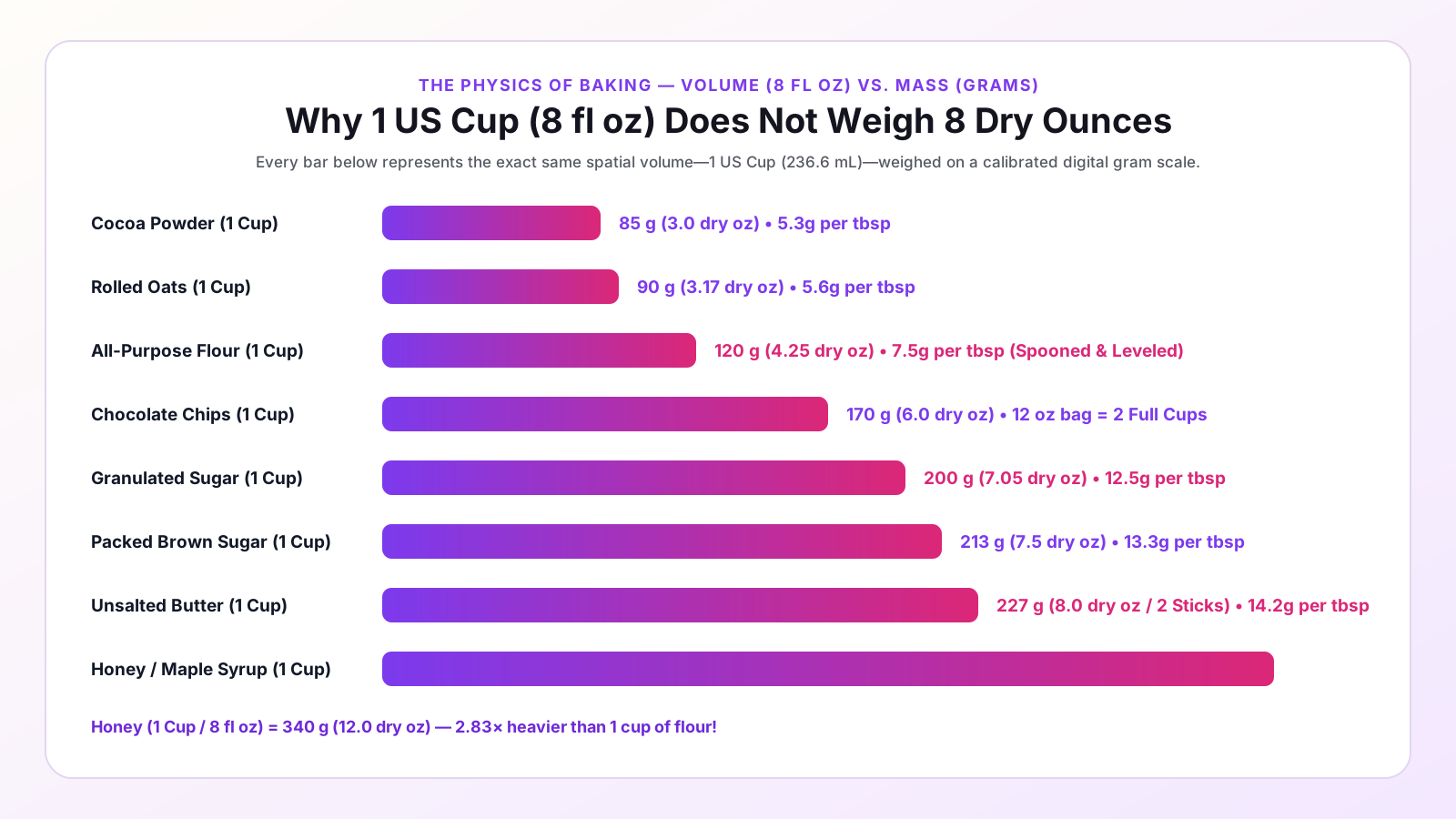
USDA bulk density matrix comparing gram weights of 1 US cup across flour (120g), oats (90g), chocolate chips (170g), sugar (200g), butter (227g), and honey (340g)
USDA FoodData Central bulk density comparison showing why 1 US cup (236.6 mL) weighs 120g for flour, 200g for sugar, 227g for butter, and 340g for honey.

1. Cold-Butter Lamination & Chemical Leavening in British Scones

Tall, level-topped afternoon tea scones rely on a 4.5 : 1 flour-to-fat ratio paired with vigorous chemical leavening: 450g self-raising flour boosted with 10g (2 level teaspoons) of baking powder and rubbed with 100g of cold 6°C cubed unsalted butter until the mixture resembles fine breadcrumbs. Keeping the butter cold coats only a fraction of the wheat gluten strands, allowing the remaining flour to hydrate rapidly when liquid is added.

Hydrating that 450g dry base with 250mL to 260mL of combined beaten egg and whole milk (or buttermilk at 55%–58% baker's hydration) creates a soft, slightly tacky dough that rises vertically when hit with 200°C Fan (220°C Conventional / 425°F / Gas Mark 7) oven heat for 12 to 14 minutes.

2. Adjusting Hydration for Apple, Sultana & Savoury Cheese Scones

When scaling recipes such as apple and cinnamon scones, sultana tea scones, or mature Cheddar scones, inclusions alter the dough's free moisture. Dried sultanas or currants (100g per 450g flour) absorb liquid during baking unless plumped first in warm tea and patted dry; conversely, folding 200g of finely diced fresh apple into a doubled 900g flour batch releases juice in the oven, so reduce the milk-and-egg liquid from 500mL to 460mL–480mL.

For savoury cheese and mustard scones, replace the 75g caster sugar with 5g dry English mustard powder and 1g cayenne pepper, fold 150g coarsely grated mature Cheddar into the rubbed crumb before adding 250mL milk, and brush tops with egg wash rather than milk for a savoury golden crust.

3. The Classical 3 : 2 : 1 Shortbread & Tea Biscuit Ratio

Unlike scones, crisp Scottish shortbread fingers, petticoat tails, and Sablé biscuits contain zero water, milk, or egg, relying on high butterfat to coat flour proteins and prevent gluten network formation. The benchmark weight ratio is 3 parts flour/starch (250g plain wheat flour plus 50g fine semolina or rice flour = 300g total) to 2 parts cold unsalted butter (200g) and 1 part caster sugar (100g).

Because there is no water to steam-leaven the dough, shortbread is docked deeply with a fork to release trapped air, chilled for 30 minutes so the fat re-solidifies, and baked low at 150°C Fan (170°C Conventional / 340°F / Gas Mark 3) for 25 to 30 minutes until pale straw-gold.

4. Cutter Mechanics, Dough Thickness & Glaze Placement

Whether stamping 12 scones or 36 catering scones, pat or lightly roll the dough to an even 2.5cm to 3cm thickness on a lightly dusted board. Press a sharp metal cutter straight down and lift straight up without twisting your wrist: twisting seals the layered vertical edges and causes scones to lean sideways as they rise.

When glazing scones with beaten egg or milk, dab only the horizontal top surface with a pastry brush—any egg wash that drips down the cut vertical sides sets in the oven heat like glue and restricts oven spring.

5. Freezing Unbaked Scones, Tin Storage & Context

Stamped raw scones freeze exceptionally well on a parchment-lined tray: once solid, transfer them to a freezer bag and bake straight from frozen at 195°C Fan (215°C Conventional) by adding 3 to 4 minutes to the standard 12-minute bake. Baked scones are best eaten warm on the day they leave the oven, whereas 3:2:1 Scottish shortbread and ginger fairings keep their snap for two weeks inside an airtight metal biscuit tin.

The flour-to-cold-butter ratios and buttermilk hydration figures in this tool are original baker's-percentage calculations and are unaffiliated with any commercial tearoom or cookbook author.

Related Search Queries & Calculator Presets Covered by This Hub

Mary Berry Apple and Cinnamon Scones (mary berry apple and cinnamon scones)Mary Berry Walnut and Poppy Seed Biscuits (mary berry walnut and poppy seed biscuits)Mary Berry Cheese Scones with Egg (mary berry cheese scones with egg)Fruit Scone Recipes Mary Berry (fruit scone recipes mary berry)Mary Berry Petit Fours (mary berry petit fours)Sunday Best Chocolate Fudge Cake Recipe Mary Berry (sunday best chocolate fudge cake recipe mary berry)Lemon Meringue Pie Biscuit Base Mary Berry (lemon meringue pie biscuit base mary berry)Mary Berry Coconut Haystacks (mary berry coconut haystacks)How to Make Lemonade Scones in a Very Simple and Easy Way (how to make lemonade scones in a very simple and easy way)Mary Berry Afternoon Tea Scones (mary berry afternoon tea scones)Rice Krispie Treats Recipe for Sculpting (rice krispie treats recipe for sculpting)Mary Berry Scones Made with Buttermilk (mary berry scones made with buttermilk)Honeycomb Rocky Road Mary Berry (honeycomb rocky road mary berry)Cornish Fairings Recipe Mary Berry (cornish fairings recipe mary berry)Chocolate Chip Scones Mary Berry (chocolate chip scones mary berry)Mary Berry Eccles Cakes Recipe (mary berry eccles cakes recipe)How to Make Madeleine Recipe Julia Child (how to make madeleine recipe julia child)Recipe for Baileys Irish Cream Fudge (recipe for baileys irish cream fudge)Apple Scones Recipe Mary Berry (apple scones recipe mary berry)Apple Scones Mary Berry (apple scones mary berry)Apple and Cinnamon Scones Mary Berry (apple and cinnamon scones mary berry)Apple Cinnamon Scones Mary Berry (apple cinnamon scones mary berry)Apple and Cinnamon Scones (apple and cinnamon scones)Mary Berry Apple Scones (mary berry apple scones)Mary Berry Apple and Cinnamon SconesMary Berry Walnut and Poppy Seed BiscuitsMary Berry Cheese Scones with EggFruit Scone Recipes Mary BerryMary Berry Petit FoursSunday Best Chocolate Fudge Cake Recipe Mary BerryLemon Meringue Pie Biscuit Base Mary BerryMary Berry Coconut HaystacksHow to Make Lemonade Scones in a Very Simple and Easy WayMary Berry Afternoon Tea SconesRice Krispie Treats Recipe for SculptingMary Berry Scones Made with ButtermilkHoneycomb Rocky Road Mary BerryCornish Fairings Recipe Mary BerryChocolate Chip Scones Mary BerryMary Berry Eccles Cakes RecipeHow to Make Madeleine Recipe Julia ChildRecipe for Baileys Irish Cream FudgeApple Scones Recipe Mary BerryApple Scones Mary BerryApple and Cinnamon Scones Mary BerryApple Cinnamon Scones Mary BerryApple and Cinnamon SconesMary Berry Apple SconesRecipe for Apple Scones Mary BerryApple Scones Recipe UK Mary BerryMary Berry Apple Scone RecipeApple Scones UK Mary BerryOld Fashioned Apple Scones UK Mary BerryOld Fashioned Apple and Cinnamon SconesMary Berry Eccles CakesOld Fashioned Apple and Cinnamon Scones Mary BerryApple Scone Recipe UK Mary BerryOld Fashioned Apple Scones Recipe Mary BerryApple and Cinnamon Scones Bbc Good FoodApple and Cinnamon Scones Recipe
Primary Scientific & Regulatory Sources: USDA FoodData Central · FDA 21 CFR 101.9 Nutrition Labeling · USDA FSIS Safe Minimum Internal Temperature Chart · NIST SI Units & Volumetric Standards

Frequently Asked Questions: Scone, Shortbread & Tea Biscuit Batch Scaling Calculator

What is the flour-to-butter-to-liquid ratio for tall British afternoon tea scones?

Use 100g cold cubed unsalted butter (22%) and 250mL–260mL combined beaten egg and milk (55%–58% hydration) per 450g self-raising flour boosted with 10g (2 tsp) baking powder, baked at 200°C Fan (220°C Conventional / 425°F) for 12 to 14 minutes.

Why should I adjust liquid when adding fresh diced apple to a scone batch?

Raw diced apple releases juice as it bakes at 200°C Fan; when folding 200g of diced apple into a doubled 24-scone batch (900g self-raising flour), reduce the milk-and-egg liquid slightly from 500mL to 460mL–480mL so the dough stamps cleanly without spreading.

What is the 3 : 2 : 1 weight ratio for Scottish all-butter shortbread?

Traditional shortbread uses 3 parts flour/starch (such as 250g plain flour plus 50g fine semolina = 300g), 2 parts cold unsalted butter (200g), and 1 part caster sugar (100g) with zero egg or water, baked at 150°C Fan (170°C Conventional) for 25 to 30 minutes.

Why do scones lean sideways if you twist the pastry cutter?

Twisting a round cutter smears and seals the sheared butter-and-flour layers around the vertical perimeter, causing one side of the scone to catch and topple during rapid oven spring; always press the cutter straight down and lift straight up.

Why do some shortbread recipes replace 15% of the plain flour with fine semolina or rice flour?

Replacing 50g of a 300g flour allowance with fine semolina or rice flour reduces total wheat gluten and adds a subtle, sandy crunch that keeps all-butter shortbread crisp for days.

Are the scone and shortbread presets affiliated with any named chef or brand?

No—every scone, shortbread, and biscuit formulation on this page is an independent baker's-percentage reference built from USDA gram weights, unaffiliated with any celebrity baker.

Explore our 7 core culinary and nutrition calculators, 18 archetype scaling hubs, and primary scientific reference databases:

Recipe Calculator, Pan Converter & Kitchen Unit ScalerFDA 21 CFR 101.9 Nutrition Facts Label MakerRecipe Calorie, 4-4-9 Macro & Net Carb CalculatorKitchen Unit Converter (Oz, Cups, Tbsp & USDA Grams)Visual 4 oz Portion Size & Cooked Meat Yield GuideMeat Per Person, BBQ Catering & Turkey Size CalculatorFood Cost Percentage, Cake Pricing & Grocery Calculator2lb Loaf Tin & Sponge Cake Scaling Calculator Hub8-Inch to 10-Inch & Tiered Cake Pan Scaling HubJam, Marmalade & Chutney 105°C Pectin Scaling HubSwiss & Italian Meringue Buttercream Ratio HubCookie Dough Flour-to-Fat & Yield Calculator HubShortcrust, Pâte Brisée & Pie Crust Weight HubFruit Crumble, Crisp & Cobbler Topping Ratio HubBBQ Dry Rub & Molasses Glaze Batch Scaling HubSmoked Ribs, Brisket & Pulled Pork Yield HubBBQ Feast Platter, Pit Beans & Mac & Cheese HubSoup, Potage & Stock Batch Scaling Calculator HubOven-to-Slow-Cooker & Braised Casserole Converter HubUK Fan Oven, Conventional & Cast-Iron Range HubMeatloaf Panade, Roast Meat & Safe Probe HubLasagne, Risotto & Potato Gratin Batch Scaling HubBerry Coulis, Posset, Cheesecake & Trifle HubGluten-Free, Reduced-Sugar & Low-Cholesterol Hub
Verified Scientific & Regulatory Sources: USDA FoodData Central — Ingredient Densities & Nutrients · FDA 21 CFR 101.9 — Nutrition Labeling Regulations · USDA FSIS — Safe Minimum Internal Temperature Chart · NIST — SI Units & Volumetric Measurement Standards

All-in-One Recipe Calculator Pro vs. Static Recipe Blogs

Static food blogs lock every recipe to a single yield, a single cake tin size, and a single oven type—leaving you to guess when converting an 8-inch sponge to a 2lb loaf tin, boiling blackberry jam to 105°C, or smoking Famous Dave's ribs at 225°F.

Our deterministic calculator applies verified UK/US gram densities, pan surface-area ratios, AGA/Smoker/Slow Cooker offsets, and Mary Berry All-in-One method simplifications automatically in one place.

Scale your ingredients, convert cake tins and appliances, and export your recipe checklist with confidence.

Start Scaling & Converting