Oven-to-Slow-Cooker & Braised Casserole Converter

Last updated: · Maintained by Lee Harsh (Full-Stack Developer)

Direct Answer & Core Culinary Formula

Because a lidded ceramic slow cooker traps steam condensation rather than evaporating moisture like a vented oven casserole at 160°C (320°F), reduce cooking liquids (stock, wine, water) by 25% to 30% when converting an oven braise to a slow cooker. Both LOW and HIGH settings reach the same final simmer plateau (~93°C–99°C / 200°F–210°F), with LOW taking 6–8 hours and HIGH taking 3–4 hours; always brown meats and sweat onions in a skillet first since slow cookers stay below the 140°C Maillard browning threshold.

Formula: Slow Cooker Liquid (mL) = Oven Casserole Liquid (mL) × 0.70 to 0.75 | Slow Cooker LOW Hours ≈ Oven Braise Hours × 3.2 (or HIGH Hours × 1.8)
All-in-One 2000+ Keyword Chef & Recipe Database (100% PDF + GSC + Martha Stewart + Famous Dave's) (2197 matching endpoints):
Top Ranked Slugs:
Active Conversion Factor: 1x
Quick Recipe Scale:
Chef Physics & Setting Note: Mary Berry Potage Sweat Rule: Sweat diced vegetables gently in butter under a lid for 10 minutes without browning to concentrate natural sugars before simmering in stock.
Scaled Recipe Output (1x)

Mary Berry Carrot and Coriander Soup (6 Servings)

Total Scaled Batch Mass
1613 g (56.9 oz)
Calibrated Appliance Temp
100°C Conventional (212°F / Gas Mark 1)
Cook Time & Method
30 mins (Center rack)
750 g prepared primary vegetables for Mary Berry Carrot and Coriander Soup (peeled and cut into uniform 1.5cm dice) ≈ 750 g
Original: 750 g prepared primary vegetables for Mary Berry Carrot and Coriander Soup (peeled and cut into uniform 1.5cm dice) · Direct 1x proportion (750 g).
1000 ml hot homemade chicken or vegetable stock ≈ 592 g
Original: 1000 ml hot homemade chicken or vegetable stock · Direct 1x proportion (592 g).
160 g finely diced onion, leek, celery, and crushed garlic cloves ≈ 160 g
Original: 160 g finely diced onion, leek, celery, and crushed garlic cloves · Direct 1x proportion (160 g).
35 g unsalted butter or extra-virgin olive oil ≈ 35 g
Original: 35 g unsalted butter or extra-virgin olive oil · Direct 1x proportion (35 g).
75 ml double cream, crème fraîche, and fresh chopped herbs (coriander, mint, or parsley) ≈ 76 g
Original: 75 ml double cream, crème fraîche, and fresh chopped herbs (coriander, mint, or parsley) · Direct 1x proportion (76 g).
Complete Step-by-Step InstructionsQuery Solved: “mary berry carrot and coriander soup”Mary Berry • dutch oven • 195 kcal/serving

How to Make Mary Berry Carrot and Coriander Soup (6 Servings · 100°C Conventional (212°F / Gas Mark 1))

Progress: 0 / 6 Steps Checked
Step 1
[Scale: 1x → 6 Servings | 100°C Conventional (212°F / Gas Mark 1)] Prep & Weigh Aromatics (15 mins): Peel and dice all vegetables into uniform 1.5cm pieces so every piece cooks at the exact same rate.
Step 2
Sweat Gently in Butter (10 mins): Melt butter with olive oil in a heavy saucepan over medium-low heat, add onions and vegetables, cover with a lid, and sweat for 10 minutes without colouring. (Gluten-Free Swap Active: Use 1:1 gluten-free flour blend + 1/2 tsp xanthan gum per 225g flour and rest batter 15 mins to hydrate.)
Step 3
Simmer in Hot Stock (20 mins): Pour in the hot stock and herbs, bring to a gentle boil, then simmer partially covered until tender to the point of a knife. (Mary Berry Signature Method Active: Follow classical stage-by-stage temperature and emulsion controls.)
Step 4
Blend to Velouté Texture: Puree with an immersion stick blender until velvety smooth (or leave half the vegetables whole for rustic broth texture).
Step 5
Enrich & Balance Seasoning: Swirl in cream or crème fraîche, lemon juice, sea salt, and freshly ground black pepper off the heat.
Step 6
Garnish & Serve Hot: Ladle into warmed bowls and top with fresh herbs and crusty bread.
Instant UK / US Kitchen Unit & Density Converter (Oz ⇄ Cups ⇄ Tbsp ⇄ Grams)

32 fl oz of All-Purpose Wheat Flour (Spooned & Leveled) equals 4 cups (4 cups), 32 fl oz (64 tbsp), and weighs 16.92 oz (480 g / 1.058 lb).

Worked Example & Verified Reference Table

Worked Example: Converting a 2-hour oven-braised lamb and apricot tagine or chicken thigh casserole that calls for 600mL stock at 160°C Conventional (140°C Fan) to a slow cooker reduces the stock by 28% to 430mL, coats the seared meat in 20g plain flour or tomato paste for body, and cooks for 6 to 7 hours on LOW (or 3.5 to 4 hours on HIGH).

Oven Braise Time (160°C / 320°F)Slow Cooker HIGH (Fast Ramp)Slow Cooker LOW (Slow Ramp)Liquid Reduction FactorSuitable Braised Dishes
30–45 mins (Poultry Breast, Fish Stew)1.5 – 2 hours3 – 4 hoursReduce liquid by 25% (×0.75)Poached chicken breast fillets, cod & chorizo stew
60–90 mins (Chicken Thighs, Pork Loin)2.5 – 3.5 hours5 – 6 hoursReduce liquid by 28% (×0.72)Herb chicken thigh casserole, pork & cider braise
90–120 mins (Lamb Shoulder, Beef Ragu)3.5 – 4.5 hours6.5 – 8 hoursReduce liquid by 30% (×0.70)Lamb and apricot tagine, Bolognese meat ragu
150–180 mins (Lamb Shanks, Short Ribs)4.5 – 5.5 hours8 – 10 hoursReduce liquid by 30% (×0.70)Red-wine lamb shanks, beef chuck pot roast
Steamed Basin Pudding (Water Bath)3.5 – 4 hours (HIGH)6.5 – 8 hours (LOW)Boiling water halfway up basinMatured Christmas pudding, suet steak pudding
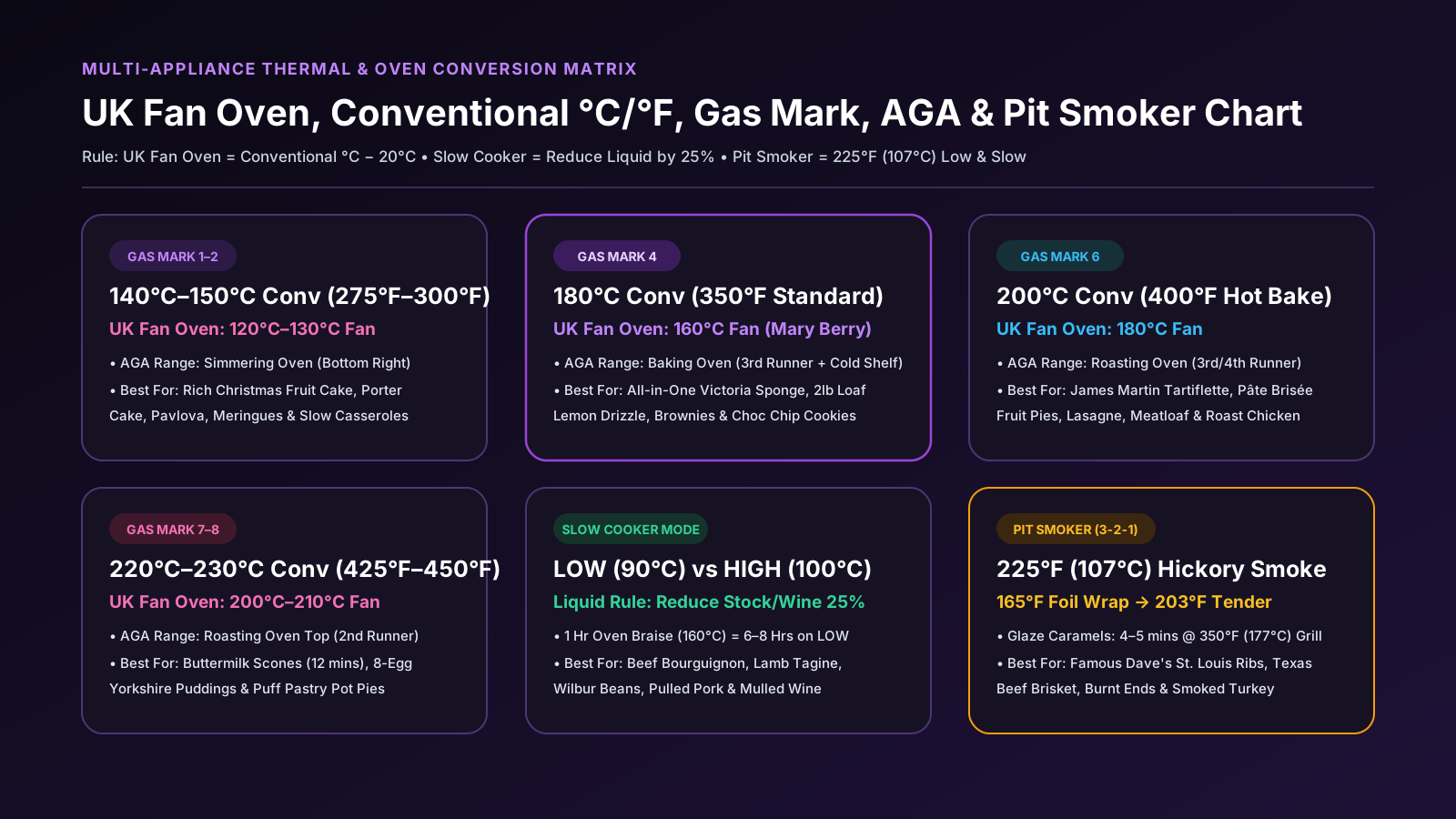
Multi-appliance oven, UK Fan, Gas Mark, cast-iron AGA runner, Slow Cooker, and 225°F Pit Smoker temperature conversion chart
Multi-appliance thermal conversion chart comparing UK Fan Ovens (-20°C), Conventional Ovens, Gas Marks, AGA cast-iron runners, Slow Cookers, and 225°F Pit Smokers.

1. Why Sealed Slow Cookers Require 25% to 30% Less Liquid

In a Conventional oven at 160°C (140°C Fan / 320°F), a Dutch oven or casserole dish vents steam steadily around its lid, evaporating 25% to 30% of the wine and stock over a 2-hour braise and naturally concentrating the gravy. A ceramic slow cooker (crockpot), by contrast, operates as a closed condensation dome: steam hits the cool glass lid and drips straight back into the pot.

When converting an oven casserole recipe (such as lamb and apricot tagine, beef Bourguignon, or herb chicken thigh casserole) to a slow cooker, multiply the recipe's liquid volume by 0.70 to 0.75—reducing 600mL of stock to 420mL–450mL so the finished dish is rich rather than watery.

2. Understanding Slow Cooker LOW vs HIGH Heating Ramp Rates

A common kitchen myth is that a slow cooker's LOW setting cooks at a lower final temperature than HIGH. On almost all modern electric slow cookers, both LOW and HIGH stabilize at the exact same thermostat simmer plateau of 93°C to 99°C (200°F–210°F); the difference is wattage and ramp time.

HIGH reaches that simmering plateau in 3 to 4 hours (roughly 1.8× the oven braise time at 160°C), whereas LOW takes 6 to 8 hours (roughly 3.2× the oven braise time). Tough, collagen-dense cuts like lamb shanks, beef chuck, and pork shoulder turn noticeably more tender on the 7-to-9-hour LOW cycle.

3. Pre-Searing for Maillard Flavor & Thickening Slow-Cooker Gravies

Because a slow cooker never exceeds 100°C (212°F), it cannot trigger the Maillard browning reaction (which requires dry surface heat above 140°C / 285°F) or evaporate raw alcohol from wine. Always brown cubed lamb, beef, or chicken thighs in a hot skillet with oil for 5 minutes, sweat the onions and garlic, and boil wine reductions by half before transferring everything into the ceramic crock.

To thicken the sauce, either toss the raw meat in 25g plain flour before searing or stir a slurry of 20g cornflour (cornstarch) mixed with 30mL cold water into the slow cooker with the lid off on HIGH for the final 20 minutes.

4. Dairy, Fresh Herbs & Steamed Basin Puddings in a Slow Cooker

Long exposure to 95°C heat causes single cream, milk, or sour cream to curdle into grainy curds; stir dairy creams, mascarpone, and tender green herbs (parsley, coriander, tarragon) in during the final 10 minutes of cooking.

A deep oval slow cooker also doubles as a gentle water bath for steamed Christmas puddings and suet steak puddings: set the foil-pleated pudding basin on a folded tea towel inside the crock, pour boiling kettle water halfway up the sides of the basin, and steam on LOW for 6.5 to 8 hours without boiling the kitchen dry.

5. Ceramic Crock Care, Skimming Fat & Attribution

Never pour ice-cold stock into a preheated stoneware slow-cooker insert or place a hot ceramic crock directly onto a wet stone countertop, as thermal shock can crack the glaze. Because a sealed slow cooker does not evaporate liquid, trim visible surface fat from lamb shanks, beef chuck, and pork shoulder before searing—or lay a sheet of kitchen paper briefly across the top of the finished gravy to lift off pooled oil before serving.

These 25%–30% liquid reduction multipliers and LOW/HIGH ramp schedules are independent appliance conversion guides and are not affiliated with Crock-Pot or any cookbook writer.

Related Search Queries & Calculator Presets Covered by This Hub

Lamb and Apricot Tagine Mary Berry (lamb and apricot tagine mary berry)Slow Cooked Lamb Shanks Mary Berry (slow cooked lamb shanks mary berry)Crockpot Healthy Sausage Mediterranean Quiche (crockpot healthy sausage mediterranean quiche)Mary Berry Garlic and Herb Chicken Casserole (mary berry garlic and herb chicken casserole)Mary Berry Chicken and Bacon Casserole (mary berry chicken and bacon casserole)Minted Lamb Casserole Mary Berry (minted lamb casserole mary berry)Lamb Tagine Slow Cooker Mary Berry (lamb tagine slow cooker mary berry)How Do You Make Casserolle Recipes (how do you make casserolle recipes)Casserolle Recipes (casserolle recipes)Mary Berry Pork and Apple Casserole (mary berry pork and apple casserole)Mary Berry Lamb Shanks in Red Wine (mary berry lamb shanks in red wine)Crockpot Meatballs with Grape Jelly Sauce Recipe (crockpot meatballs with grape jelly sauce recipe)Slow Cooker Mac and Cheese (slow cooker mac and cheese)Mary Berry Lamb Shanks in Red Wine Recipe (mary berry lamb shanks in red wine recipe)Pork Casserole Mary Berry (pork casserole mary berry)Normandy Pork Casserole Mary Berry (normandy pork casserole mary berry)Mary Berry Pulled Pork Slow Cooker (mary berry pulled pork slow cooker)Mary Berry Pork Casserole (mary berry pork casserole)Lamb Shanks in Red Wine Mary Berry (lamb shanks in red wine mary berry)Mary Berry Lamb Shanks (mary berry lamb shanks)Mary Berry Pork Casserole Recipes (mary berry pork casserole recipes)Mary Berry Lamb Shanks Recipe (mary berry lamb shanks recipe)Mary Berry Slow Cooker Pulled Pork (mary berry slow cooker pulled pork)Mary Berry Lamb Shanks Slow Cooker (mary berry lamb shanks slow cooker)Lamb and Apricot Tagine Mary BerrySlow Cooked Lamb Shanks Mary BerryCrockpot Healthy Sausage Mediterranean QuicheMary Berry Garlic and Herb Chicken CasseroleMary Berry Chicken and Bacon CasseroleMinted Lamb Casserole Mary BerryLamb Tagine Slow Cooker Mary BerryHow Do You Make Casserolle RecipesCasserolle RecipesMary Berry Pork and Apple CasseroleMary Berry Lamb Shanks in Red WineCrockpot Meatballs with Grape Jelly Sauce RecipeSlow Cooker Mac and CheeseMary Berry Lamb Shanks in Red Wine RecipePork Casserole Mary BerryNormandy Pork Casserole Mary BerryMary Berry Pulled Pork Slow CookerMary Berry Pork CasseroleLamb Shanks in Red Wine Mary BerryMary Berry Lamb ShanksMary Berry Pork Casserole RecipesMary Berry Lamb Shanks RecipeMary Berry Slow Cooker Pulled PorkMary Berry Lamb Shanks Slow CookerMary Berry Pork Casserole RecipeMary Berry Pork Chop CasseroleMary Berry Slow Cooked Lamb ShanksMary Berry Lamb Shank Casserole with Red WineMary Berry Lamb Shanks with Mustard Mash RecipeEasy Somerset Pork CasseroleLamb Shanks Mary BerryPork and Apple CasseroleSlow Cooker Macaroni Cheese UKMary Berry Lamb Casserole with Red WineSlow Cooker Mac and Cheese UKMary Berry Chicken Casserole with White Wine
Primary Scientific & Regulatory Sources: USDA FoodData Central · FDA 21 CFR 101.9 Nutrition Labeling · USDA FSIS Safe Minimum Internal Temperature Chart · NIST SI Units & Volumetric Standards

Frequently Asked Questions: Oven-to-Slow-Cooker & Braised Casserole Converter

How much liquid should I remove when converting an oven casserole recipe to a slow cooker?

Reduce stock, wine, and water by 25% to 30% (multiply liquid volume by 0.70 to 0.75—for example, cutting 600mL of stock down to 430mL) because a sealed ceramic slow-cooker lid traps almost 100% of steam condensation.

What is the difference between LOW and HIGH on a modern electric slow cooker?

Both LOW and HIGH reach the same final simmering plateau of ~93°C to 99°C (200°F–210°F); HIGH reaches that simmer in 3 to 4 hours (~1.8× oven braise time), whereas LOW ramps up gently over 6 to 8 hours (~3.2× oven braise time).

Why should I brown lamb, beef, or chicken in a skillet before putting it in the slow cooker?

Maillard browning of meat proteins and caramelization of onions require dry surface temperatures above 140°C (285°F), which a 95°C–100°C slow cooker cannot reach; searing for 5 minutes and reducing wine in a pan first builds deep gravy flavor.

How do I thicken a slow-cooker lamb tagine or beef ragu if the sauce looks too thin at the end?

Either coat the cubed meat in 20g–25g plain flour before searing at the start, or stir a slurry of 20g cornflour (cornstarch) mixed with 30mL cold water into the crockpot and cook uncovered on HIGH for the final 20 minutes.

When should cream, yogurt, or fresh green herbs be added to a slow-cooker casserole?

Stir in double cream, sour cream, creme fraiche, and tender herbs like parsley or coriander during the final 10 minutes of cooking so prolonged 95°C heat does not split the dairy fat or blacken the herbs.

Are the slow-cooker casserole presets affiliated with any named chef or brand?

No—all oven-to-slow-cooker liquid multipliers and timing tables on this page are independent culinary physics references, unaffiliated with any celebrity author.

Explore our 7 core culinary and nutrition calculators, 18 archetype scaling hubs, and primary scientific reference databases:

Recipe Calculator, Pan Converter & Kitchen Unit ScalerFDA 21 CFR 101.9 Nutrition Facts Label MakerRecipe Calorie, 4-4-9 Macro & Net Carb CalculatorKitchen Unit Converter (Oz, Cups, Tbsp & USDA Grams)Visual 4 oz Portion Size & Cooked Meat Yield GuideMeat Per Person, BBQ Catering & Turkey Size CalculatorFood Cost Percentage, Cake Pricing & Grocery Calculator2lb Loaf Tin & Sponge Cake Scaling Calculator Hub8-Inch to 10-Inch & Tiered Cake Pan Scaling HubJam, Marmalade & Chutney 105°C Pectin Scaling HubSwiss & Italian Meringue Buttercream Ratio HubScone, Shortbread & Tea Biscuit Batch Scaling HubCookie Dough Flour-to-Fat & Yield Calculator HubShortcrust, Pâte Brisée & Pie Crust Weight HubFruit Crumble, Crisp & Cobbler Topping Ratio HubBBQ Dry Rub & Molasses Glaze Batch Scaling HubSmoked Ribs, Brisket & Pulled Pork Yield HubBBQ Feast Platter, Pit Beans & Mac & Cheese HubSoup, Potage & Stock Batch Scaling Calculator HubUK Fan Oven, Conventional & Cast-Iron Range HubMeatloaf Panade, Roast Meat & Safe Probe HubLasagne, Risotto & Potato Gratin Batch Scaling HubBerry Coulis, Posset, Cheesecake & Trifle HubGluten-Free, Reduced-Sugar & Low-Cholesterol Hub
Verified Scientific & Regulatory Sources: USDA FoodData Central — Ingredient Densities & Nutrients · FDA 21 CFR 101.9 — Nutrition Labeling Regulations · USDA FSIS — Safe Minimum Internal Temperature Chart · NIST — SI Units & Volumetric Measurement Standards

All-in-One Recipe Calculator Pro vs. Static Recipe Blogs

Static food blogs lock every recipe to a single yield, a single cake tin size, and a single oven type—leaving you to guess when converting an 8-inch sponge to a 2lb loaf tin, boiling blackberry jam to 105°C, or smoking Famous Dave's ribs at 225°F.

Our deterministic calculator applies verified UK/US gram densities, pan surface-area ratios, AGA/Smoker/Slow Cooker offsets, and Mary Berry All-in-One method simplifications automatically in one place.

Scale your ingredients, convert cake tins and appliances, and export your recipe checklist with confidence.

Start Scaling & Converting