Requires ~5.3 oz (150g) of raw chicken breast before cooking; 4 oz raw chicken yields 3 oz (85g) cooked (~26g protein).
VISUAL 4 OZ CHICKEN & STEAK GUIDE • HAND COMPARISONS • POUNDS TO CUPS
Visual Portion Size & Kitchen Scale Calculator
See exactly what 1 oz, 2 oz, 3 oz, 4 oz, 6 oz, and 8 oz of chicken breast, steak, ground beef, salmon, cheese, and 2 tablespoons of peanut butter look like, plus convert chicken pounds to breasts and shredded cups.
Looks Like: Adult Palm of Hand (No Fingers)
Physical Dimensions: 4.0" × 3.0" × 0.85"
4 oz cooked chicken (113g) comes from ~5.3 oz raw breast, equals ~0.8 cup (about 3/4 to 4/5 cup) diced/shredded, and provides 35.2g protein.
4 oz Cooked = 113 Grams (0.8 Cups)
1 lb Raw Chicken (16 oz) = 2 to 3 breasts ≈ 2.43 Cups Shredded Cooked (12 oz)
15-Minute Garlic Herb 4 oz Chicken & Jasmine Rice Bowl (445 kcal · 42g Protein)
- 5.3 oz raw boneless chicken breast (yields 4 oz / 113g cooked, palm size)
- 1/2 cup dry jasmine rice (92g dry → yields 1.5 cups cooked)
- 1 cup broccoli florets (steamed)
- 1.5 tsp extra-virgin olive oil + garlic powder & lemon juice
COMPLETE VISUAL 4 OZ PORTION SIZE & HAND COMPARISON GUIDE
What Is a Visual Portion Size Calculator & What Does 4 oz Look Like?
Whether you want to know what 4 oz of chicken breast, steak, salmon, or ground beef looks like without a kitchen scale, or how 2 tablespoons of peanut butter and 1.5 oz of cheese compare to everyday objects, our interactive guide gives you exact physical dimensions and USDA macros.
A visual portion size calculator—frequently searched as 'what does 4 oz of chicken look like', '3 oz vs 4 oz meat deck of cards', 'hand portion size guide', or 'what does 2 tablespoons of peanut butter look like'—translates abstract scale weights into familiar physical objects you can recognize anywhere. Even experienced home cooks can misjudge meat, nut butter, cheese, and grain portions by 40% to 80% when plating by eye at a restaurant, family dinner, or buffet.
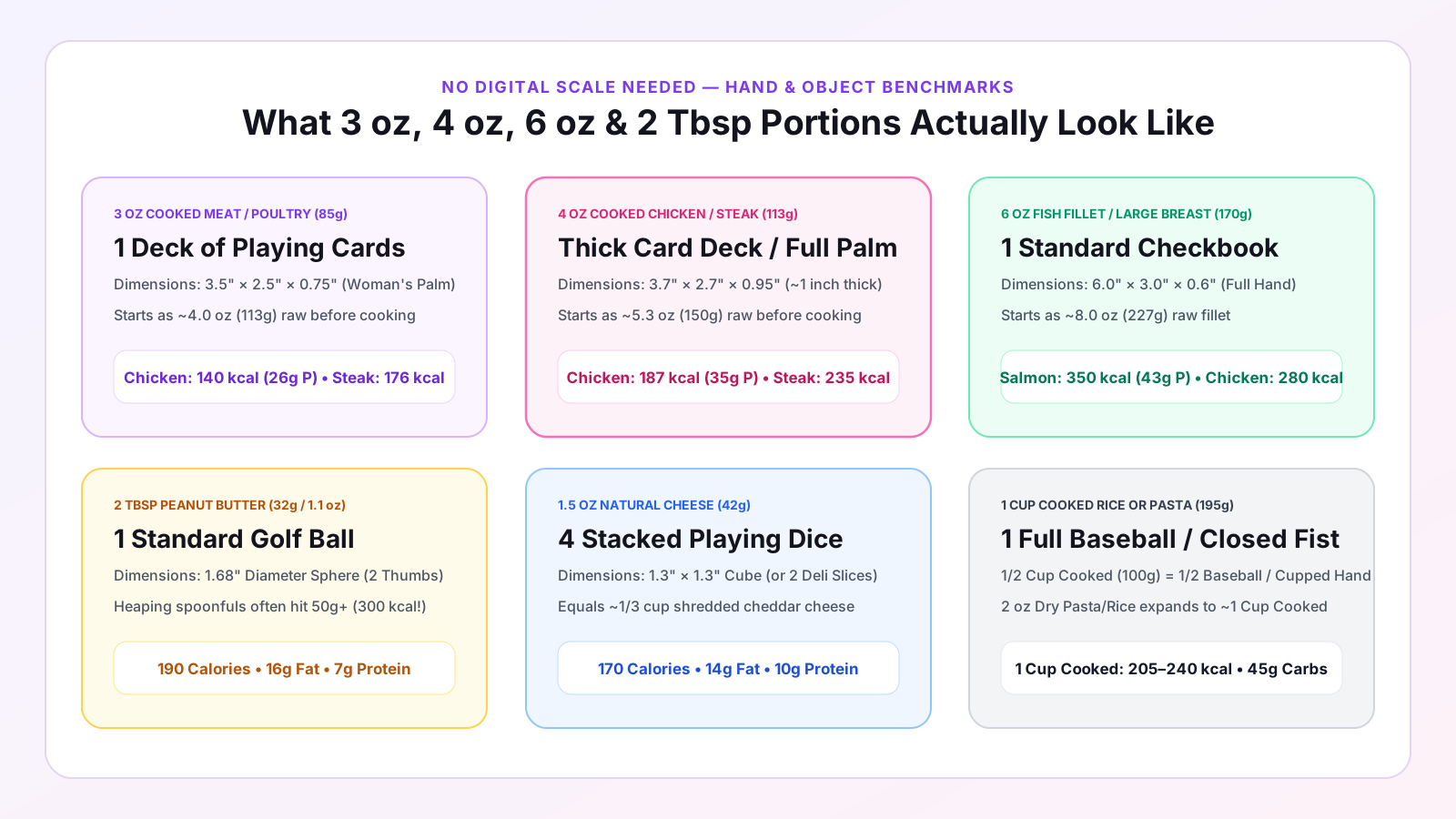
So what does 4 oz of chicken breast or steak actually look like? A standard 3-ounce (85g) cooked portion of boneless chicken breast, steak, pork loin, or fish fillet is the exact length, width, and thickness of a standard deck of playing cards (3.5 inches × 2.5 inches × 0.75 inches) or the flat palm of a woman's hand (excluding fingers). Stepping up to a 4-ounce (113g) cooked portion equals a thick deck of cards (about 1 inch thick) or the full palm of a large adult hand, delivering 35 grams of lean protein in chicken breast (~187 Calories) or 31 grams of protein in sirloin steak (~235 Calories).
Always check whether a recipe or meal plan specifies 4 ounces RAW or 4 ounces COOKED. Because meat and poultry lose roughly 25% of their moisture weight during grilling, baking, or pan-searing, 4 ounces (113g) of raw chicken breast shrinks down to 3 ounces (85g) of cooked chicken on your plate. Conversely, if your macro plan calls for 4 ounces (113g) of cooked chicken breast, you must start with about 5.3 ounces (150g) of raw chicken breast.
Beyond proteins, our interactive visualizer also calibrates high-calorie and high-carbohydrate staples against everyday objects: 2 tablespoons (32g / 1.1 oz) of peanut butter equals 1 standard golf ball (190 Calories), 1.5 ounces (42g) of cheddar cheese equals 4 stacked standard dice (170 Calories), and 1/2 cup (100g) of cooked white rice or pasta equals half a baseball or a cupped adult hand.
Worked Visual Portion & Hand Comparison Benchmarks
Compare the most searched ounce and tablespoon portions against physical objects and USDA nutrition:
A 4 oz cooked top sirloin or tenderloin filet is roughly 1 inch thick across the palm; an 8 oz steakhouse cut equals two stacked decks.
A 'heaping' dinner-spoon scoop of peanut butter often weighs 48g–60g (300–360 kcal)—keep level 2 tbsp to golf-ball size.
DIRECT ANSWERS & WORKED BENCHMARKS
What Does 4 oz of Chicken Look Like & How Many Chicken Breasts in a Pound?
A 4-ounce (113g) portion of cooked boneless chicken breast or steak is the size and thickness of a large adult palm or a thick deck of playing cards (about 3.7 × 2.7 × 1.0 inches), providing 35g of protein and 187 Calories. In raw butcher weight, 1 pound (16 oz / 454g) of boneless skinless chicken contains 2 to 3 medium chicken breasts (5.3 to 8 oz each) and yields about 2.5 to 3 cups of cooked diced or shredded chicken.
Worked Example: How Much Is 4 oz of Chicken Raw vs. Cooked & Rotisserie Chicken Yield
Because chicken breast loses ~25% of its weight as water vapor during cooking, 4 oz (113g) of raw chicken breast shrinks to 3 oz (85g — one standard deck of cards, 26g protein) on your plate. To end up with a full 4 oz (113g) of cooked chicken breast, weigh out 5.3 oz (150g) of raw chicken breast. If you buy a standard 2.25-pound grocery store rotisserie chicken, removing the skin and bones yields ~15 to 16 ounces (about 3.25 to 3.5 cups) of shredded cooked chicken—enough for four generous 4-ounce portions.
Quick-Answer Visual Portion & Chicken Yield Reference Table
| Portion / Yield Question | Exact Weight / Volume Answer | Everyday Visual Object Match | USDA Calories & Protein |
|---|---|---|---|
| Visual 4 oz of chicken (Cooked) | 113 g (0.25 lb / ~0.8 cup diced) | Thick deck of cards / Full adult palm | 187 kcal • 35g Protein • 4g Fat |
| How much is 3 oz of chicken (Cooked) | 85 g (from 4 oz raw breast) | Standard deck of playing cards (3.5" × 2.5") | 140 kcal • 26g Protein • 3g Fat |
| How many chicken breasts in a pound (1 lb) | 2 to 3 medium raw breasts (5.3–8 oz each) | Two to three adult palms side-by-side | 1 lb raw (454g) = 540 kcal • 102g Protein |
| How many cups of shredded chicken in 1 lb | 1 lb raw → 2.5 to 3 cups cooked shredded | 1 cup cooked diced/shredded = ~5 oz (140g) | 1 cup cooked = 231 kcal • 43g Protein |
| Cups of chicken in a rotisserie chicken | 3.25 to 3.5 cups shredded (~15–16 oz meat) | Four 4-oz card-deck portions per bird | ~750 kcal • 140g Protein total edible meat |
| Visual 4 oz salmon fillet | 113 g cooked (from ~5 oz raw fillet) | 2/3 of a standard checkbook / Flat palm | 233 kcal • 29g Protein • 14g Fat |
| Steak servings (3 oz, 4 oz, 6 oz, 8 oz) | 3 oz = 85g • 4 oz = 113g • 8 oz = 227g | 3 oz = 1 card deck • 8 oz = 2 stacked decks | 4 oz cooked sirloin = 235 kcal • 31g Protein |
| 2 tablespoons of peanut butter visual | 32 g (1.13 oz / 2 level tbsp) | 1 standard golf ball (1.68" sphere) | 190 kcal • 7g Protein • 16g Fat |
| Portion size for cheese (1 oz vs 1.5 oz) | 1 oz = 28g (1/4 c shredded) • 1.5 oz = 42g | 1 oz = 2 playing dice • 1.5 oz = 4 stacked dice | 1.5 oz cheddar = 170 kcal • 10g Protein |
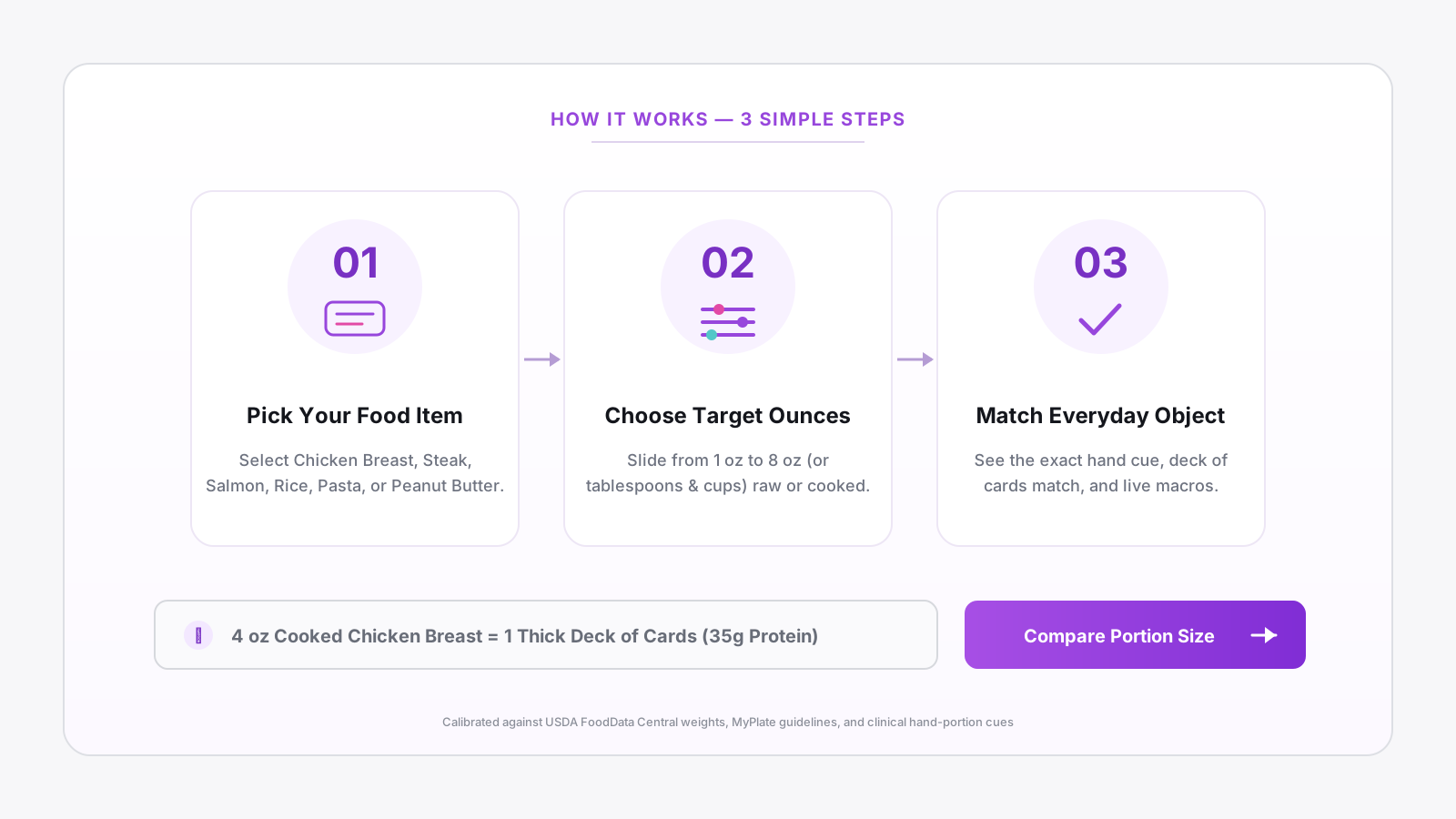
HOW IT WORKS — 3 SIMPLE STEPS
How Our Visual Portion Size Calculator Works in 3 Simple Steps
Estimate protein, grain, cheese, and fat portions accurately at home or at any restaurant without pulling out a scale.
Select Your Food Category
Pick Boneless Chicken Breast, Sirloin/Filet Steak, Salmon Fillet, 90/10 Ground Beef, Deli Turkey, Cheddar Cheese, Peanut Butter, or Cooked Rice & Pasta.
Slide Ounces & Raw/Cooked State
Adjust the portion slider from 1 oz up to 10 oz (or tablespoons/cups) and toggle between Cooked Plate Weight and Raw Butcher Weight.
Match Object, Hand Cue & Macros
See the matching everyday object, exact physical dimensions in inches, raw-to-cooked conversion weight, and live USDA Calories, Protein, Carbs, and Fat.
Because nut butter clings to a regular kitchen spoon, a casual 'spoonful' often equals 2 to 2.5 level measuring tablespoons (190 to 240 kcal). Visualizing a single 1.68-inch golf ball keeps a 2-tablespoon serving (32g) dead-on.
WHY THIS CALCULATOR IS DIFFERENT
What Makes Our Visual Portion Guide Different
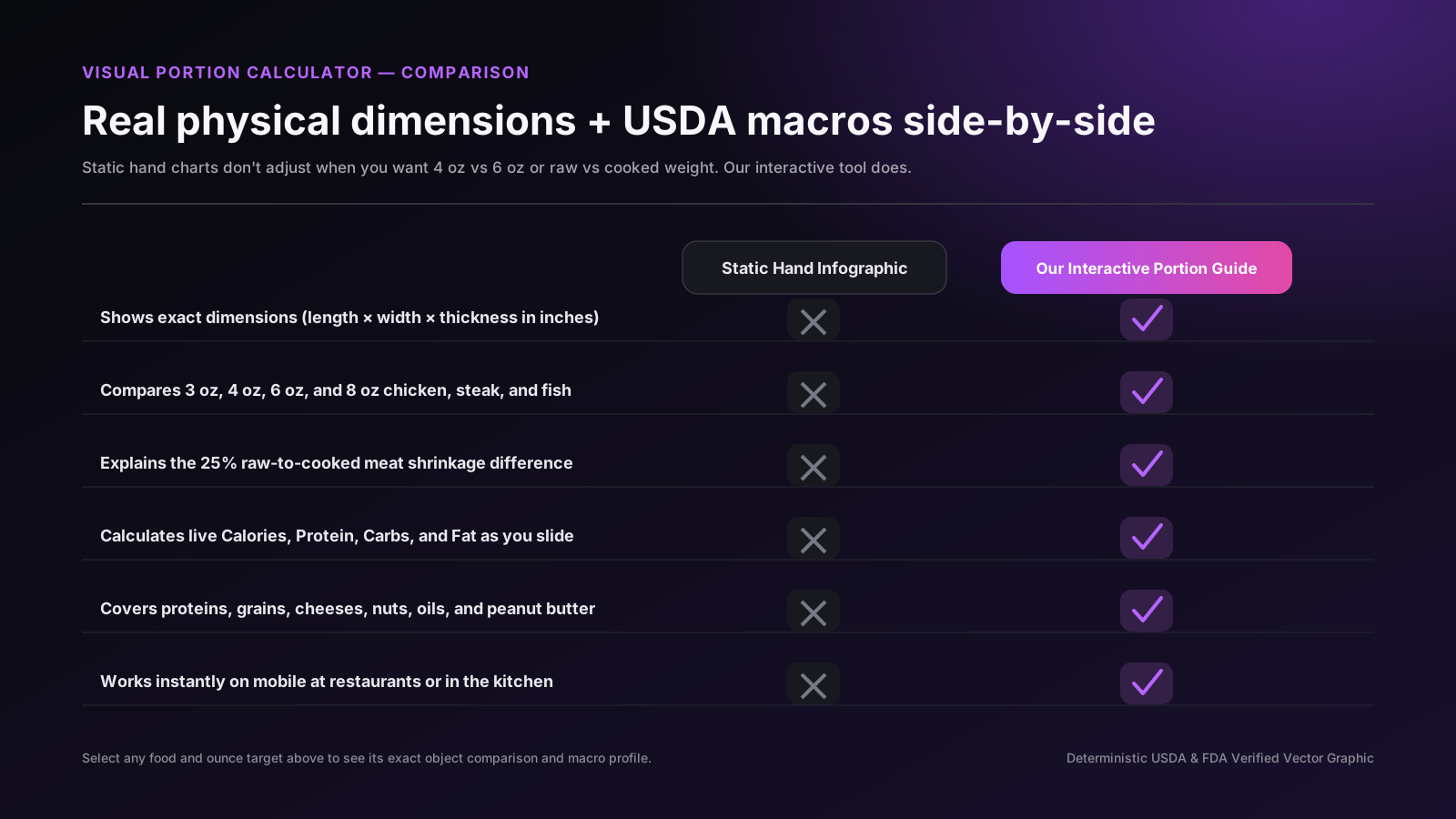
Static nutrition handouts only show one fixed serving size. Our interactive visualizer scales dimensions, object matches, and macros dynamically across any ounce target.
Exact physical dimensions in inches & centimeters
Gives real-world length × width × thickness measurements (e.g., 3.5" × 2.5" × 0.75" for a 3 oz deck of cards) so you can judge cutlet thickness as well as footprint.
Side-by-side Raw vs. Cooked weight toggle
Automatically shows how 4 oz raw chicken (113g) cooks down to 3 oz (85g), and how 4 oz cooked chicken requires 5.3 oz (150g) raw.
Both Household Object and Hand-Portion cues
Pairs classic object benchmarks (deck of cards, checkbook, golf ball, dice, hockey puck, baseball) with portable hand cues (palm, fist, cupped hand, thumb).
Live USDA FoodData Central macro updates
Updates Calories, Protein, Carbohydrates, and Dietary Fat instantly as you slide from 2 oz to 8 oz.
Dedicated coverage of high-density calorie foods
Includes the foods most prone to portion creep: peanut butter, cheddar cheese, olive oil, almonds, steaks, and cooked pasta/rice.
Mobile-ready for restaurant & travel dining
Check steakhouse cut sizes, sushi fish portions, or deli sandwich meat weights discreetly on your phone in seconds.
VERIFIED CULINARY & NUTRITION METHODOLOGY
The Clinical Science of Hand & Object Portion Estimation
Clinical dietitians, the USDA MyPlate program, and sports nutrition researchers use three-dimensional object and hand-portion models because human vision judges volume (length × width × height) far better when anchored to a known reference object. A flat 6-ounce chicken cutlet pounded thin for chicken piccata covers nearly twice the plate area of a thick 6-ounce center-cut tenderloin filet, even though both weigh 170 grams and contain the same protein.
Hand-based portioning also scales naturally with body size: a taller, larger individual has a larger palm, fist, and thumb—which correlates closely with their higher Basal Metabolic Rate (BMR) and protein requirements. Across clinical validation studies, an adult woman's palm averages ~3 ounces (85g) of cooked meat (~22–26g protein), while a large adult man's palm averages ~4 to 4.5 ounces (113–128g) of cooked meat (~32–38g protein).
For calorie-dense fats and cheeses, small volumetric errors create large caloric swings. One level tablespoon of olive oil or melted butter (14g, the tip of your thumb) contains 120 Calories, and two level tablespoons of peanut butter (32g, one golf ball) contain 190 Calories. Anchoring these foods to compact spheres and dice prevents unintentional 300-calorie surpluses.
What the deterministic engine verifies on every calculation
- Calibrates 3 oz (85g) cooked meat/poultry to a standard playing card deck (3.5" × 2.5" × 0.75").
- Calibrates 4 oz (113g) cooked meat/poultry to a thick card deck / full adult palm (~1.0" thick).
- Calibrates 6 oz (170g) fish fillet to a standard checkbook (6.0" × 3.0" × 0.6").
- Calibrates 4 oz (113g) ground beef patty to a standard ice hockey puck (3.0" diameter × 1.0" thick).
- Calibrates 2 tbsp (32g) peanut butter to a golf ball (1.68" diameter) and 1.5 oz (42g) cheese to 4 dice.
- Applies the 0.75 raw-to-cooked meat retention factor when converting between raw and cooked ounces.
Quick restaurant rule: A typical American restaurant chicken breast or steak entree weighs 8 to 10 ounces cooked—roughly two full 4-ounce palm portions on a single plate.
MODES, FORMATS & BENCHMARKS
Five Core Visual Portion Benchmarks Every Cook Should Know
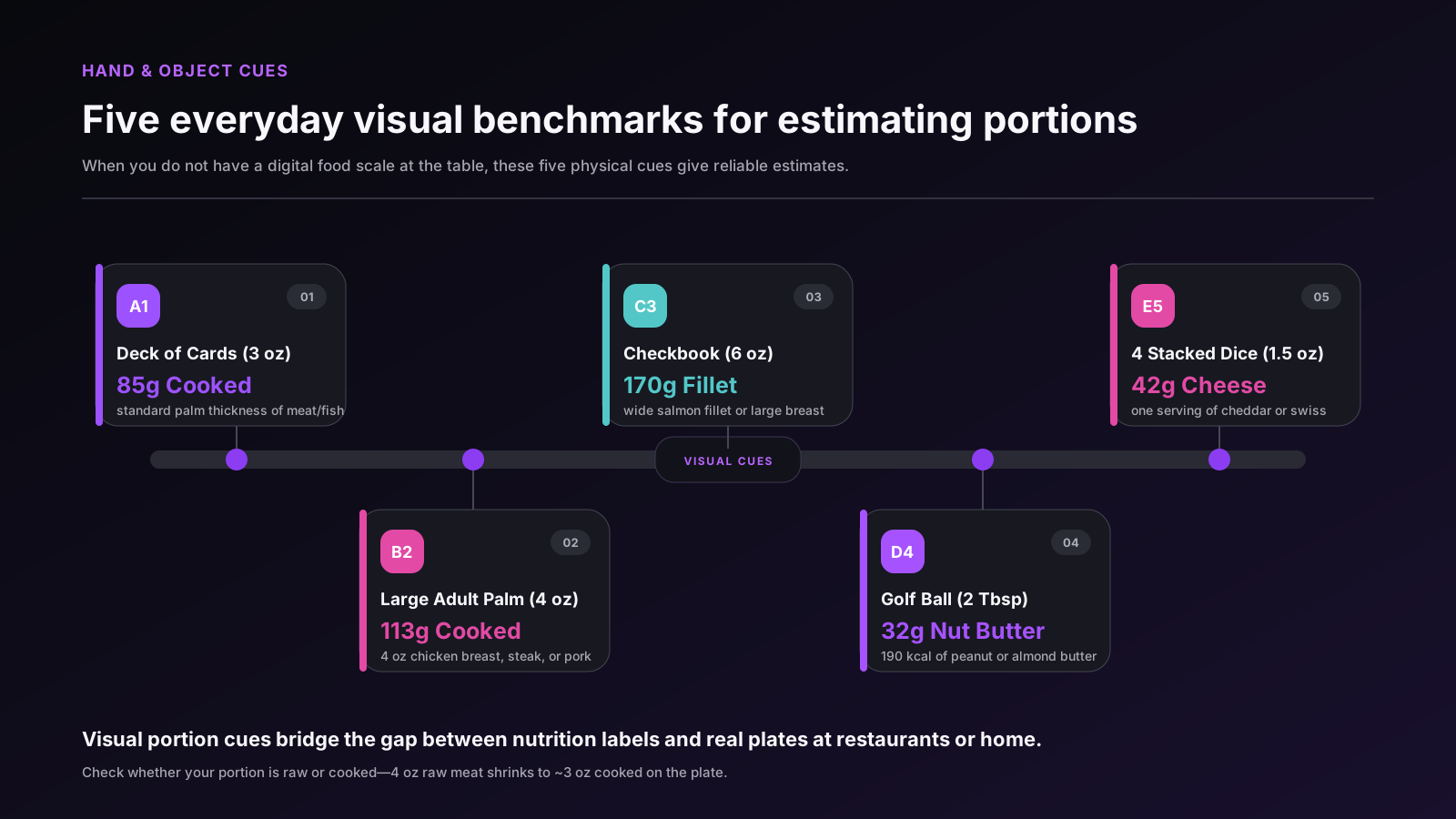
Memorize these five physical anchors and you can estimate calories and protein accurately anywhere in the world:
Deck of Playing Cards = 3 oz (85g) Cooked Meat
The universal USDA & MyPlate benchmark for one standard serving of cooked chicken, turkey, pork loin, or lean beef.
Chicken: 140 kcal (26g P) • Steak: 176 kcal (23g P)Large Adult Palm = 4 oz (113g) Cooked Meat
A slightly thicker (~1 inch) palm-sized medallion or cutlet; the go-to athletic serving for hitting 30g–35g protein per meal.
Chicken: 187 kcal (35g P) • Salmon: 233 kcal (29g P)Standard Checkbook = 6 oz (170g) Fish Fillet
Because flounder, tilapia, and salmon fillets are flatter than steak, a 6 oz cooked fillet matches the footprint of a checkbook or large smartphone.
6 oz Cooked Salmon: 350 kcal • 43g Protein • 21g FatGolf Ball (2 Tbsp) & 4 Dice (1.5 oz Cheese)
Use a golf ball (Ping-Pong ball) to gauge 2 tbsp (32g) of peanut butter or salad dressing, and 4 dice for 1.5 oz (42g) of cubed cheese.
2 Tbsp PB: 190 kcal • 1.5 oz Cheddar: 170 kcal (10g P)REAL-WORLD APPLICATIONS
Eight Everyday Situations Where Visual Portion Cues Help
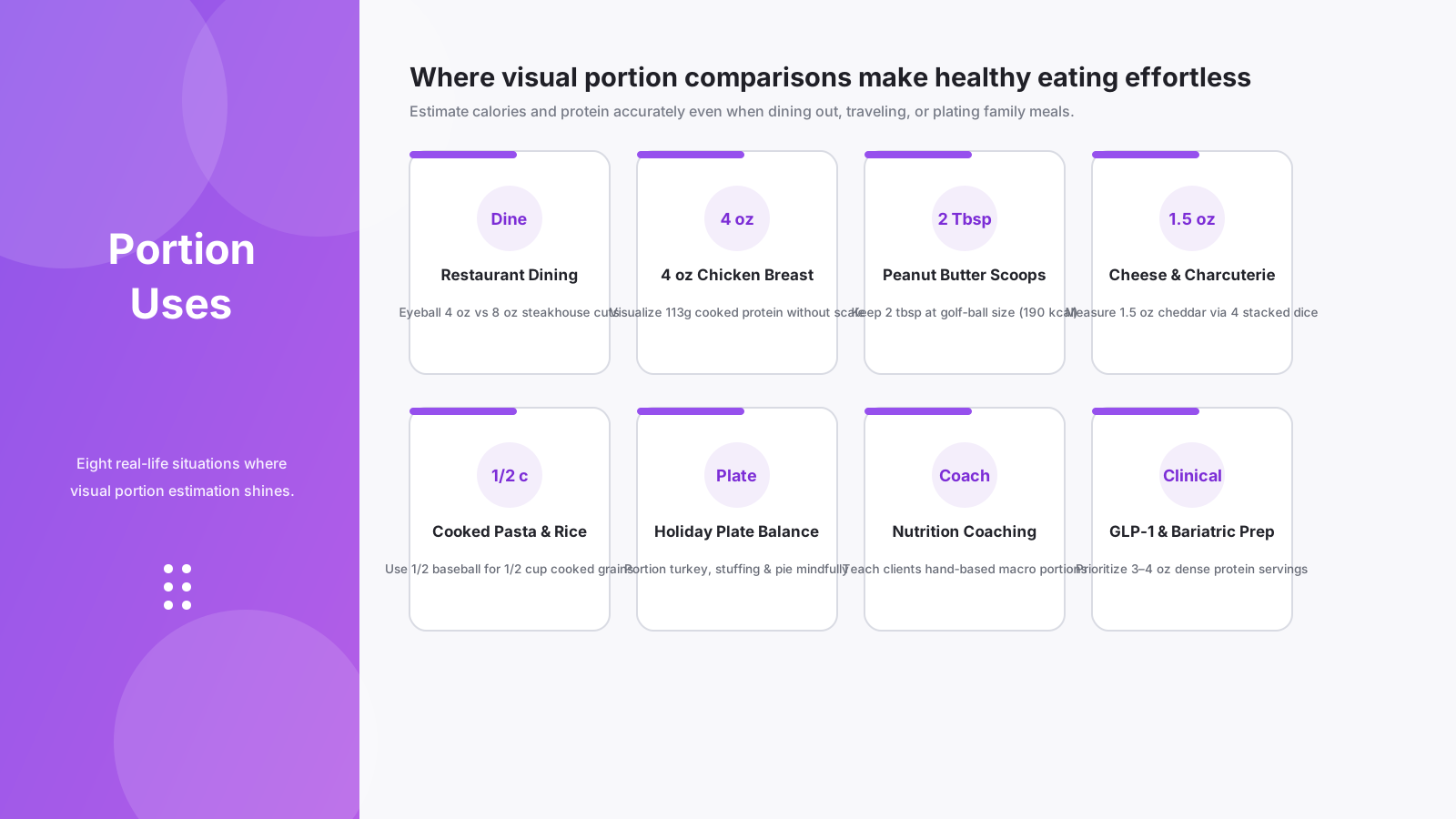
From steakhouse dinners and charcuterie boards to GLP-1 / bariatric high-protein meal planning, here are eight practical uses:
Restaurant steakhouse & entrée estimation
Distinguish a 4 oz filet mignon medallion from a 6 oz sirloin, 8 oz strip, or 12 oz ribeye before logging your meal.
Eyeballing 4 oz of chicken breast for meal prep
Portion sliced or grilled chicken breast evenly across lunch containers when you don't have a digital scale handy.
Keeping peanut butter & nut butter on target
Prevent a '2-tablespoon' toast topping or smoothie scoop from quietly doubling to 400 calories.
Charcuterie board & cheese portioning
Count 4 dice-sized cubes (or 2 thin deli slices) as one 1.5-ounce (42g) serving of cheddar, gouda, or swiss.
Cooked rice, oatmeal & pasta plating
Use half a baseball (1/2 cup cooked, ~100 kcal) or a full baseball (1 cup cooked, ~200 kcal) to plate starches consistently.
Deli counter & sandwich building
Visualize 3 oz to 4 oz of folded deli turkey or roast beef (~4 to 5 thin deli slices, matching the thickness of a card deck).
Nutrition coaching & family education
Teach athletes, kids, and clients how to build balanced plates using their own palm, fist, cupped hand, and thumb.
GLP-1 & post-bariatric protein prioritization
Ensure small, high-satiety meals deliver 3 to 4 ounces (26g–35g protein) of lean protein first.
VERIFIED DATA BENCHMARKS
Master Visual Portion Size, Object & USDA Macro Reference Table
Use this comprehensive reference chart to compare ounces, grams, physical dimensions, object equivalents, and USDA macros:
| Food & Portion Size | Gram Weight | Everyday Object Match | Hand Cue | Dimensions (L × W × H) | USDA Calories & Macros |
|---|---|---|---|---|---|
| 3 oz Cooked Chicken Breast | 85 g | Standard Deck of Cards | Average Woman's Palm | 3.5" × 2.5" × 0.75" | 140 kcal • 26g P • 0g C • 3g F |
| 4 oz Cooked Chicken Breast | 113 g | Thick Deck of Cards | Large Adult Palm | 3.7" × 2.7" × 0.95" | 187 kcal • 35g P • 0g C • 4g F |
| 4 oz Raw Chicken Breast | 113 g raw (85g cooked) | Computer Mouse (Raw) | Palm + 25% Shrinkage | 4.2" × 2.8" × 0.9" | 136 kcal • 25g P • 0g C • 3g F |
| 6 oz Cooked Chicken Breast | 170 g | 1.5 Stacked Card Decks | Palm + Half Palm | 4.5" × 3.0" × 1.1" | 280 kcal • 53g P • 0g C • 6g F |
| 3 oz Cooked Sirloin Steak | 85 g | Standard Deck of Cards | Average Adult Palm | 3.4" × 2.4" × 0.8" | 176 kcal • 23g P • 0g C • 9g F |
| 4 oz Cooked Sirloin Steak | 113 g | Thick Deck of Cards | Large Adult Palm | 3.5" × 2.5" × 1.0" | 235 kcal • 31g P • 0g C • 12g F |
| 8 oz Cooked Steakhouse Cut | 227 g | Two Stacked Card Decks | Two Full Palms | 4.8" × 3.2" × 1.25" | 470 kcal • 62g P • 0g C • 24g F |
| 4 oz Ground Beef Patty (90/10) | 113 g | 1 Ice Hockey Puck | 1 Flat Palm Circle | 3.0" diameter × 1.0" | 200 kcal • 23g P • 0g C • 11g F |
| 4 oz Cooked Salmon Fillet | 113 g | 2/3 of a Checkbook | Flat Adult Palm | 4.2" × 2.8" × 0.65" | 233 kcal • 29g P • 0g C • 14g F |
| 6 oz Cooked Salmon / White Fish | 170 g | 1 Standard Checkbook | Full Hand Length | 6.0" × 3.0" × 0.6" | 350 kcal • 43g P • 0g C • 21g F |
| 4 oz Sliced Deli Turkey Breast | 113 g (4–5 slices) | Thin CD Case Stack | 4–5 Folded Slices | 4.0" × 3.5" × 0.6" | 120 kcal • 24g P • 2g C • 1.5g F |
| 1.5 oz Natural Cheddar Cheese | 42 g | 4 Stacked Standard Dice | Two Whole Thumbs | 1.3" × 1.3" × 1.3" | 170 kcal • 10g P • 1g C • 14g F |
| 2 Tbsp Peanut / Almond Butter | 32 g (1.1 oz) | 1 Standard Golf Ball | Two Thumb Tips | 1.68" Sphere | 190 kcal • 7g P • 7g C • 16g F |
| 1 Tbsp Olive Oil / Butter | 14 g (0.5 fl oz) | 1 Poker Chip / Postage Stamp | 1 Thumb Tip | 1.5" × 0.25" | 120 kcal • 0g P • 0g C • 14g F |
| 1/2 Cup Cooked Rice or Pasta | 100 g | 1/2 Baseball / Lightbulb | 1 Cupped Adult Hand | 2.8" Half-Sphere | 130 kcal • 3g P • 28g C • 0.5g F |
| 1 Cup Cooked Rice, Pasta or Oats | 195–200 g | 1 Full Baseball / Apple | 1 Closed Adult Fist | 2.9" Sphere | 260 kcal • 6g P • 56g C • 1g F |
| 1 oz Almonds or Mixed Nuts | 28 g (~23 almonds) | 1 Shot Glass / Small Tin | 1 Small Cupped Palm | 1.75" × 1.5" | 164 kcal • 6g P • 6g C • 14g F |
USEFUL TERMINOLOGY & SEARCH PHRASES
Other Names People Use for a Visual Portion Size Calculator
People search for visual food portion comparisons using several everyday questions and clinical terms:
What does 4 oz of chicken look like
Compares 113g of raw or cooked chicken breast to a thick deck of cards or large palm.
Deck of cards meat portion guide
Uses a 3.5 × 2.5 × 0.75 inch playing card box to benchmark 3–4 oz of cooked protein.
Hand portion size calculator
Maps palm (protein), fist (veggies/carbs), cupped hand (starches), and thumb (fats) to gram weights.
2 tablespoons peanut butter visual
Matches 32g (190 kcal) of nut butter to a 1.68-inch golf ball.
Raw vs. cooked ounce visualizer
Shows the 25% moisture shrinkage from 4 oz raw meat to 3 oz cooked meat.
MyPlate ounce-equivalent guide
Translates USDA ounce-equivalents of protein, dairy, and grains into plate visuals.
Restaurant steak ounce estimator
Helps diners estimate 4 oz, 6 oz, 8 oz, and 12 oz cuts by thickness and area.
CLIENT-SIDE PRIVACY & DATA SECURITY
How Your Portion Selections Are Handled
Our Visual Portion Size Calculator runs 100% locally in your browser with zero tracking of your dietary selections:
- All ounce sliders, raw/cooked toggles, and macro comparisons execute directly on your device.
- No login, app install, or personal profile is needed to view visual portion guides.
- Works offline-friendly once loaded so you can reference it quickly at restaurants or grocery stores.
- Read our Privacy Policy and Cookies Policy for full details on site-wide analytics and zero-server recipe storage.
EXPERT KITCHEN & NUTRITION TIPS
Six Practical Tips for Estimating Portions Without a Scale
Master these six habits and you will be within 5%–10% of a digital food scale wherever you eat:
Calibrate your eye once a week with a scale
Place a 4 oz cooked chicken breast and a 2-tablespoon scoop of peanut butter on a digital gram scale once a week to keep your visual memory sharp.
Check thickness, not just plate coverage
A thin cutlet looks huge on a plate, while a 1.5-inch thick tenderloin filet looks compact. Always check side thickness against a 0.75"–1.0" card deck.
Pre-portion nuts and cheese into ramekins
Never eat almonds or cheddar straight from a 16 oz bag or block; measure 1 oz (a shot glass of nuts) or 1.5 oz (4 dice of cheese) onto a plate first.
Use a level measuring spoon for nut butters
Scrape peanut butter level across the rim of a tablespoon—a rounded 'dome' on top easily doubles the weight from 16g to 32g per spoon.
Remember the 0.75× cooked meat rule
If a steakhouse menu lists an '8 oz sirloin' (measured raw before grilling), it will weigh ~6 oz cooked on your plate.
Use smaller 9-inch plates at home
Because of the Delboeuf optical illusion, a 4 oz chicken breast and 1/2 cup of rice look generous on a 9-inch plate but tiny on a 12-inch charger.
VISUAL 4 OZ CHICKEN, STEAK SIZE CHART & MEAL-PREP PRESET GENERATOR
How Much Is 4 oz Chicken, Steak Portion Size Chart & Random Recipe Generator
When meal prepping without a scale, how much is 4 oz chicken (also asked as how much is 4 oz of chicken, what does 4 oz of chicken look like, visual 4 oz of chicken, how big is 4 oz of chicken, how much is 4 ounces of chicken, what does 4 ounces of chicken look like, what does four ounces of chicken look like, how much is four ounces of chicken, how much chicken is 4 oz, how much is 4oz of chicken, how much chicken is 4oz, how much is 4 oz of chicken breast, what does 4 oz of chicken breast look like, and how big is a 4 oz chicken breast)? Answer: 4 oz (how many grams is 4 oz of chicken = 113.4g) of raw boneless skinless chicken breast shrinks 25% during cooking to 3 oz (85g) cooked, which matches a standard deck of playing cards (3.5 × 2.5 × 0.5 inches) or the flat palm of an adult hand (4 oz chicken breast compared to hand). If you weigh 4 oz of already-cooked chicken, it equals about 1.33 decks of cards (35g protein, ~185 kcal).
| Visual Portion / Serving Size Question | Everyday Object & Hand Comparison | Exact Grams, Cups & Protein Math |
|---|---|---|
| How much 3 oz of chicken / How much is three ounces of chicken / How big is 3 oz of chicken / How much chicken is a serving / What is the portion size for chicken / Chicken breast size / One serving is how much | 1 standard deck of playing cards (or 1 adult palm without fingers) | 3 oz (85g) cooked chicken is the official USDA single serving (made from 4 oz / 113.4g raw breast) and delivers how many grams of protein in a deck of cards = 26g protein (~140 kcal). |
| What does 6 ounces of chicken look like / How much is six ounces of chicken / How much is 8 oz of chicken / 6 oz of meat | 6 oz cooked = 2 decks of cards (both palms) • 8 oz raw = 6 oz cooked | 6 oz (170g) cooked chicken breast provides 52g protein (~280 kcal); 8 oz (227g) raw breast cooks down to 6 oz. |
| Portion size steak / Steak size chart oz / Steak oz sizes / 3 oz of steak / What does 3 oz of steak look like / How big is a 4 oz steak / Visual 4 oz steak size / 6 oz steak size / 1 oz of steak | 3 oz cooked steak = 1 deck of cards (0.5 in thick) • 4 oz steak = 1 thick deck of cards (0.7 in thick) • 1 oz of steak = 4 stacked dice (28.35g) | Also covers 4 oz of meat, 4 ounces of meat, how much is 4 oz of meat, what does 4 oz of meat look like, visual 4 oz of meat, three ounces of meat, and how much is 3 ounces of meat. A 6 oz steak size equals two decks of cards side-by-side. |
| How much is 4 oz of ground beef / How much is 4 ounces of ground beef / How many cups is 4 oz of ground beef / How many cups is 4oz of ground beef / 4 oz ground beef to cups / How many ounces of ground beef in a cup | 4 oz raw ground beef = 1 tennis-ball scoop (cooks down to a 3 oz patty or 1/2 to 2/3 cup crumbled) | 1 cup of cooked crumbled ground beef weighs ~5.5 to 6 oz (160g); 4 oz (113.4g) cooked ground beef equals ~0.7 cup. |
| What does 2 oz look like / What does 2 tbsp of peanut butter look like / How big is a tbsp of peanut butter / How many grams is 1 tablespoon of peanut butter / How many grams peanut butter in a tablespoon | 2 oz meat/cheese = 2/3 deck of cards (or 6–8 dice) • 2 tbsp peanut butter = 1 golf ball / ping-pong ball (32g) | 1 tablespoon of peanut butter weighs 16 grams (~95 kcal, 4g protein, 8g fat), which matches the tip of an adult thumb. |
| How many slices of ham is 2 ounces / 2 oz of meat / 1 oz visual / How much meat is 3 ounces / What does 3 oz of meat look like / What does 4 ounces of meat look like / How big is 4 oz of meat / How big is 4oz of meat / How much is 4oz meat | 2 oz deli ham = 2 to 3 standard slices (56.7g) • 1 oz visual = 4 stacked dice (28.35g) • 3 oz meat = 1 deck of cards (85g) | Covers 3 ounces of beef, beef servings, what is a serving size of steak, 3 oz steak size, how big is 4 ounces of steak, how big is 4oz of steak, how big is 4oz steak, 4 oz chicken breast size, how much is 4 ounces of chicken breast, visual 6 oz of chicken, and how much is 8 ounces of chicken. |
| How much is 2 tablespoons of peanut butter / What does a tablespoon of peanut butter look like / How much is a spoonful of peanut butter / Ground beef serving size in cups / How much is 4 oz of ground beef in cups / Portion size cereal | 2 tbsp peanut butter = 1 golf ball (32g / ~190 kcal) • 1 tbsp = 1 thumb tip (16g) • 4 oz cooked ground beef = ~2/3 cup • Cereal = 1 baseball (1 cup / 30–40g) | Also use the preset selector above as a random ingredient generator for balanced protein + grain + vegetable plates. |
| Random recipe generator / Random recipe picker / Recipe randomizer (Balanced Plate Builder) | 1 Palm Protein (4 oz) + 1 Fist Complex Carb (1 cup) + 1 Baseball Vegetables + 1 Thumb Healthy Fat (1 tbsp) | Use the interactive portion builder above as a meal-prep random recipe generator, random recipe picker, or recipe randomizer by mixing any 4 oz protein preset (chicken, salmon, sirloin, tofu) with a 1-cup grain and 1-tbsp dressing (~450–520 kcal per plate). |
AUTHORITATIVE SOURCES & REFERENCES
Primary USDA, FDA & Scientific Sources
- USDA MyPlate — Protein Foods & Ounce-Equivalent Portion Guidelines — Official consumer visual portion benchmarks for meat, poultry, seafood, eggs, nuts, and seeds.
- USDA FoodData Central — Cooked vs. Raw Poultry & Beef Nutrient Profiles — Empirical gram weights, moisture-loss ratios, and macronutrient densities per 100g.
- National Heart, Lung, and Blood Institute (NHLBI) — Serving Size Card Visuals — Clinical deck-of-cards, baseball, golf-ball, and dice visual portion equivalents.
How to Use the Visual 4 oz Portion Size & Chicken Breast Yield Calculator (Step-by-Step Workflow)
Scaling recipes, generating FDA-compliant nutrition facts labels, and converting between volume (cups, tablespoons, fluid ounces) and weight (grams, dry ounces, pounds) requires accounting for ingredient density and cooking moisture loss. Follow these four steps:
- Enter Your Original Yield & Ingredients: Input the recipe's current number of servings (the yield) and paste or select your ingredient list in standard kitchen units (cups, tbsp, tsp, oz, lbs, cans, or grams).
- Select Your Conversion Factor or Baking Pan Ratio: Click a quick preset (
1/2x Cut in Half,1/3x,2x Double,3x Triple), type your desired target servings, or use the Baking Pan Size Converter to scale by pan surface area. - Verify Kitchen Fractions & Gram Equivalents: Review both the rounded culinary fraction (such as converting
0.375 cupsinto6 tbsp) and the density-adjusted metric gram weight for precision on a digital kitchen scale. - Generate Labels, Macros, or Catering Lists & Export: Star your favorite calculations to local browser storage or export your scaled recipe, nutrition panel, or food cost breakdown as a
.txt,.csv, or.jsonfile.
Who This Tool Is For: Practical Kitchen, Nutrition & Food Business Use Cases
Different culinary tasks require different mathematical rules. Halving a cake batter involves pan area geometry, whereas tracking macros for fat loss requires raw-to-cooked weight conversion and the 4-4-9 Atwater energy formula:
- Home Cooks & Bakers Scaling Recipes: Use the Recipe Converter & Doubler and Kitchen Unit Converter to halve, double, or triple recipes and convert between ounces, cups, tablespoons, and metric grams without awkward decimal measurements.
- Cottage Food Bakers, Meal Preppers & Supplement Brands: Use the FDA Nutrition Facts & Supplement Label Maker to generate vertical, horizontal/tabular, dual-column cereal box, and supplement facts panels with automatic
% Daily Value (%DV)calculations. - Fitness, Weight-Loss & Macro Trackers: Use the Recipe Calorie, Macro & TDEE Calculator and Visual Portion Size Guide to calculate homemade food calories, net carbs, 4-4-9 macro splits, and visual hand comparisons (such as what 4 oz of chicken or 3 oz of steak looks like).
- Holiday Hosts, Event Planners & BBQ Caterers: Use the Meat Per Person & Thanksgiving Turkey Calculator to determine exact raw purchase weights for 10 to 100+ guests across whole turkey, pulled pork, brisket, ribs, ribeye steak, chicken breasts, and deli cold cuts.
- Restaurant Chefs, Custom Cake Bakers & Households: Use the Food Cost, Cake Pricing & Grocery Budget Calculator to compute recipe food cost percentage (28%–33% target), custom wedding cake pricing, and USDA monthly grocery budgets.
The Science Behind Our Calculators: USDA Densities, Atwater 4-4-9 & FDA 21 CFR 101.9
Every calculator on Recipe Calculator Pro uses verified reference constants from USDA FoodData Central and U.S. Food and Drug Administration (FDA 21 CFR 101.9) Nutrition Labeling Standards:
- Fluid Ounces (Volume) vs. Avoirdupois Ounces (Weight): A fluid ounce (
fl oz) measures volume (1 fl oz = 2 tablespoons = 29.57 mL;8 fl oz = 1 US cup;32 fl oz = 4 cups). A dry ounce (oz) measures mass (1 oz = 28.35 grams;16 oz = 1 pound). Because dry ingredients have different bulk densities, 1 cup of all-purpose flour weighs 4.25 oz (120g), 1 cup of chocolate chips weighs 6 oz (170g), and 1 cup of peanut butter weighs 9.1 oz (258g). - The Atwater 4-4-9 Macronutrient Energy System: Dietary energy (kilocalories) is determined by macronutrient oxidation: 1 gram of Protein = 4 kcal, 1 gram of Carbohydrate = 4 kcal, 1 gram of Fat (Lipids) = 9 kcal (making fat the most energy-dense macronutrient), and 1 gram of Alcohol = 7 kcal. Dietary fiber and sugar alcohols are subtracted from total carbohydrates when computing net carbs.
- Raw-to-Cooked Moisture & Fat Retention Yields: Meat, poultry, and fish lose approximately 20% to 25% of their raw weight as water and rendered fat during cooking. Consequently, 4 oz of raw boneless chicken breast or steak (113g) yields ~3 oz cooked (85g), while dry grains like rice and oats absorb water and expand to 2.5x–3.0x their dry weight.
Common Kitchen Calculation Mistakes vs. Verified Culinary Math
| Kitchen Task | Common Mistake (Before) | Verified Calculation (After) | Culinary / Nutritional Reason |
|---|---|---|---|
| 4 oz Chocolate Chips to Cups | 1/2 cup (confusing weight oz with 8 fl oz cup) | 2/3 cup (113g) | 1 US cup of chocolate chips weighs 6 oz (170g), so 4 oz by weight is 4/6 = 2/3 cup. |
| Weighing Chicken or Rice for Macros | Logging 4 oz cooked chicken as 4 oz raw entry | 4 oz cooked = 5.3 oz raw (35g protein) | Chicken loses ~25% water weight when cooked, concentrating protein from 22.5g/100g raw to 31g/100g cooked. |
| Menu Pricing at 30% Food Cost | Adding 30% markup ($4.50 × 1.30 = $5.85) | $4.50 ÷ 0.30 = $15.00 Menu Price | Food Cost % equals Ingredient Cost divided by Menu Selling Price, leaving 70% gross margin for labor and overhead. |
| BBQ Pulled Pork for 20 Guests | Buying 10 lbs raw pork butt for 10 lbs cooked | 15–16 lbs raw butt → ~8.5 lbs cooked | Pork shoulder loses ~45% weight to bone, fat rendering, and bark evaporation during smoking. |
VISUAL 4 OZ PORTION SIZE & CHICKEN YIELD FAQS
Frequently Asked Questions About Visual Portions & Chicken Yields
What does 4 oz of chicken look like (visual 4 oz of chicken)?
A cooked 4-ounce (113g) boneless skinless chicken breast is the size and thickness of a large adult palm (excluding fingers) or a thick deck of playing cards (~3.7 × 2.7 × 1.0 inches). It equals roughly 3/4 to 4/5 cup of diced cooked chicken and provides 187 Calories and 35 grams of lean protein.
How much is 3 oz vs 4 oz of chicken, and how does raw vs cooked weight change?
A 3-ounce (85g) cooked chicken portion matches a standard deck of playing cards (3.5 × 2.5 × 0.75 inches, 140 Calories, 26g protein). Because raw chicken loses ~25% of its weight as water during cooking, 4 oz (113g) of raw chicken cooks down to 3 oz (85g) on the plate. To eat 4 oz (113g) of cooked chicken, start with ~5.3 oz (150g) of raw chicken.
How many chicken breasts in a pound (1 lb), and how many ounces is a chicken breast?
One pound (16 oz / 454g) of raw boneless skinless chicken typically contains 2 to 3 medium chicken breasts, with each raw breast weighing 5.3 to 8 ounces (150g to 227g). Large supermarket 'family pack' chicken breasts can weigh 9 to 10 ounces raw each (two full 4.5-oz servings per breast).
How many cups of shredded chicken in a pound, and how many cups in a rotisserie chicken?
One pound (16 oz) of raw boneless chicken breast cooks down to ~12 ounces (340g) of cooked meat, which yields 2.5 to 2.75 cups of shredded or diced cooked chicken (1 cup cooked shredded chicken weighs ~5 oz / 140g). A whole 2.25-pound grocery rotisserie chicken yields ~3.25 to 3.5 cups (15 to 16 oz) of shredded meat after removing skin and bones.
What does 2 tablespoons of peanut butter look like visually?
Two level tablespoons (32 grams / 1.13 oz) of peanut butter or almond butter match the exact volume of 1 standard golf ball (or Ping-Pong ball, 1.68 inches in diameter) and contain ~190 Calories, 16g fat, and 7g protein. A single 1-tablespoon serving (16g) matches the tip of your thumb (~95 Calories).
What is the visual portion size for steak (3 oz, 4 oz, 6 oz, and 8 oz)?
A 3 oz (85g) cooked steak matches 1 standard deck of cards (~23g protein). A 4 oz (113g) cooked sirloin or tenderloin medallion matches a thick 1-inch deck of cards or adult palm (~31g protein). A 6 oz (170g) bistro cut equals 1.5 stacked decks, and an 8 oz (227g) steakhouse cut equals 2 full decks of cards (~62g protein).
What does a visual 4 oz salmon fillet look like?
Because fish fillets are flatter than beef steaks, a 4-ounce (113g) cooked salmon fillet looks like 2/3 of a standard checkbook (about 4.2 × 2.8 × 0.65 inches) and supplies ~233 Calories, 29g protein, and 14g heart-healthy fat. A 6-ounce (170g) cooked fish fillet matches 1 full checkbook.
What is the portion size for cheese, and what does 1 oz or 2 oz look like?
One ounce (28g) of natural cheddar, swiss, or mozzarella cheese matches 2 standard six-sided playing dice (or 1/4 cup shredded cheese, ~113 Calories). The official USDA MyPlate serving of 1.5 ounces (42g) matches 4 stacked dice (~170 Calories), and 2 ounces (57g) matches 1/2 cup of shredded cheese or 2–3 deli slices.
Compare Any Portion Size Visually
You have seen how a 3 oz deck of cards, a 4 oz adult palm, a 6 oz checkbook, and a 2-tablespoon golf ball of peanut butter correspond to gram weights and USDA macros.
Pick your protein, grain, cheese, or nut butter above and toggle between raw and cooked weight to see exact dimensions and nutrition.
Compare Visual Portions Now