Calculate calories and macros in homemade food, smoothies, and recipes, convert grams of protein (4 kcal/g), carbs (4 kcal/g), and fat (9 kcal/g) into calories, compute net carbs, and find your exact BMR and TDEE macro split.
Calorie-to-Protein Benchmark: A ratio under 10:1 (e.g. 150 kcal with 15g+ protein) indicates a lean, high-protein food ideal for fat loss and muscle retention.
COMPLETE ATWATER 4-4-9 MACRO, NET CARB & TDEE GUIDE
What Is a Recipe Macro Calculator & How Does the 4-4-9 Rule Work?
Whether you want to calculate macros in a homemade recipe, verify calories using the 4-4-9 rule, track digestible net carbs for keto or PCOS, or align dinner portions with your daily TDEE, our analyzer handles both recipe-level and full-day macro math.
Important Note: Educational & Non-Medical Disclaimer: This Recipe Macro, Calorie, and TDEE Calculator is an informational nutrition and meal-planning tool built by software developer Lee Harsh. It is not medical or clinical dietetic advice, and it is not a substitute for consultation with a physician or Registered Dietitian (RD), especially if you manage diabetes, PCOS, kidney disease, or an eating disorder.
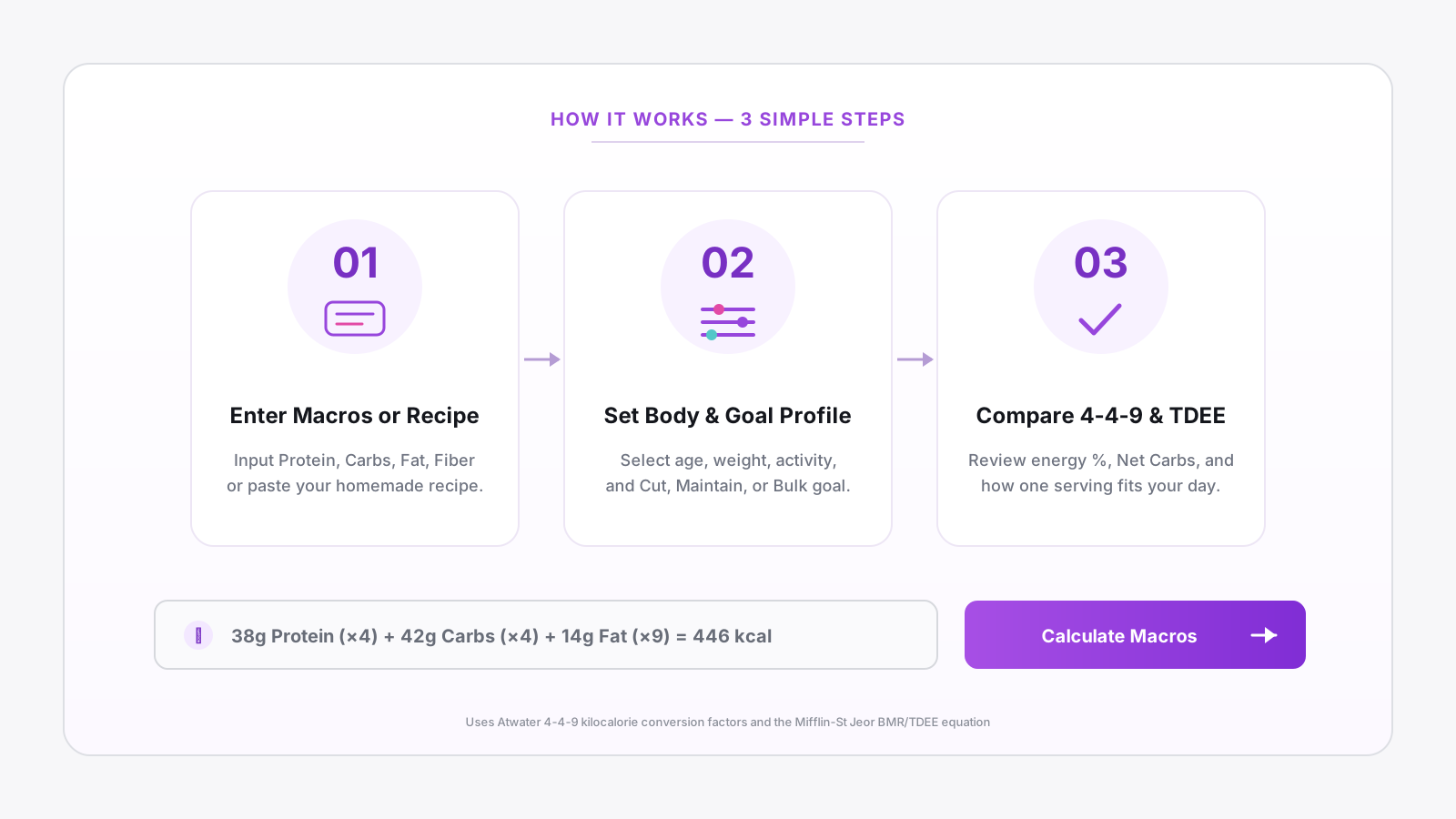
How the Recipe Macro & TDEE Calculator combines Atwater 4-4-9 kilocalorie conversion with Mifflin-St Jeor daily energy targets in three steps.
A recipe macro calculator—also searched as a homemade food calorie calculator, macro ratio calculator, net carb calculator, or TDEE macro planner—is a nutritional analysis tool that computes the exact protein, carbohydrate, dietary fat, fiber, and calorie breakdown of any meal or recipe per serving. Instead of guessing how a bowl of homemade chili or a slice of protein banana bread fits into your day, it quantifies both the gram weights and the percentage of total energy coming from each macronutrient.
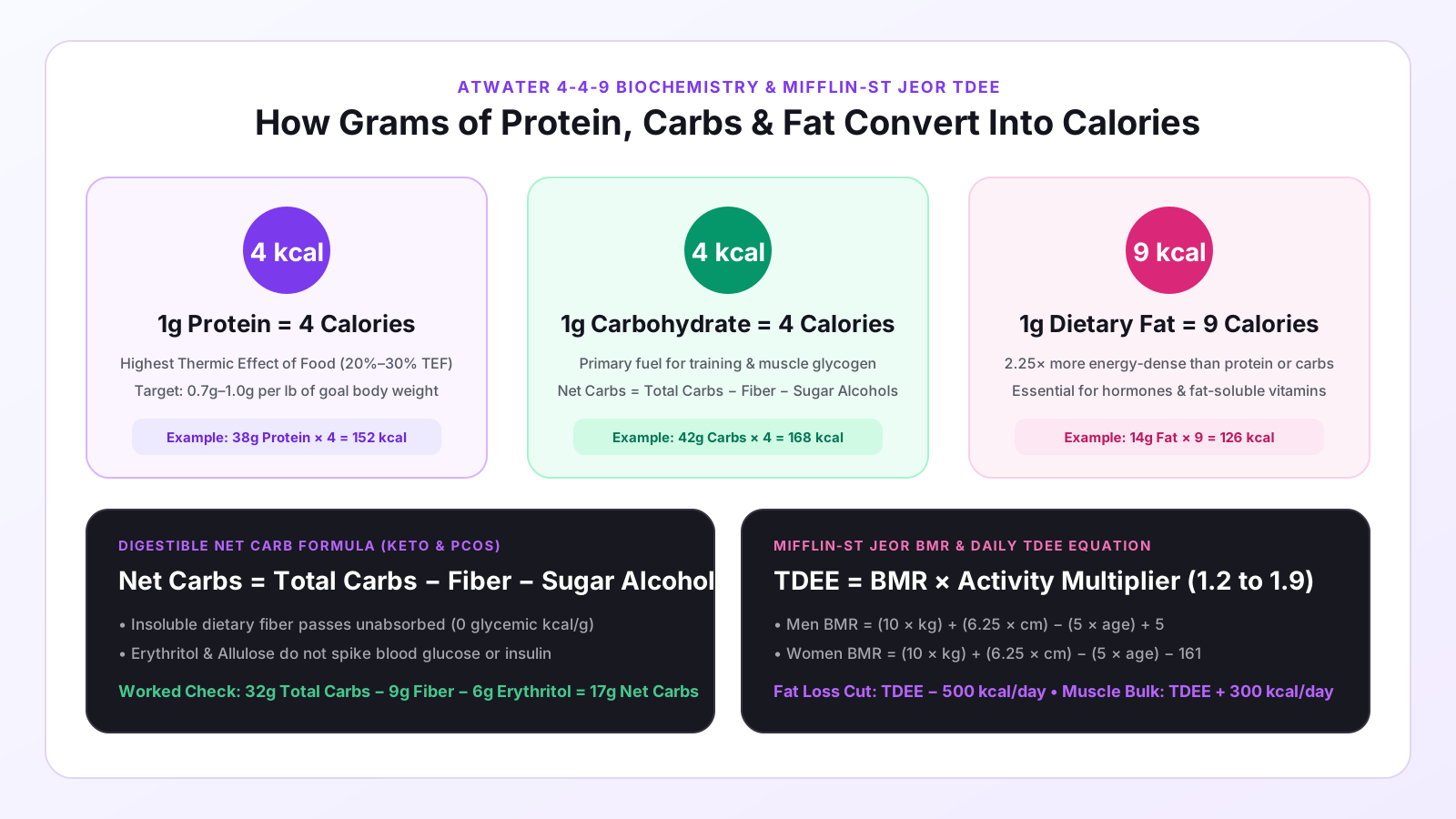
At the heart of nutritional biochemistry is the Atwater 4-4-9 Energy System, developed by agricultural chemist Wilbur Olin Atwater and used by the USDA and FDA. Under the 4-4-9 rule: 1 gram of Protein provides 4 kilocalories (Calories), 1 gram of Carbohydrate provides 4 kilocalories, and 1 gram of Dietary Fat provides 9 kilocalories (more than double the energy density of protein or carbs). Alcohol, when present, provides 7 kilocalories per gram.
For low-carb, ketogenic, diabetic, and PCOS meal planning, our calculator also computes Digestible Net Carbs alongside Total Carbohydrates. Because insoluble dietary fiber and most sugar alcohols (such as erythritol and allulose) pass through the small intestine without raising blood glucose or insulin, subtracting Dietary Fiber (and applicable sugar alcohols) from Total Carbohydrates reveals the true glycemic carbohydrate load per serving.
Finally, a meal's macros only make sense in the context of your daily energy needs. By integrating the clinically validated Mifflin-St Jeor Basal Metabolic Rate (BMR) and Total Daily Energy Expenditure (TDEE) equations directly into the tool, you can immediately see what percentage of your daily Fat Loss, Maintenance, Muscle Gain, Keto, or PCOS macro budget a single serving of your recipe consumes.
Worked Atwater 4-4-9, Net Carb & TDEE Calculations
See how our macro calculator converts gram weights into kilocalories, digestible net carbs, and daily TDEE targets:
Atwater 4-4-9 Formula3-step check
38g Protein (×4 kcal)+42g Carbs (×4) + 14g Fat (×9)
Verified Output446 Total kcal (34% P)
Ratio / Yield Benchmark34%
152 protein kcal + 168 carb kcal + 126 fat kcal = 446 total kcal, delivering a high-satiety 34% protein / 38% carb / 28% fat split.
Net Carb Subtraction2-step check
32g Total Carbs+9g Fiber + 6g Erythritol
Verified Output17g Digestible Net Carbs
Ratio / Yield Benchmark53%
Subtracting non-digestible fiber and zero-glycemic sugar alcohols reveals 17g Net Carbs—saving 60 kcal of non-absorbed fiber energy.
Mifflin-St Jeor TDEE4-step check
1,650 kcal BMR+× 1.55 Moderate Activity
Verified Output2,058 kcal Cut Target (−500)
Ratio / Yield Benchmark80%
Maintenance TDEE is 2,558 kcal/day; subtracting 500 kcal/day sets a sustainable ~1 lb/week fat-loss target with 180g daily protein.
DIRECT ANSWERS & WORKED BENCHMARKS
What Is Macros? 1 Gram of Fat, Protein & Carbs to Calories (Grams to Kcal Table)
Macros (short for macronutrients) are the three primary chemical nutrients your body requires in large gram quantities every day to produce cellular energy: protein, carbohydrates, and dietary fat. Under the Atwater 4-4-9 energy standard, each gram of protein is 4 calories (kcal), 1 gram of carbohydrates is 4 calories (kcal), and 1 gm of fat is 9 calories (kcal).
Worked Example: Difference Between Carbs and Calories & Best Macros for Weight Loss
Carbohydrates are a physical macronutrient measured in grams on a food scale, whereas calories (kilocalories) measure the heat energy released when your body metabolizes protein, carbs, or fat. For example, if a homemade chicken burrito bowl contains 45g protein, 50g total carbohydrates (with 8g dietary fiber = 42g net carbs), and 15g fat, its energy is (45 × 4) + (50 × 4) + (15 × 9) = 180 + 200 + 135 = 515 kcal. For sustainable weight loss, clinical sports nutrition studies generally recommend a high-protein macro split of 35% protein, 35% carbohydrates, and 30% fat inside a 400–500 kcal daily deficit below your TDEE.
Quick-Answer Grams to Kcal & Calories to Grams Conversion Table (4-4-9 Rule)
Nutrient / Macro Query
Calories Per 1 Gram
10 Grams in Kcal
25 Grams in Kcal
50 Grams in Kcal
100 Calories in Grams
Protein (each gram of protein)
4 kcal / gram
40 kcal
100 kcal
200 kcal
25.0 g protein per 100 kcal
Carbohydrates (1g carb to calories)
4 kcal / gram
40 kcal
100 kcal
200 kcal
25.0 g carbs per 100 kcal
Dietary Fat (1 gm of fat to calories)
9 kcal / gram
90 kcal
225 kcal
450 kcal
11.1 g fat per 100 kcal
Digestible Net Carbs (Total − Fiber)
4 kcal / gram
40 kcal
100 kcal
200 kcal
Excludes insoluble fiber (0 kcal/g)
Alcohol (Ethanol in beverages)
7 kcal / gram
70 kcal
175 kcal
350 kcal
14.3 g alcohol per 100 kcal
TDEE vs. BMR (Basal Factor)
BMR = Resting Energy
TDEE = BMR × 1.2–1.9
Cut = TDEE − 450 kcal
Bulk = TDEE + 300 kcal
Best weight loss split: 35P / 35C / 30F
HOW IT WORKS — 3 SIMPLE STEPS
How Our Recipe Macro & TDEE Calculator Works in 3 Simple Steps
Analyze a single serving, divide a cooked pot by gram weight, or build your complete daily macro split in seconds.
Visual breakdown of the Atwater 4-4-9 kilocalorie conversion factors, Total vs. Net Carbohydrates, and daily TDEE macro split presets.
01→
Enter Recipe Macros or Ingredients
Input per-serving Protein, Total Carbs, Dietary Fiber, Sugar Alcohols, and Fat—or enter your full batch totals and number of servings (or cooked pot weight in grams).
02→
Configure Your TDEE & Diet Preset
Select your sex, age, height, weight, and activity multiplier to compute your Mifflin-St Jeor BMR and TDEE, then choose Balanced, Fat Loss Cut, Muscle Gain, Keto, or PCOS.
03
Compare Energy % & Daily Fit
Review exact 4-4-9 calories, fiber-adjusted net calories, macro energy percentages, protein-per-100-kcal density, and how many servings fit your daily goal.
Pro Tip for Meal Preppers: Weigh the cooked pot in grams.
Instead of guessing what '1/6th of a pot of chili' looks like, weigh the empty pot first, weigh the finished cooked batch, subtract the pot weight, and divide by 6. Every meal-prep container will have identical macros to the gram.
WHY THIS CALCULATOR IS DIFFERENT
What Makes Our Recipe Macro Calculator Different
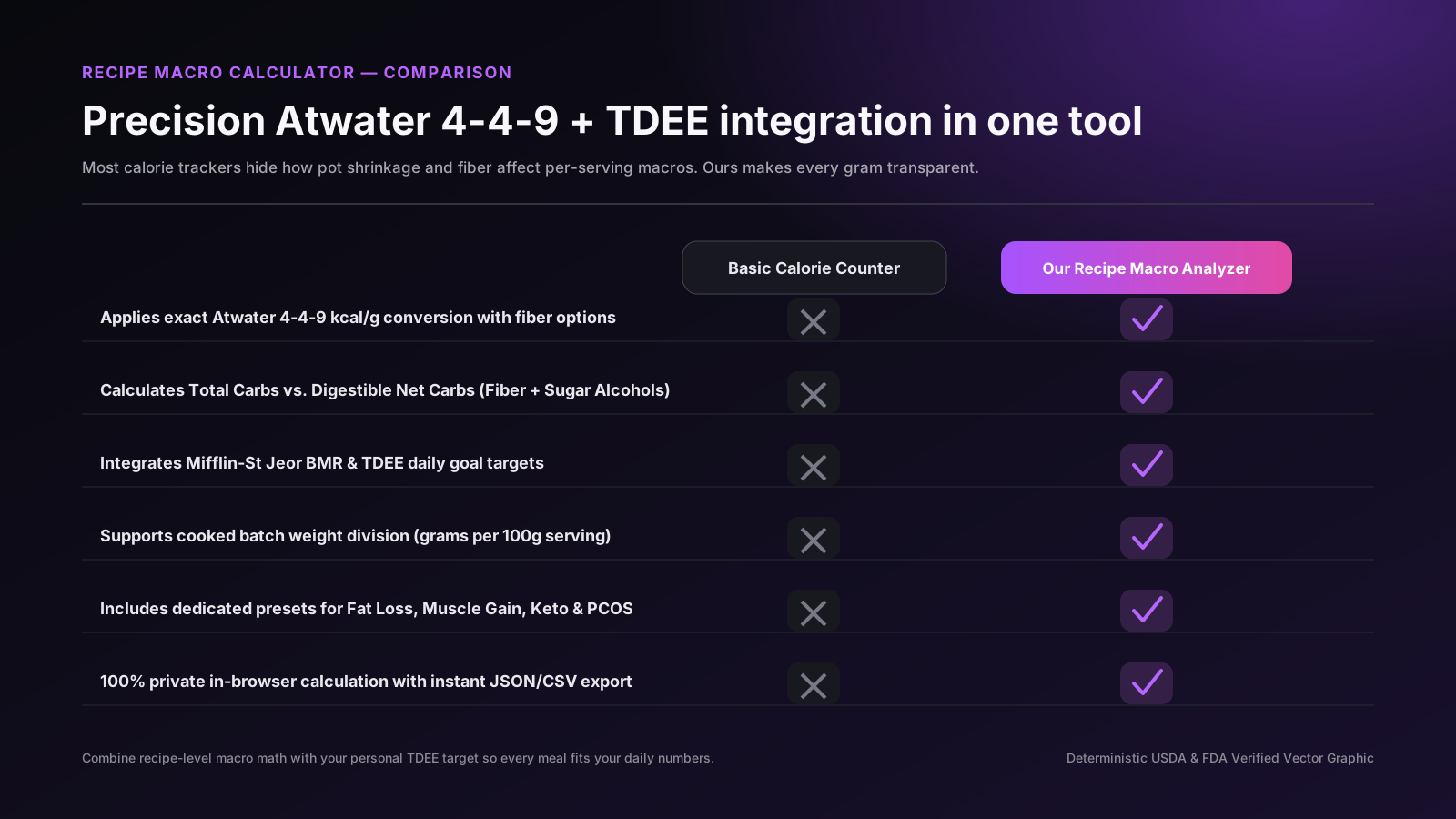
Standard fitness apps force you to search bloated, user-submitted food databases full of errors. Our calculator uses transparent, deterministic math.
Transparent Atwater 4-4-9 & Net Calorie math
Shows both standard label calories (4 kcal × Total Carbs) and net digestible calories (subtracting insoluble fiber calories) so you never wonder why a food label's calories differ by 15–30 kcal.
Built-in Total vs. Net Carb breakdown
Dedicated inputs for Dietary Fiber and Sugar Alcohols let keto, low-carb, and insulin-resistant users track true glycemic impact instantly.
Integrated Mifflin-St Jeor BMR & TDEE engine
No need to open a second website to find your daily calorie target—your personal BMR, maintenance TDEE, and goal gram targets update right alongside your recipe.
Dedicated PCOS, Keto, Cut & Bulk presets
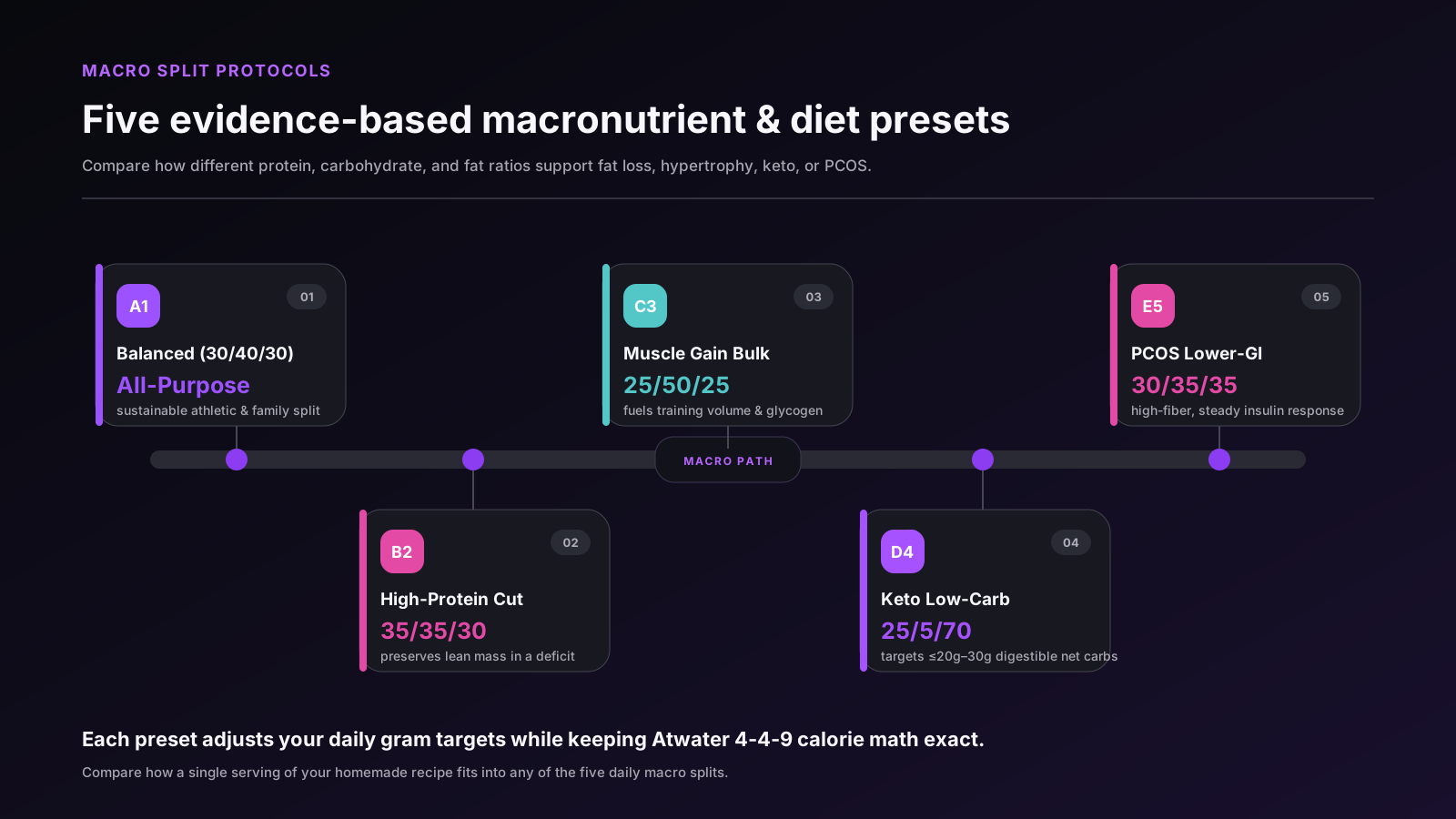
One-click macro ratios tailored for high-protein fat loss (35P/35C/30F), lean hypertrophy (25P/50C/25F), ketogenic diets (25P/5C/70F), and PCOS insulin balance (30P/35C/35F).
Protein efficiency & satiety scoring
Calculates grams of protein per 100 calories (P:E ratio)—any recipe offering ≥8g protein per 100 kcal is flagged as high-satiety for body recomposition.
Cooked batch weight division (per 100g)
Handles water evaporation during baking or roasting and outputs nutrition per 100g of cooked weight for effortless kitchen-scale plating.
VERIFIED CULINARY & NUTRITION METHODOLOGY
The Nutritional Science of 4-4-9 Macros, Net Carbs & Mifflin-St Jeor TDEE
Why do nutrition labels sometimes show slightly different calories than multiplying Protein × 4, Carbs × 4, and Fat × 9? While the general Atwater factors (4 kcal/g protein, 4 kcal/g carbohydrate, 9 kcal/g fat) are the universal standard, FDA 21 CFR 101.9(c)(1)(i)(C) allows manufacturers to subtract insoluble dietary fiber from Total Carbohydrates before multiplying by 4 kcal/g (and assigns soluble fermentable fiber ~2 kcal/g). That is why a high-fiber tortilla with 20g Total Carbs and 15g Fiber lists 70 Calories instead of 130 Calories.
When calculating daily energy requirements, clinical sports nutritionists rely on the Mifflin-St Jeor equation (1990), which the Academy of Nutrition and Dietetics identified as the most accurate non-calorimetric predictor of Basal Metabolic Rate (BMR). For men: BMR = (10 × weight in kg) + (6.25 × height in cm) − (5 × age in years) + 5. For women: BMR = (10 × weight in kg) + (6.25 × height in cm) − (5 × age in years) − 161.
Multiplying your BMR by your Physical Activity Level (1.2 for sedentary, 1.375 for light exercise 1–3 days/week, 1.55 for moderate training 3–5 days/week, 1.725 for hard training 6–7 days/week, or 1.9 for two-a-day athletic/manual labor) yields your Total Daily Energy Expenditure (TDEE). From there, a 400–500 kcal/day deficit drives ~0.8–1.0 lb/week of fat loss while keeping protein at 0.8–1.0g per pound of body weight preserves lean muscle tissue.
What the deterministic engine verifies on every calculation
Computes Protein Energy = Protein (g) × 4 kcal/g and Fat Energy = Total Fat (g) × 9 kcal/g.
Computes Total Carb Energy = Total Carbs (g) × 4 kcal/g and Net Carb Energy = max(0, Total Carbs − Fiber − Sugar Alcohols) × 4 kcal/g.
Calculates exact macronutrient energy share (% Protein, % Carbs, % Fat) normalized to 100%.
Evaluates Mifflin-St Jeor BMR and multiplies by your selected activity factor to establish daily TDEE.
Computes the exact percentage of your daily Calorie, Protein, Carb, and Fat budget supplied by 1 serving of your recipe.
For PCOS and insulin resistance: pairing 30g+ of protein with 8g–10g+ of soluble/insoluble fiber per meal slows gastric emptying and blunts post-meal glucose spikes.
MODES, FORMATS & BENCHMARKS
Five Evidence-Based Macro Split Protocols Compared
Your ideal macronutrient ratio depends on your training volume, metabolic health, and body-composition goal. Compare all five built-in protocols below:
Balanced Athletic Split (30% P / 40% C / 30% F)
Provides ample protein for recovery, moderate complex carbohydrates for daily training, and sufficient dietary fat for hormone synthesis.
2,000 kcal = 150g Protein • 200g Carbs • 67g Fat
High-Protein Fat Loss Cut (35% P / 35% C / 30% F)
Elevates protein share during a 500-kcal caloric deficit to maximize satiety, thermic effect of food (TEF), and lean muscle retention.
1,800 kcal = 158g Protein • 158g Carbs • 60g Fat
Hypertrophy & Muscle Gain (25% P / 50% C / 25% F)
Uses a 250–350 kcal surplus with high carbohydrate availability to fuel progressive overload and muscle glycogen replenishment.
2,600 kcal = 163g Protein • 325g Carbs • 72g Fat
PCOS & Insulin-Steady Split (30% P / 35% C / 35% F)
Moderates glycemic load while emphasizing high protein (≥30g/meal), healthy anti-inflammatory fats, and ≥30g/day of dietary fiber.
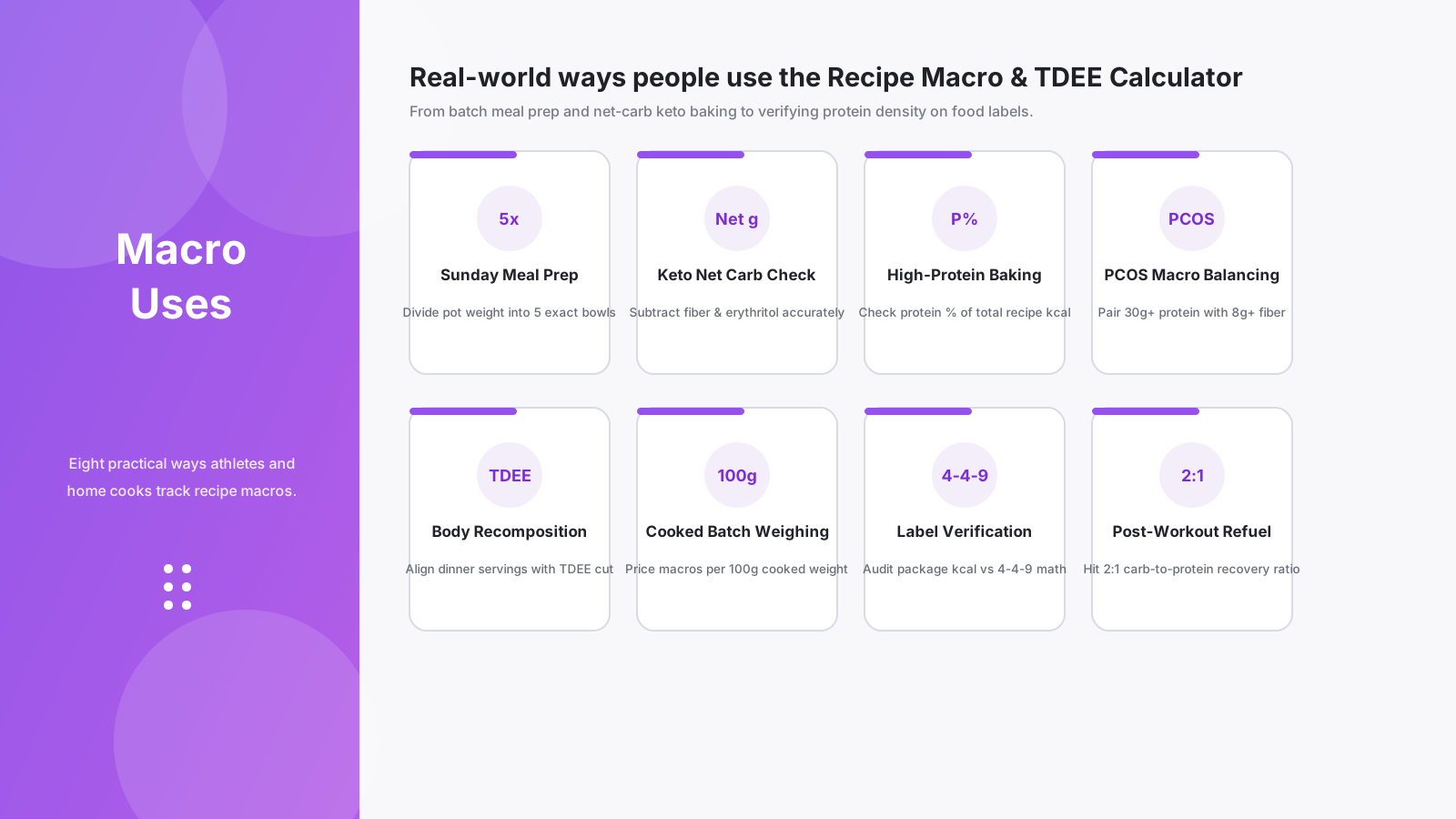
Eight Practical Ways People Use Our Recipe Macro Calculator
From dividing a Sunday batch of turkey chili into five identical lunch bowls to auditing net carbs in keto baked goods, here is how home cooks and athletes use the tool:
Sunday batch meal prep portioning
Weigh your cooked casserole, soup, or stir-fry pot in grams, divide into 4 to 8 meal-prep containers, and log exact per-box macros.
Keto & low-carb net carb verification
Subtract dietary fiber and sugar alcohols (erythritol, allulose, monk fruit) from almond-flour or lupin-flour bakes to stay under 20g–30g Net Carbs.
High-protein dessert & baking formulation
Test how swapping Greek yogurt, cottage cheese, egg whites, or whey/casein isolate changes the protein-to-calorie ratio of pancakes and muffins.
PCOS & blood-sugar balanced meal design
Verify that every recipe serving delivers at least a 1:1 or 1:1.2 protein-to-net-carb ratio with ≥7g of dietary fiber.
Body recomposition & deficit tracking
Check immediately whether a homemade dinner leaves enough calories and protein in your daily Mifflin-St Jeor TDEE budget.
Per-100g cooked weight macro lookup
Create a custom 'per 100g cooked' entry so family members can scoop different portion sizes and multiply by their own plate weight.
Auditing commercial food label claims
Plug any store-bought package's fat, carb, fiber, and protein grams into the 4-4-9 verifier to see if the printed calorie count uses fiber subtraction.
Endurance & post-workout glycogen refueling
Formulate rice bowls, smoothies, and overnight oats that hit the classic 2:1 or 3:1 carbohydrate-to-protein recovery ratio.
VERIFIED DATA BENCHMARKS
Master Atwater 4-4-9 Macro, Net Carb & TDEE Reference Table
Reference this table for kilocalorie conversion factors, Thermic Effect of Food (TEF), protein satiety benchmarks, and daily macro split formulas:
Macronutrient / Metric
Energy Density (kcal/g)
Thermic Effect (TEF)
Clinical & Culinary Benchmark
Protein
4 kcal per gram
20%–30% of kcal burned digesting
Target 0.7–1.0g per lb of body weight (25%–35% of calories)
Total Carbohydrate
4 kcal per gram
5%–10% of kcal burned digesting
FDA Daily Value = 275g/day on a 2,000-kcal diet
Digestible Net Carbs
4 kcal per gram
5%–10% of kcal burned digesting
Total Carbs − Dietary Fiber − Sugar Alcohols (Keto ≤20–30g/day)
Insoluble Dietary Fiber
0 kcal per gram
Non-digestible bulk & motility
Subtract from Total Carbs under FDA 21 CFR 101.9 calorie rules
Soluble Dietary Fiber
~2 kcal per gram
Fermented into short-chain fatty acids
Slows glucose absorption and supports gut microbiome
Sugar Alcohols (Erythritol/Allulose)
0–0.4 kcal per gram
Minimal glycemic or insulin response
Subtracted in net-carb calculations for keto baking
Dietary Fat (Unsaturated/Saturated)
9 kcal per gram
0%–3% of kcal burned digesting
Minimum 0.3g per lb of body weight for hormone health
Alcohol (Ethanol)
7 kcal per gram
~15% thermogenic oxidation
Cooking simmers off 25%–90% depending on duration
High-Satiety Protein Density
≥8g Protein / 100 kcal
≥32% of recipe calories from protein
Examples: Chicken breast (19g/100kcal), Greek yogurt (17g/100kcal)
Mifflin-St Jeor BMR (Men)
10W(kg) + 6.25H(cm) − 5A + 5
Resting basal energy (60%–70% TDEE)
Multiply by activity factor (1.2 to 1.9) for Maintenance TDEE
Mifflin-St Jeor BMR (Women)
10W(kg) + 6.25H(cm) − 5A − 161
Resting basal energy (60%–70% TDEE)
Multiply by activity factor (1.2 to 1.9) for Maintenance TDEE
Fat Loss Deficit Target
TDEE − 400 to 500 kcal/day
~3,500 kcal cumulative weekly deficit
Yields ~0.8 to 1.0 lb/week fat loss while preserving muscle
Lean Muscle Gain Surplus
TDEE + 250 to 350 kcal/day
Supports myofibrillar protein synthesis
Pair with progressive resistance training and 0.8g+/lb protein
PCOS Balanced Plate Target
30% P / 35% Low-GI C / 35% F
High fiber (≥8g/meal) + ≥30g protein
Reduces postprandial insulin excursions and cravings
USEFUL TERMINOLOGY & SEARCH PHRASES
Other Names People Use for a Recipe Macro Calculator
From fitness coaching and bodybuilding to clinical dietetics and home meal prep, this tool is known by several common search terms:
✦
Homemade food calorie calculator
Calculates exact calories per serving for home-cooked meals that don't have a barcode.
✦
4-4-9 macro calculator
Applies the Atwater 4 kcal/g protein, 4 kcal/g carb, and 9 kcal/g fat conversion formula.
✦
Net carb recipe analyzer
Subtracts dietary fiber and sugar alcohols from total carbohydrates for keto and diabetes management.
✦
TDEE & BMR macro splitter
Combines Mifflin-St Jeor daily energy expenditure with custom protein/carb/fat percentage splits.
✦
PCOS macro calculator
Balances protein, fiber, and low-glycemic carbohydrates to support steady insulin levels.
✦
Meal prep batch divider
Divides whole-pot macros by container count or cooked gram weight.
✦
Protein-to-calorie ratio checker
Measures how many grams of protein a recipe provides per 100 calories.
CLIENT-SIDE PRIVACY & DATA SECURITY
How Your Personal Body Metrics & Recipe Macros Are Handled
Your health metrics (age, weight, height, goal) and homemade recipes are personal. Our Recipe Macro & TDEE Calculator runs 100% inside your browser:
Your body weight, height, age, and dietary goal selections are never transmitted to or stored on any server.
No account creation, app download, or email subscription is required to calculate macros or TDEE.
You can export your complete recipe and daily macro report locally as a JSON or CSV file at any time.
Read our Privacy Policy and Cookies Policy for full details on site-wide analytics and zero-server recipe storage.
EXPERT KITCHEN & NUTRITION TIPS
Six Ways to Get More Accurate Recipe Macro Results
Avoid the hidden logging mistakes that throw homemade meal-prep macros off by 200+ calories per serving:
01
Always log cooking oils and butter
One tablespoon of olive oil or avocado oil adds 14g of fat (120 Calories). Measure pan oils with a spoon rather than pouring freely from the bottle.
02
Specify raw vs. cooked meat weights
4 oz (113g) of raw chicken breast contains ~25g protein, whereas 4 oz (113g) of cooked chicken breast contains ~35g protein because 25% of water weight evaporated.
03
Weigh dry rice, pasta, and oats before cooking
Grains absorb different amounts of water depending on simmer time. Always calculate macros from the dry uncooked gram weight for 100% consistency.
04
Use cooked pot weight for one-pot meals
Weigh the entire cooked batch of soup, curry, or casserole in grams, then weigh your individual bowl to calculate your exact fraction of the pot.
05
Check soluble vs. insoluble fiber on keto
Whole-food fiber from avocado, chia seeds, and broccoli is truly zero-glycemic; be cautious with modified resistant starches in ultra-processed 'keto' breads.
06
Prioritize protein floor before carb/fat splits
Hit your daily protein target (0.7–1.0g per lb of goal body weight) first, then distribute remaining TDEE calories between carbs and fats based on preference.
ATWATER 4-4-9 ENERGY DENSITY & TDEE / BEE REFERENCE
Each Gram of Protein, Carbohydrate & Fat Is How Many Calories? (Grams to Kcal Table)
Under the USDA Atwater general factor system used in clinical dietetics and food labeling: each gram of protein is how many calories? Exactly 4 calories per gram (so when asking how many calories per gram of protein, how many calories are in 1g of protein, how many calories in 1g of protein, how many kcal in a gram of protein, or how many kilocalories in 1 gram of protein, the answer is always 4 kcal/g). Likewise, for how many calories are in 1 gram of carbohydrates (or how many calories are in one gram of carbohydrates, how many calories are in a gram of carbs, how many calories in a gram of carbohydrate, 1 gram of carbohydrates is how many calories, and calories in one gram of carbohydrate), 1 gram of digestible carbohydrate provides 4 calories (4 kcal). Finally, for 1 gm of fat is how many calories (how many calories in fat gram, how many calories is one gram of fat, how many kcal in a gram of fat, how many calories in gram of fat, how many kilocalories in 1 gram of fat, and 1 gram of fat to calories), 1 gram of dietary fat provides 9 calories (9 kcal).
Macronutrient / Energy Query
Exact Energy Value (kcal / kJ)
Conversion Formula & Worked Recipe Example
Protein (How many calories per gram of protein / Protein vs calories)
4 kcal per gram (16.7 kJ/g) • 0.25 g per kcal
35g protein in a chicken bowl = 35 * 4 = 140 kcal. Protein builds tissue, whereas calories measure heat energy.
Carbohydrates (Carbohydrates kilocalories per gram / Carbohydrates kcal per gram / Carbs kcal per gram)
4 kcal per gram (16.7 kJ/g) • 0.25 g per kcal
Covers 1 gram of carbohydrates to calories, 1 gram carbohydrate calories, calories per gram carbohydrate, how many calories per gram carb, how many calories are in 1 g of carbs, calories to grams of carbs, and kcal to grams of carbohydrate (e.g., 200 kcal of rice = 200 / 4 = 50g carbs).
Dietary Fat (g of fat to calories / Fat versus carbohydrates)
9 kcal per gram (37.7 kJ/g) • 0.111 g per kcal
In fat versus carbohydrates, fat is 2.25x more calorie-dense per gram (9 kcal/g vs. 4 kcal/g). 20g of olive oil fat = 20 * 9 = 180 kcal.
How many calories in a gram / How many calories are in a gram / How many kilocalories in a gram / How many grams in a calorie
4 to 9 kcal per gram depending on macro composition
Pure water & fiber = 0 kcal/g; protein & carbs = 4 kcal/g (0.25g per calorie); alcohol = 7 kcal/g; pure fat = 9 kcal/g (0.111g per calorie).
How many macros do I need? (Macro percentages / Macro ratio for fat loss / Good macros for fat loss)
Weight Loss Split: 35% Protein / 35% Carbs / 30% Fat at TDEE - 400 kcal
At 1,800 kcal/day: 158g protein (630 kcal), 158g carbs (630 kcal), and 60g fat (540 kcal). Covers both macros and micros (vitamins/minerals) and full breakdown of nutrients.
How to calculate my TDEE (How do I calculate my TDEE / What is TDEE calculator / TDE calc / BEE calculator / Total expenditure)
BMR (or BEE) * Activity Multiplier (1.2 to 1.9) = Total Daily Energy Expenditure
A BEE calculator computes Basal Energy Expenditure (BMR) at complete rest; multiplying by your lifestyle factor yields total expenditure (TDEE) for comparing calories.
Which macronutrient provides the most energy? / Does protein have calories? / What's the difference between carbs and calories? / Calories vs protein
Dietary fat provides the most energy at 9 kcal/g (vs. 4 kcal/g for protein and carbohydrates)
Yes, protein has 4 calories per gram (1 g of fat calories = 9 kcal; 1 gram carb calories / gram of carbohydrate how many calories / calories in 1 g of carbohydrate = 4 kcal). In macro ratios for muscle gain, aim for 30% protein, 45% carbs, and 25% fat after you calculate macros from recipe and how to figure out tdee (covering both micros and macros).
Smoothie calorie calculator / Smoothie nutrition calculator / How to find out calories in homemade food
Sum gram weights of fruit, milk, protein powder, and nut butter, then divide by servings
To figure out calories in a recipe (e.g., 1 banana 105 kcal + 1 cup almond milk 30 kcal + 30g whey 120 kcal + 1 tbsp peanut butter 95 kcal = 350 kcal smoothie).
How to Use the Recipe Macro, 4-4-9 Calorie, Net Carb & TDEE Calculator (Step-by-Step Workflow)
Scaling recipes, generating FDA-compliant nutrition facts labels, and converting between volume (cups, tablespoons, fluid ounces) and weight (grams, dry ounces, pounds) requires accounting for ingredient density and cooking moisture loss. Follow these four steps:
Enter Your Original Yield & Ingredients: Input the recipe's current number of servings (the yield) and paste or select your ingredient list in standard kitchen units (cups, tbsp, tsp, oz, lbs, cans, or grams).
Select Your Conversion Factor or Baking Pan Ratio: Click a quick preset (1/2x Cut in Half, 1/3x, 2x Double, 3x Triple), type your desired target servings, or use the Baking Pan Size Converter to scale by pan surface area.
Verify Kitchen Fractions & Gram Equivalents: Review both the rounded culinary fraction (such as converting 0.375 cups into 6 tbsp) and the density-adjusted metric gram weight for precision on a digital kitchen scale.
Generate Labels, Macros, or Catering Lists & Export: Star your favorite calculations to local browser storage or export your scaled recipe, nutrition panel, or food cost breakdown as a .txt, .csv, or .json file.
Who This Tool Is For: Practical Kitchen, Nutrition & Food Business Use Cases
Different culinary tasks require different mathematical rules. Halving a cake batter involves pan area geometry, whereas tracking macros for fat loss requires raw-to-cooked weight conversion and the 4-4-9 Atwater energy formula:
Home Cooks & Bakers Scaling Recipes: Use the Recipe Converter & Doubler and Kitchen Unit Converter to halve, double, or triple recipes and convert between ounces, cups, tablespoons, and metric grams without awkward decimal measurements.
Cottage Food Bakers, Meal Preppers & Supplement Brands: Use the FDA Nutrition Facts & Supplement Label Maker to generate vertical, horizontal/tabular, dual-column cereal box, and supplement facts panels with automatic % Daily Value (%DV) calculations.
Fitness, Weight-Loss & Macro Trackers: Use the Recipe Calorie, Macro & TDEE Calculator and Visual Portion Size Guide to calculate homemade food calories, net carbs, 4-4-9 macro splits, and visual hand comparisons (such as what 4 oz of chicken or 3 oz of steak looks like).
Holiday Hosts, Event Planners & BBQ Caterers: Use the Meat Per Person & Thanksgiving Turkey Calculator to determine exact raw purchase weights for 10 to 100+ guests across whole turkey, pulled pork, brisket, ribs, ribeye steak, chicken breasts, and deli cold cuts.
Restaurant Chefs, Custom Cake Bakers & Households: Use the Food Cost, Cake Pricing & Grocery Budget Calculator to compute recipe food cost percentage (28%–33% target), custom wedding cake pricing, and USDA monthly grocery budgets.
The Science Behind Our Calculators: USDA Densities, Atwater 4-4-9 & FDA 21 CFR 101.9
Fluid Ounces (Volume) vs. Avoirdupois Ounces (Weight): A fluid ounce (fl oz) measures volume (1 fl oz = 2 tablespoons = 29.57 mL; 8 fl oz = 1 US cup; 32 fl oz = 4 cups). A dry ounce (oz) measures mass (1 oz = 28.35 grams; 16 oz = 1 pound). Because dry ingredients have different bulk densities, 1 cup of all-purpose flour weighs 4.25 oz (120g), 1 cup of chocolate chips weighs 6 oz (170g), and 1 cup of peanut butter weighs 9.1 oz (258g).
The Atwater 4-4-9 Macronutrient Energy System: Dietary energy (kilocalories) is determined by macronutrient oxidation: 1 gram of Protein = 4 kcal, 1 gram of Carbohydrate = 4 kcal, 1 gram of Fat (Lipids) = 9 kcal (making fat the most energy-dense macronutrient), and 1 gram of Alcohol = 7 kcal. Dietary fiber and sugar alcohols are subtracted from total carbohydrates when computing net carbs.
Raw-to-Cooked Moisture & Fat Retention Yields: Meat, poultry, and fish lose approximately 20% to 25% of their raw weight as water and rendered fat during cooking. Consequently, 4 oz of raw boneless chicken breast or steak (113g) yields ~3 oz cooked (85g), while dry grains like rice and oats absorb water and expand to 2.5x–3.0x their dry weight.
Common Kitchen Calculation Mistakes vs. Verified Culinary Math
Kitchen Task
Common Mistake (Before)
Verified Calculation (After)
Culinary / Nutritional Reason
4 oz Chocolate Chips to Cups
1/2 cup (confusing weight oz with 8 fl oz cup)
2/3 cup (113g)
1 US cup of chocolate chips weighs 6 oz (170g), so 4 oz by weight is 4/6 = 2/3 cup.
Weighing Chicken or Rice for Macros
Logging 4 oz cooked chicken as 4 oz raw entry
4 oz cooked = 5.3 oz raw (35g protein)
Chicken loses ~25% water weight when cooked, concentrating protein from 22.5g/100g raw to 31g/100g cooked.
Menu Pricing at 30% Food Cost
Adding 30% markup ($4.50 × 1.30 = $5.85)
$4.50 ÷ 0.30 = $15.00 Menu Price
Food Cost % equals Ingredient Cost divided by Menu Selling Price, leaving 70% gross margin for labor and overhead.
BBQ Pulled Pork for 20 Guests
Buying 10 lbs raw pork butt for 10 lbs cooked
15–16 lbs raw butt → ~8.5 lbs cooked
Pork shoulder loses ~45% weight to bone, fat rendering, and bark evaporation during smoking.
4-4-9 MACROS, NET CARBS & TDEE FAQS
Frequently Asked Questions About Counting Macros & Calories
What is macros, and what does counting macros mean?⌄
Macros (short for macronutrients) are the three major nutrients that supply caloric energy in human nutrition: protein, carbohydrates, and dietary fat. Counting macros means tracking the exact gram targets of protein, carbs, and fat you eat each day rather than tracking total calories alone, ensuring you preserve lean muscle mass while managing body weight.
1 gm of fat is how many calories, and each gram of protein or carbohydrate is how many calories?⌄
Under the USDA and FDA Atwater 4-4-9 rule: 1 gram of dietary fat is 9 calories (kcal), each gram of protein is 4 calories (kcal), and 1 gram of carbohydrate is 4 calories (kcal). Alcohol provides 7 calories per gram. Because fat provides 9 kcal/g, it has 2.25 times the energy density of protein or carbohydrates.
How do I convert grams to kcal and calories to grams?⌄
To convert grams to kcal, multiply protein grams by 4, carbohydrate grams by 4, and fat grams by 9. Conversely, to convert calories to grams: divide protein calories by 4, carbohydrate calories by 4, and fat calories by 9. For example, 600 calories of protein ÷ 4 = 150 grams of protein, and 450 calories of fat ÷ 9 = 50 grams of fat.
What is the difference between carbs and calories?⌄
Carbohydrates are a physical macronutrient (comprising starches, sugars, and dietary fiber) measured in grams on a kitchen scale, whereas calories (kilocalories) are a unit of heat energy. Every 1 gram of digestible carbohydrate supplies 4 calories of energy, while insoluble dietary fiber supplies 0 digestible calories.
What are the best macros for weight loss and muscle gain?⌄
For sustainable fat loss while retaining muscle, clinical sports nutritionists recommend a high-protein split of 35% protein, 35% carbohydrates, and 30% fat inside a 400–500 kcal daily deficit below your TDEE (providing roughly 0.8g to 1.0g of protein per pound of goal body weight). For lean muscle gain, a 30% protein, 45%–50% carbohydrate, and 20%–25% fat split in a 250–300 kcal surplus fuels progressive resistance training.
What is the difference between TDEE vs BMR (basal factor)?⌄
BMR (Basal Metabolic Rate, or basal factor) is the number of calories your body burns at complete rest just to keep vital organs functioning (typically 60%–70% of daily burn). TDEE (Total Daily Energy Expenditure) is your BMR multiplied by your physical activity factor (1.2 for sedentary up to 1.9 for heavy athletic training), representing the total calories you burn in 24 hours.
How do you calculate net carbs in a homemade recipe?⌄
Subtract non-digestible Dietary Fiber and zero-glycemic Sugar Alcohols (such as erythritol or allulose) from Total Carbohydrates: Net Carbs = Total Carbohydrates (g) − Dietary Fiber (g) − Sugar Alcohols (g). For example, a keto muffin with 18g Total Carbs, 7g Fiber, and 6g Erythritol contains 5g Net Carbs.
What is a good calorie to protein ratio for high-satiety meals?⌄
A meal or recipe with a calorie-to-protein ratio of 10:1 or lower (meaning at least 10 grams of protein per 100 calories, or ≥40% of calories from protein) is considered high-protein and highly satiating for fat loss and body recomposition.
Calculate Your Recipe Macros & Daily TDEE Fit
You have seen how the Atwater 4-4-9 energy system, digestible Net Carb subtraction, grams-to-kcal conversion, and Mifflin-St Jeor TDEE equations work together.
Enter your recipe's macronutrients or batch weights above to test how one serving fits into your weight loss, muscle gain, keto, or PCOS targets.