Total Carbohydrate %DV is calculated against the FDA 275g daily reference intake (41 ÷ 275 = 14.9% → 15% DV), while Dietary Fiber is benchmarked against 28g/day.
FDA 21 CFR 101.9 & SUPPLEMENT FACTS GENERATOR
FDA Nutrition Facts & Supplement Label Maker
Create vertical FDA nutrition facts labels, horizontal/tabular labels, dual-column cereal box panels, blank printable templates, and Supplement Facts labels with automatic 4-4-9 calorie verification and % Daily Value calculation.
COMPLETE FDA 21 CFR 101.9 & SUPPLEMENT FACTS GUIDE
What Is a Nutrition Label Maker & How Do FDA Food Labels Work?
Whether you are creating a compliant retail food label for a cottage-bakery jar, building a cereal box nutrition facts template for a packaging project, or learning where macronutrients and Kosher or Supplement symbols appear on food labels, our generator automates every calculation.
A nutrition label maker—also known as a nutrition facts generator, nutrition facts label creator, food label maker, or nutrition chart maker—is a regulatory calculation tool that transforms raw recipe ingredients or laboratory nutrient weights into a standardized FDA Nutrition Facts panel. Under United States Food and Drug Administration (FDA) regulation 21 CFR 101.9, packaged foods sold to consumers must display a structured breakdown of Servings Per Container, Serving Size (in both common household measures and metric grams), Calories per serving, and mandatory macronutrients and micronutrients.
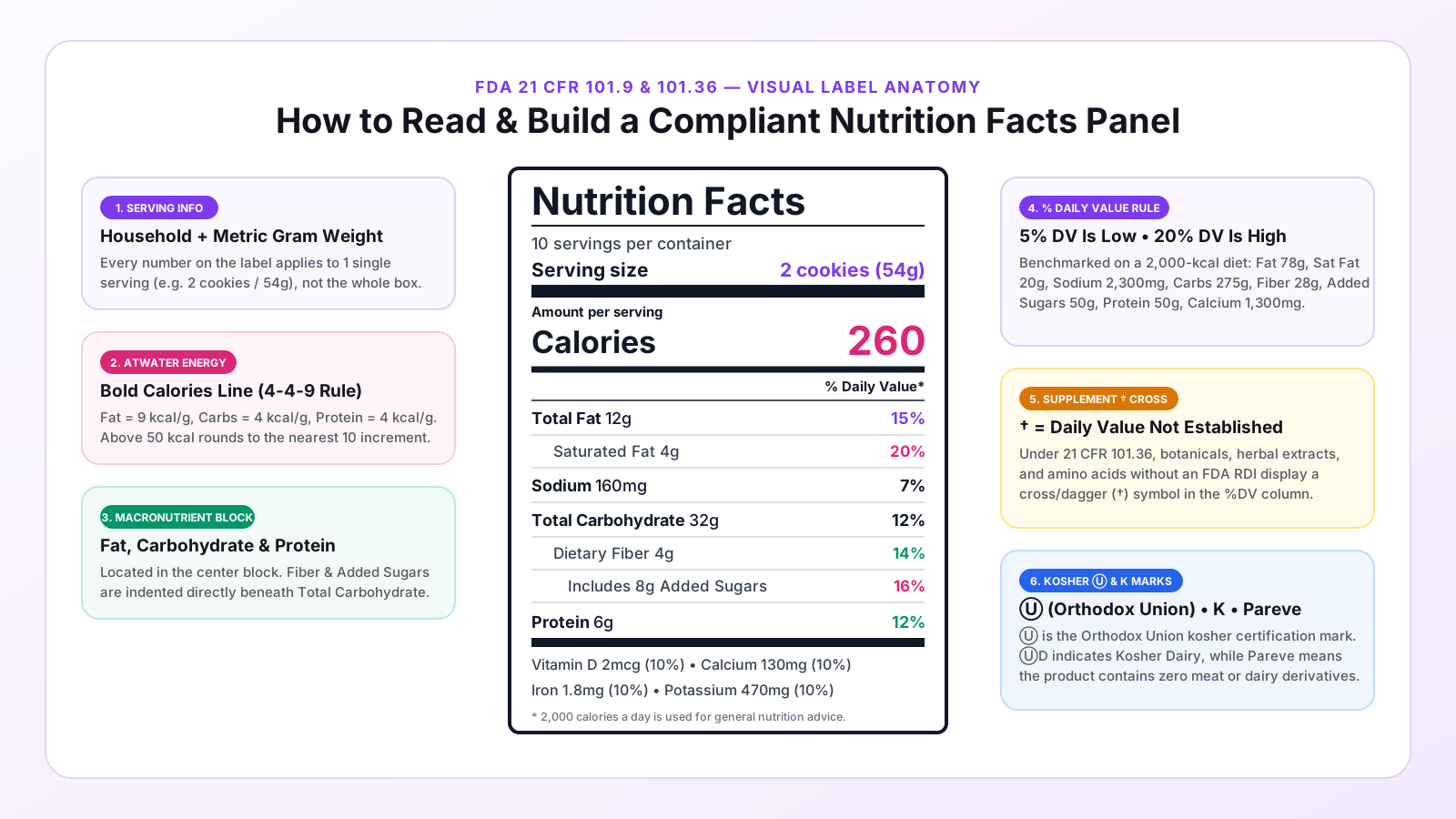
Understanding how to read a nutrition label begins at the very top of the panel. Every single calorie count, gram weight, and % Daily Value (%DV) printed on the label applies strictly to one single Serving Size—not the entire package, jar, or cereal box, unless you are reading the second column of a dual-column panel. If a bag of granola lists 4 servings per container at 240 Calories per serving, eating the whole bag supplies 960 Calories.
Right below the bold Calories line, where are macronutrients located on a food label? The three primary energy-yielding macronutrients are grouped in the central block: Total Fat (9 Calories per gram, with Saturated Fat and Trans Fat indented beneath it), Total Carbohydrate (4 Calories per gram, with Dietary Fiber, Total Sugars, and Added Sugars indented beneath it), and Protein (4 Calories per gram) at the bottom of the main section above the thick bar.
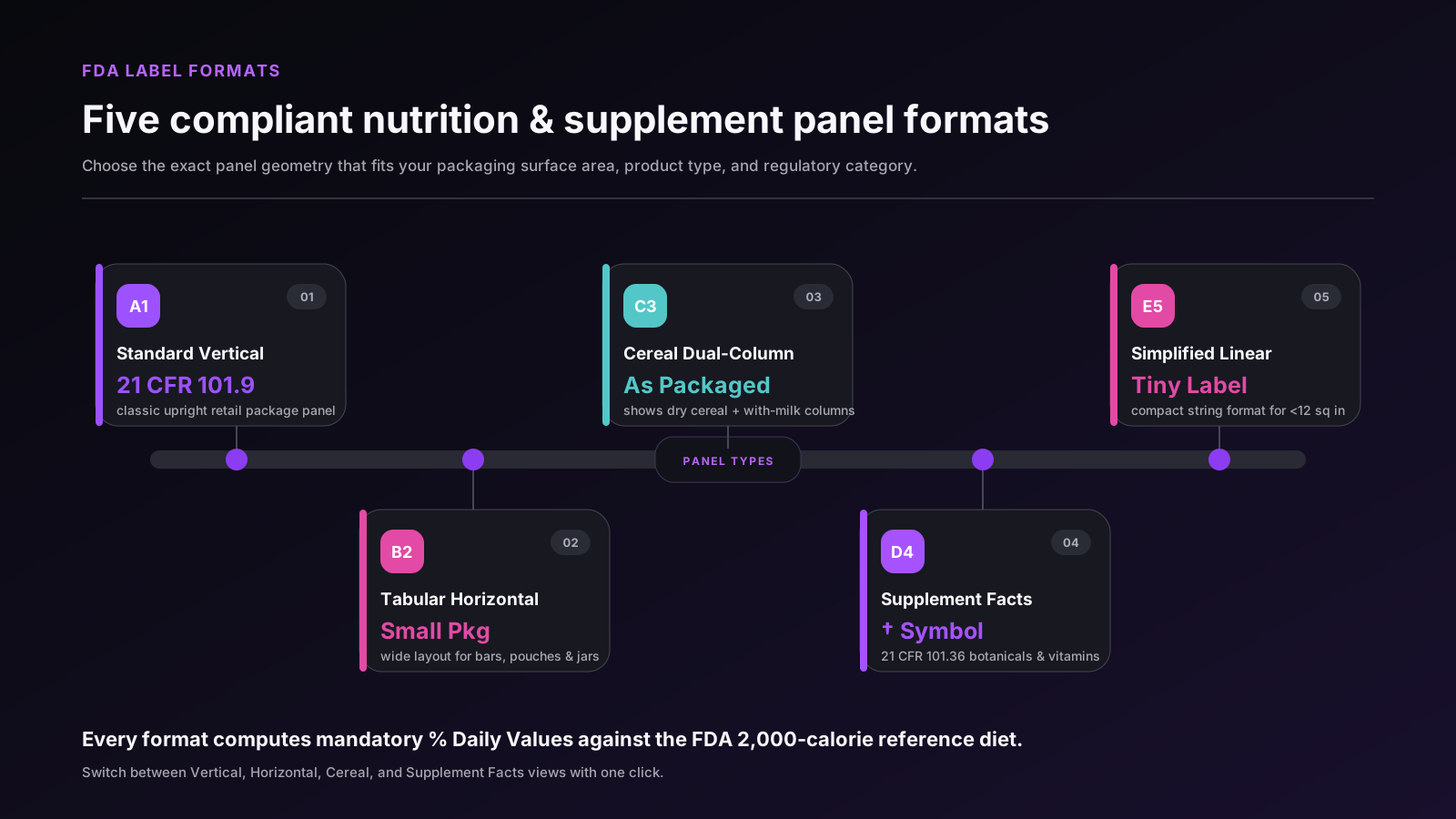
Our interactive label creator supports four distinct regulatory formats: Standard Vertical (for boxes, jars, and upright pouches), Tabular Horizontal (for smaller packages with limited vertical height), Cereal Dual-Column (showing both As Packaged dry cereal and Prepared with 1/2 cup skim milk), and Supplement Facts (21 CFR 101.36, which uses the dagger/cross symbol † to denote dietary ingredients without an established FDA Reference Daily Intake).
Worked FDA Label & Supplement Facts Calculations
See how our nutrition facts label creator computes % Daily Value, rounds calories, and applies Supplement Facts symbols:
126 fat kcal + 168 carb/protein kcal = 294 raw kcal, which rounds to 290 Calories under FDA >50 kcal 10-increment rules.
A cross/dagger (†) on a Supplement Facts panel indicates that the FDA has not established a Reference Daily Intake for that botanical or amino acid.
DIRECT ANSWERS & WORKED BENCHMARKS
Blank Nutrition Label Template, Cereal Box Format & Symbol Meanings (Ⓤ, K, †)
A blank nutrition label template is an editable, empty FDA 21 CFR 101.9 Nutrition Facts panel that lets students, teachers, and cottage food bakers fill in custom serving sizes, calories, and % Daily Values without starting from scratch in graphic design software. You can switch our generator above to 'Blank Printable Template' or 'Cereal Box Dual-Column' in one click and download a scalable SVG.
Worked Example: How to Read a Nutrition Facts Label on a 2-Serving Snack Bag
Suppose a bag of roasted almonds lists 'Servings per container: 2', 'Serving size: 1/4 cup (28g)', 'Calories: 160', 'Total Fat: 14g (18% DV)', 'Dietary Fiber: 3g (11% DV)', and 'Protein: 6g (12% DV)'. Because all numbers on an FDA label apply to a single 28g serving, eating the entire 2-serving bag doubles your intake to 320 Calories, 28g Total Fat (36% DV), 6g Fiber (22% DV — meeting the FDA ≥20% High Fiber threshold), and 12g Protein.
Quick-Answer Guide: Nutrition Label Templates, Formats & Packaging Symbols
| Label Template / Symbol Query | Direct Meaning & Regulatory Rule | Where It Appears on the Package | When to Use It |
|---|---|---|---|
| Blank Nutrition Label / Template | Empty 21 CFR 101.9 panel with standard bold rules and %DV lines | Back or side package panel | School projects, nutrition worksheets & custom packaging mockups |
| Cereal Box Nutrition Facts Label | Dual-column format showing 'Cereal Alone' vs. 'With 1/2 Cup Skim Milk' | Side panel of breakfast cereal boxes | Dry breakfast cereals, granola, and mix-in products |
| Cross / Dagger Symbol (†) | 'Daily Value (DV) not established' under FDA 21 CFR 101.36 | Right column of Supplement Facts panels | Botanicals, herbal extracts, amino acids, and probiotics |
| Circled U Symbol (Ⓤ / OU) | Orthodox Union Kosher certification trademark | Front lower corner or near ingredient list | Certified kosher foods (ⓊD = Kosher Dairy; Ⓤ Pareve = neutral) |
| K Symbol & Pareve | Rabbinical Kosher mark; Pareve means zero meat or dairy derivatives | Front panel or back ingredient block | Kosher-certified groceries, baked goods, and beverages |
| 5% / 20% Daily Value (%DV) Rule | ≤5% DV per serving is Low; ≥20% DV per serving is High | Right-hand %DV column of Nutrition Facts | Comparing sodium, saturated fat, added sugars, and fiber |
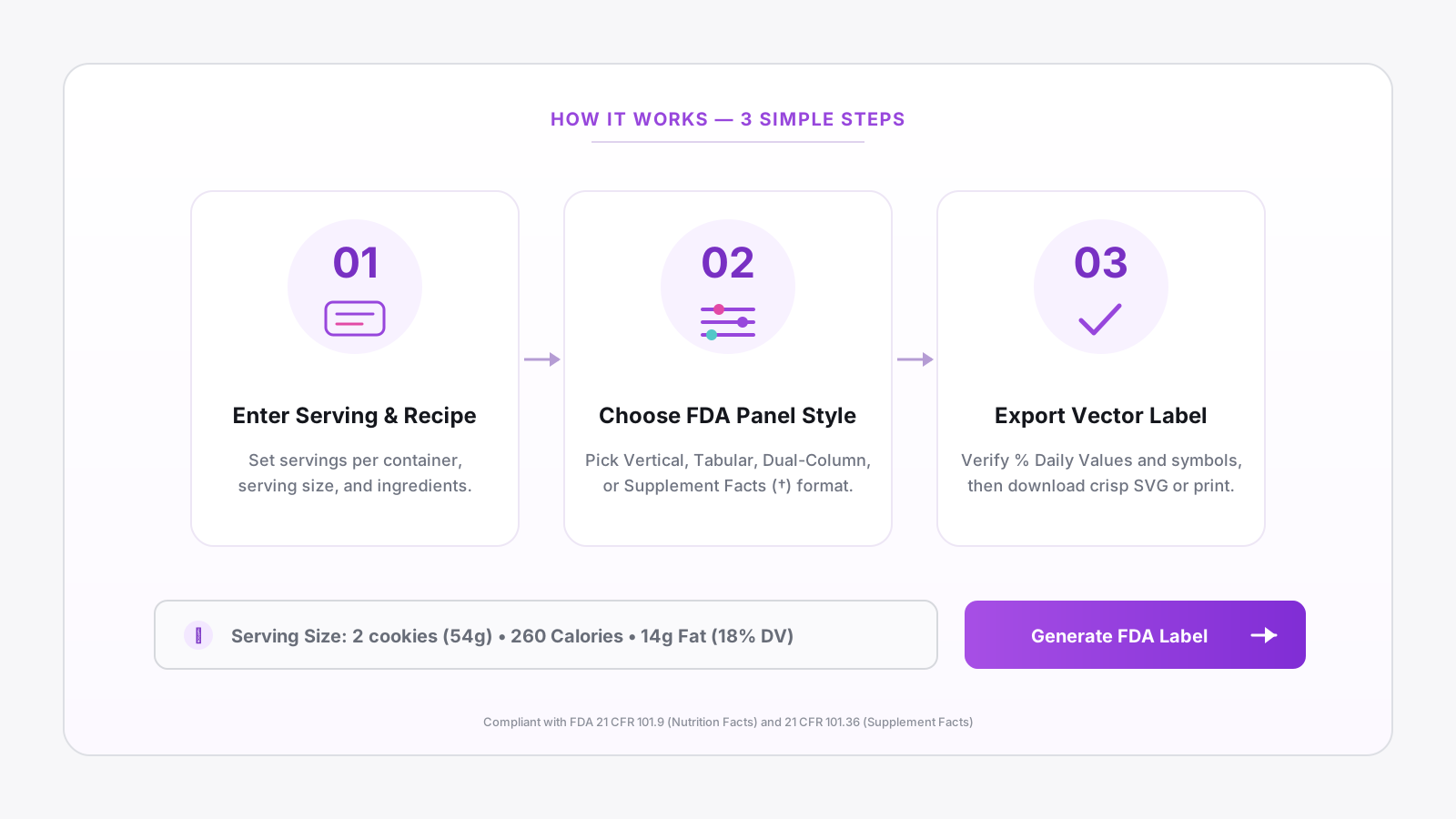
HOW IT WORKS — 3 SIMPLE STEPS
How Our FDA Nutrition Label Maker Works in 3 Simple Steps
No registration or paid subscription is required. Enter your recipe ingredients or nutrient values, select your panel geometry, and download a print-ready vector label.
Enter Recipe or Nutrient Weights
Type your product title, servings per container, and household serving size (e.g., '2 cookies (54g)'). Either paste your full recipe ingredient list to auto-compute nutrients from USDA data or enter gram and milligram values directly.
Select Your FDA Panel Format
Switch seamlessly between Standard Vertical, Tabular Horizontal, Cereal Box Dual-Column, or Supplement Facts (21 CFR 101.36). Toggle voluntary rows or kosher/allergen footnote badges as needed.
Verify %DV & Export Vector SVG
Review the automatically calculated % Daily Values, check which nutrients hit the 5% (Low) or 20% (High) FDA thresholds, and download a crisp vector SVG or print sheet.
Under FDA labeling rules, Serving Size is based on the Reference Amount Customarily Consumed (for example, 30g for cookies, 55g for bread, 240 mL for beverages)—not an arbitrary portion chosen to make calories look lower.
WHY THIS CALCULATOR IS DIFFERENT
What Makes Our Nutrition Facts Generator Different
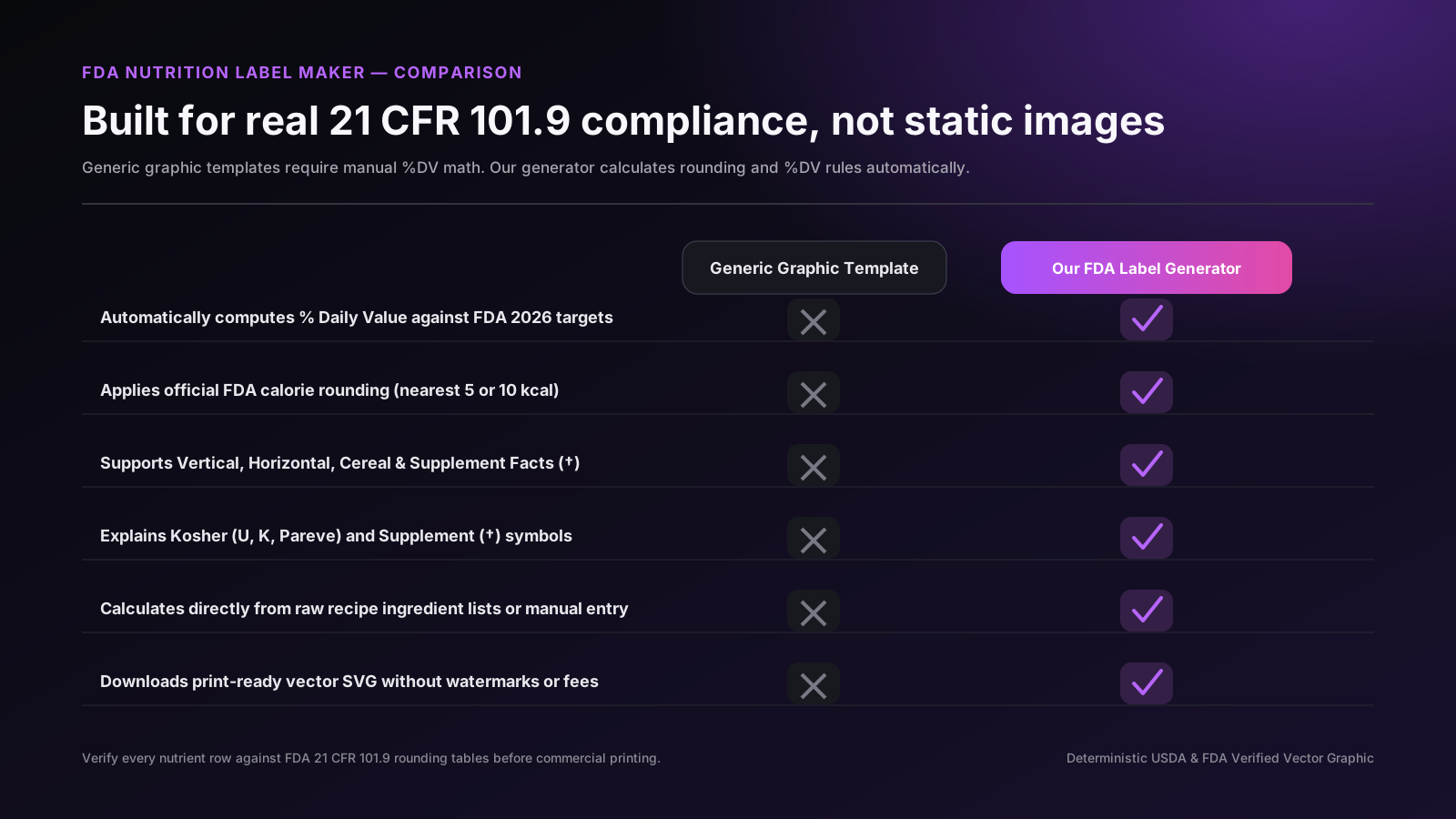
Static graphic design templates make you calculate % Daily Values and FDA rounding rules by hand. Our engine builds a mathematically verified panel in real time.
Automatic FDA 2026 % Daily Value calculation
Every gram of fat, carbohydrate, fiber, added sugar, and protein—plus milligrams of sodium, cholesterol, calcium, iron, and potassium—is automatically divided by its current FDA 2,000-calorie Daily Value.
Built-in FDA calorie & gram rounding logic
Applies 21 CFR 101.9 rounding rules automatically: calories under 5 round to 0, calories up to 50 round to the nearest 5 increment, and calories above 50 round to the nearest 10 increment.
Four compliant panel geometries in one tool
Generate Standard Vertical panels, Tabular Horizontal labels for small jars, Dual-Column Cereal Box templates, and 21 CFR 101.36 Supplement Facts panels without switching tools.
Full guide to food & supplement label symbols
Clearly explains what the circle-U (Ⓤ Orthodox Union), K, and Pareve Kosher symbols mean on food packaging, as well as the † (cross/dagger) symbol on Supplement Facts panels.
Recipe-to-Label ingredient parser included
Don't have lab results yet? Paste your recipe ingredients (flour, butter, sugar, eggs, oats, milk, meats) to compute per-serving nutrient weights directly from USDA reference profiles.
Watermark-free vector SVG & print export
Download scalable vector SVG files that stay razor-sharp at 300+ DPI in Adobe Illustrator, Canva, Affinity Designer, or thermal label printers.
VERIFIED CULINARY & NUTRITION METHODOLOGY
The Regulatory Science Behind FDA 21 CFR 101.9 & 101.36 Labels
The modern FDA Nutrition Facts label is governed by Title 21 of the Code of Federal Regulations, Part 101.9 (for conventional foods) and Part 101.36 (for dietary supplements). When the FDA updated the Nutrition Facts format, it increased the type size of Calories, Servings Per Container, and Serving Size, mandated the declaration of Added Sugars (with a 50g Daily Value), and updated the mandatory micronutrient footer to feature Vitamin D (20 mcg), Calcium (1,300 mg), Iron (18 mg), and Potassium (4,700 mg).
Percent Daily Value (%DV) shows how much a nutrient in a single serving of food contributes to a total daily diet of 2,000 calories. Dietitians and the FDA recommend the 5/20 Rule for quick label evaluation: 5% DV or less of a nutrient per serving is considered LOW (ideal for Saturated Fat, Sodium, and Added Sugars), while 20% DV or more per serving is considered HIGH (ideal for Dietary Fiber, Vitamin D, Calcium, Iron, and Potassium).
Packaging also carries third-party religious and regulatory marks outside the Nutrition Facts box. A 'U' inside a circle (Ⓤ) is the certification trademark of the Orthodox Union (OU), indicating the product is Kosher. A standalone 'K' indicates kosher certification by a supervising rabbi, while 'Pareve' (or Parve) means the food contains neither meat nor dairy derivatives. On Supplement Facts labels, a cross or dagger symbol (†) next to a botanical, herbal extract, or amino acid means 'Daily Value not established.'
What the deterministic engine verifies on every calculation
- Divides Total Fat (g) by 78g, Saturated Fat (g) by 20g, Cholesterol (mg) by 300mg, and Sodium (mg) by 2,300mg.
- Divides Total Carbohydrate (g) by 275g, Dietary Fiber (g) by 28g, Added Sugars (g) by 50g, and Protein (g) by 50g.
- Divides Vitamin D (mcg) by 20mcg, Calcium (mg) by 1,300mg, Iron (mg) by 18mg, and Potassium (mg) by 4,700mg.
- Rounds %DV to the nearest whole integer and flags nutrients meeting the ≤5% DV (Low) or ≥20% DV (High) rule.
- Formats Cereal Box dual-column panels with both As-Packaged and Prepared-with-Milk %DV columns.
- Applies the † footnote symbol automatically when switched to Supplement Facts (21 CFR 101.36) mode.
For cottage food producers and small food brands: recipe-calculated nutrition panels are accepted for most FDA-exempt small businesses and local retail markets, provided all ingredient weights and moisture losses are measured accurately.
MODES, FORMATS & BENCHMARKS
Five FDA Nutrition & Supplement Label Formats Compared
Packaging shape and regulatory category determine which label layout you should print. Our generator lets you preview and export all five industry-standard formats.
Standard Vertical Nutrition Facts (21 CFR 101.9)
The classic upright rectangular box required on food packages with more than 40 square inches of available label space.
Best for: Boxes, cartons, bottles, bags & jarsTabular Horizontal Format
A wide, side-by-side layout authorized for packages with 20 to 40 square inches of label space or shallow containers where a vertical panel will not fit.
Best for: Granola bars, shallow tubs & pouchesCereal Box Dual-Column Panel
Displays two side-by-side % Daily Value columns—one for dry cereal as packaged and a second for cereal prepared with 1/2 cup of skim milk.
Best for: Breakfast cereals, pancake mixes & dry goodsSupplement Facts Panel (21 CFR 101.36)
Required for vitamins, minerals, protein powders, and herbal supplements; groups RDI nutrients above a thick bar and non-RDI botanicals with a † symbol below.
Best for: Capsules, gummies, pre-workouts & botanicalsREAL-WORLD APPLICATIONS
Where Brands, Bakers & Educators Use Our Nutrition Label Maker
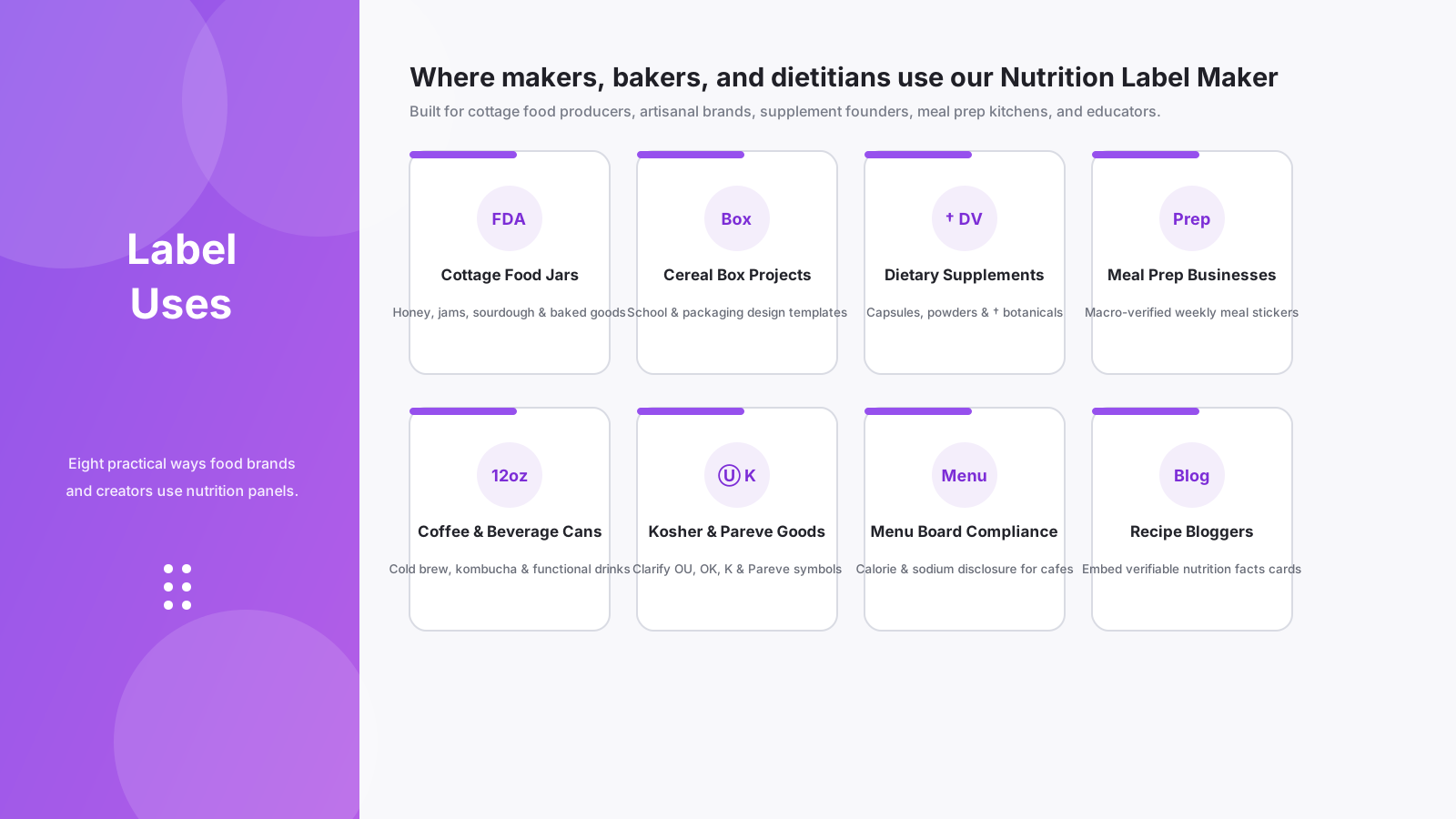
From farmers-market sourdough loaves and meal-prep containers to school cereal-box design projects and retail CPG launches, here are eight popular applications:
Cottage food & artisan bakery packaging
Create professional nutrition stickers for sourdough bread, cookies, jams, honey, and spice rubs sold at farmers markets or local grocers.
Cereal box nutrition facts templates
Generate authentic dual-column cereal box nutrition panels for graphic design portfolios, school book-report cereal boxes, and commercial cereal brands.
Dietary supplement & botanical labels
Build 21 CFR 101.36 Supplement Facts panels with accurate RDI percentages and † (Daily Value not established) footnotes.
Commercial meal prep & ghost kitchens
Print per-container calorie, protein, net carb, fat, and sodium labels for weekly macro-tracked meal prep deliveries.
Craft beverages, cold brew & kombucha
Format 12 fl oz and 16 fl oz beverage panels with precise Added Sugar %DV and zero-fat simplified declarations.
Kosher & allergen disclosure education
Teach culinary students and consumers how to interpret Ⓤ (Orthodox Union), K, Pareve, and major food allergen statements.
Restaurant menu board calorie compliance
Calculate per-serving calories, saturated fat, sodium, and carbohydrates for chain menu boards under FDA menu labeling rules.
Food bloggers & digital cookbook authors
Embed verified, high-trust FDA nutrition cards inside recipe posts and downloadable PDF cookbooks.
VERIFIED DATA BENCHMARKS
Master FDA Daily Value (%DV), Rounding & Symbol Reference Table
Use this official reference table to verify mandatory FDA 2,000-calorie Daily Values, rounding increments, 5%/20% thresholds, and packaging symbols:
| Nutrient / Label Symbol | FDA Daily Value (100% DV) | FDA Rounding Rule | 5% Low / 20% High Guidance |
|---|---|---|---|
| Calories (Energy) | 2,000 kcal reference | <5 kcal = 0; ≤50 round to 5; >50 round to 10 | 400 kcal per meal is moderate on a 2,000-kcal diet |
| Total Fat | 78 g | <0.5g = 0g; <5g round to 0.5g; ≥5g round to 1g | ≤3.9g is Low (≤5% DV); ≥15.6g is High (≥20% DV) |
| Saturated Fat | 20 g | <0.5g = 0g; <5g round to 0.5g; ≥5g round to 1g | ≤1.0g is Low (≤5% DV); ≥4.0g is High (≥20% DV) |
| Trans Fat | No DV established (0g goal) | <0.5g per serving may be declared as 0g | Check ingredient list for 'partially hydrogenated oils' |
| Cholesterol | 300 mg | <2mg = 0mg; 2–5mg = 'less than 5mg'; >5mg round to 5mg | ≤15mg is Low (≤5% DV); ≥60mg is High (≥20% DV) |
| Sodium | 2,300 mg | <5mg = 0mg; 5–140mg round to 5mg; >140mg round to 10mg | ≤115mg is Low (≤5% DV); ≥460mg is High (≥20% DV) |
| Total Carbohydrate | 275 g | <0.5g = 0g; <1g = 'less than 1g'; ≥1g round to 1g | Includes starch, dietary fiber, and total sugars |
| Dietary Fiber | 28 g | <0.5g = 0g; <1g = 'less than 1g'; ≥1g round to 1g | ≥2.8g (10% DV) Good Source; ≥5.6g (20% DV) High Fiber |
| Total Sugars | No DV established | <0.5g = 0g; ≥1g round to nearest 1g | Includes natural fruit/dairy sugars + added sugars |
| Added Sugars | 50 g | <0.5g = 0g; ≥1g round to nearest 1g | ≤2.5g is Low (≤5% DV); ≥10g is High (≥20% DV) |
| Protein | 50 g | <0.5g = 0g; <1g = 'less than 1g'; ≥1g round to 1g | ≥5g (10% DV) Good Source; ≥10g (20% DV) High Protein |
| Vitamin D | 20 mcg (800 IU) | Declared to nearest 0.1 mcg and whole %DV | ≥2 mcg (10% DV); ≥4 mcg (20% DV) |
| Calcium | 1,300 mg | Declared to nearest 10 mg and whole %DV | ≥130 mg (10% DV); ≥260 mg (20% DV) |
| Iron | 18 mg | Declared to nearest 0.1 mg and whole %DV | ≥1.8 mg (10% DV); ≥3.6 mg (20% DV) |
| Potassium | 4,700 mg | Declared to nearest 10 mg and whole %DV | ≥470 mg (10% DV); ≥940 mg (20% DV) |
| Ⓤ / K / Pareve Symbols | Kosher Certification Marks | Printed on front or back package panel | Ⓤ = Orthodox Union; K = Kosher; Pareve = No meat or dairy |
| † (Cross / Dagger Symbol) | Supplement Facts Footnote | 21 CFR 101.36 non-RDI ingredients | Indicates 'Daily Value (DV) not established' |
USEFUL TERMINOLOGY & SEARCH PHRASES
Other Names People Use for a Nutrition Label Maker
Depending on whether you are a food entrepreneur, graphic designer, dietitian, or student, you may see this tool described in several ways:
Nutrition facts generator
Builds an FDA-formatted Nutrition Facts panel from raw nutrient numbers or recipe ingredients.
Nutrition label creator
Lets small food brands design and download print-ready vertical or horizontal package panels.
Cereal box nutrition facts template
Produces the dual-column 'As Packaged' and 'With Skim Milk' format used on breakfast cereal boxes.
Supplement facts label maker
Generates a 21 CFR 101.36 panel for capsules, gummies, and powders using the † symbol.
Recipe nutrition calculator
Aggregates gram weights across multiple recipe ingredients to find per-serving calories and macros.
FDA %DV calculator
Computes Percent Daily Value against the official 2,000-calorie reference intake.
Kosher & food symbol guide
Explains front- and back-of-pack marks including Ⓤ, K, Pareve, and bioengineered disclosures.
CLIENT-SIDE PRIVACY & DATA SECURITY
How Your Proprietary Recipes & Label Data Are Handled
Food founders and cottage bakers often work with proprietary commercial formulations. Our Nutrition Label Maker runs 100% locally inside your browser:
- Your secret recipe ratios, ingredient weights, and product names never leave your device or get uploaded to an external database.
- No account signup, credit card, or email gate is required to generate or export vector SVG nutrition labels.
- All FDA %DV calculations and SVG vector rendering execute instantaneously in client-side JavaScript.
- Read our Privacy Policy and Cookies Policy for full details on site-wide analytics and zero-server recipe storage.
EXPERT KITCHEN & NUTRITION TIPS
Six Expert Tips for Creating Accurate Nutrition Facts Labels
Before sending your packaging artwork to a printer, run through these six regulatory and culinary checks:
Weigh the finished cooked batch
Baking and simmering evaporate water. Always divide total batch nutrients by the final cooked batch weight to get accurate per-gram density.
Match household and metric serving sizes
FDA labels require both a common household unit (e.g., '1/2 cup' or '2 cookies') and its exact metric weight in parentheses ('(114g)' or '(54g)').
Separate Total Sugars from Added Sugars
Pure maple syrup, honey, and cane sugar count as Added Sugars (50g DV), whereas lactose in unsweetened milk and fructose in whole fruit count only toward Total Sugars.
Check the 4-4-9 calorie consistency
Verify that (Fat g × 9) + (Total Carb g × 4) + (Protein g × 4) closely matches your declared Calories (accounting for insoluble fiber subtraction if applicable).
Use Tabular Horizontal on small jars
If your jar or bar wrapper has less than 40 square inches of printable area, switch to the Horizontal Tabular format so type sizes remain legible.
Export in SVG for commercial printing
Always use our Vector SVG download rather than a screenshot so hairline rules and 6pt–8pt FDA footnotes print crisply at 300+ DPI.
FDA 21 CFR 101.9 TEMPLATES, SYMBOLS & CEREAL / SUPPLEMENT PANELS
Nutritional Information Label Maker: Blank Templates, Cereal Labels & Food Symbols
Our free nutritional information label maker and nutrition facts label generator (also searched as a food nutrition facts label creator, nutritional label generator, food nutrition label maker, or nutrition fact label maker) builds print-ready panels for cottage food bakers, meal-prep kitchens, and CPG startups. You can export a blank nutrition facts label (blank nutrition label, blank nutrition food label, or nutrition facts blank) or use our nutrition facts label template free (nutrition facts template free, nutrition label template free, nutrition chart template, nutritional information template, and nutritional panel template) to make nutrition label free online.
| Label Format / Symbol Question | FDA Regulatory Standard (21 CFR 101.9 / 101.36) | How to Read & Apply on Packaged Foods |
|---|---|---|
| Where are the macronutrients located on a nutritional label? | Center section directly below the thick bar under Calories | When learning how to read nutrition facts label (or nutritonal facts), the three macronutrients are Total Fat (top), Total Carbohydrate (middle), and Protein (bottom of the macro block). |
| What does a cross on a nutrition label mean? (What does the cross on supplement facts mean?) | The dagger or cross symbol (†) means Daily Value (DV) Not Established | Used in a supplement facts label generator (or when you create supplement facts label) and on standard panels beside Trans Fat, Total Sugars, or botanical extracts that have no FDA Reference Daily Intake. |
| What does a circled U on food labels mean? | The circled U (Ⓤ) is the Orthodox Union (OU) Kosher certification mark | Indicates the product and its ingredient label maker declaration meet kosher inspection standards (Ⓤ-D indicates Dairy; Ⓤ-Pareve indicates neither meat nor dairy). |
| Cereal nutrition labels & food labels for cereal | Dual-column format showing Cereal Alone vs. With 1/2 Cup Skim Milk | Per FDA RACC tables, the standard portion size of cereal is 30g to 40g (~3/4 to 1 cup) for medium-weight flakes or puffs, and 55g (~1/2 cup) for dense granola. |
| Horizontal nutritional facts & Blank supplement facts label (FDA nutrition label generator) | 21 CFR 101.9(d)(11) Tabular (Horizontal) & Linear Formats for packages with <40 sq in of label space | Use our fda nutrition label generator (nutrition fact generator, nutrition facts maker, make food nutrition label, create nutrition label free, or nutrtional fact maker) to export a blank nutrition facts template, blank nutrition facts label template, empty nutrition label, or nutritional info template. |
| How to calculate nutrition facts for homemade food (How do you make a nutrition facts label?) | Sum USDA gram weights for all raw ingredients, divide by total servings, and apply FDA rounding | Whether you want to make nutrition label, create nutrition label, how to make a nutrition label, nutrition fact label generator, generate nutrition label, or how to make nutrition chart with our food label generator (nutrition label creater), enter your batch ingredients above and divide by finished portions. |
AUTHORITATIVE SOURCES & REFERENCES
Primary USDA, FDA & Scientific Sources
- FDA 21 CFR § 101.9 — Nutrition Labeling of Conventional Foods — Official federal rules for serving sizes, mandatory nutrients, %DV reference values, and rounding increments.
- FDA 21 CFR § 101.36 — Nutrition Labeling of Dietary Supplements (Supplement Facts) — Federal rules governing Supplement Facts panels and the † (Daily Value not established) symbol.
- USDA FoodData Central — Standard Reference & Foundation Foods — Primary nutrient database used to estimate recipe calories, macronutrients, and micronutrients.
How to Use the FDA Nutrition Label Maker & Supplement Facts Generator (Step-by-Step Workflow)
Scaling recipes, generating FDA-compliant nutrition facts labels, and converting between volume (cups, tablespoons, fluid ounces) and weight (grams, dry ounces, pounds) requires accounting for ingredient density and cooking moisture loss. Follow these four steps:
- Enter Your Original Yield & Ingredients: Input the recipe's current number of servings (the yield) and paste or select your ingredient list in standard kitchen units (cups, tbsp, tsp, oz, lbs, cans, or grams).
- Select Your Conversion Factor or Baking Pan Ratio: Click a quick preset (
1/2x Cut in Half,1/3x,2x Double,3x Triple), type your desired target servings, or use the Baking Pan Size Converter to scale by pan surface area. - Verify Kitchen Fractions & Gram Equivalents: Review both the rounded culinary fraction (such as converting
0.375 cupsinto6 tbsp) and the density-adjusted metric gram weight for precision on a digital kitchen scale. - Generate Labels, Macros, or Catering Lists & Export: Star your favorite calculations to local browser storage or export your scaled recipe, nutrition panel, or food cost breakdown as a
.txt,.csv, or.jsonfile.
Who This Tool Is For: Practical Kitchen, Nutrition & Food Business Use Cases
Different culinary tasks require different mathematical rules. Halving a cake batter involves pan area geometry, whereas tracking macros for fat loss requires raw-to-cooked weight conversion and the 4-4-9 Atwater energy formula:
- Home Cooks & Bakers Scaling Recipes: Use the Recipe Converter & Doubler and Kitchen Unit Converter to halve, double, or triple recipes and convert between ounces, cups, tablespoons, and metric grams without awkward decimal measurements.
- Cottage Food Bakers, Meal Preppers & Supplement Brands: Use the FDA Nutrition Facts & Supplement Label Maker to generate vertical, horizontal/tabular, dual-column cereal box, and supplement facts panels with automatic
% Daily Value (%DV)calculations. - Fitness, Weight-Loss & Macro Trackers: Use the Recipe Calorie, Macro & TDEE Calculator and Visual Portion Size Guide to calculate homemade food calories, net carbs, 4-4-9 macro splits, and visual hand comparisons (such as what 4 oz of chicken or 3 oz of steak looks like).
- Holiday Hosts, Event Planners & BBQ Caterers: Use the Meat Per Person & Thanksgiving Turkey Calculator to determine exact raw purchase weights for 10 to 100+ guests across whole turkey, pulled pork, brisket, ribs, ribeye steak, chicken breasts, and deli cold cuts.
- Restaurant Chefs, Custom Cake Bakers & Households: Use the Food Cost, Cake Pricing & Grocery Budget Calculator to compute recipe food cost percentage (28%–33% target), custom wedding cake pricing, and USDA monthly grocery budgets.
The Science Behind Our Calculators: USDA Densities, Atwater 4-4-9 & FDA 21 CFR 101.9
Every calculator on Recipe Calculator Pro uses verified reference constants from USDA FoodData Central and U.S. Food and Drug Administration (FDA 21 CFR 101.9) Nutrition Labeling Standards:
- Fluid Ounces (Volume) vs. Avoirdupois Ounces (Weight): A fluid ounce (
fl oz) measures volume (1 fl oz = 2 tablespoons = 29.57 mL;8 fl oz = 1 US cup;32 fl oz = 4 cups). A dry ounce (oz) measures mass (1 oz = 28.35 grams;16 oz = 1 pound). Because dry ingredients have different bulk densities, 1 cup of all-purpose flour weighs 4.25 oz (120g), 1 cup of chocolate chips weighs 6 oz (170g), and 1 cup of peanut butter weighs 9.1 oz (258g). - The Atwater 4-4-9 Macronutrient Energy System: Dietary energy (kilocalories) is determined by macronutrient oxidation: 1 gram of Protein = 4 kcal, 1 gram of Carbohydrate = 4 kcal, 1 gram of Fat (Lipids) = 9 kcal (making fat the most energy-dense macronutrient), and 1 gram of Alcohol = 7 kcal. Dietary fiber and sugar alcohols are subtracted from total carbohydrates when computing net carbs.
- Raw-to-Cooked Moisture & Fat Retention Yields: Meat, poultry, and fish lose approximately 20% to 25% of their raw weight as water and rendered fat during cooking. Consequently, 4 oz of raw boneless chicken breast or steak (113g) yields ~3 oz cooked (85g), while dry grains like rice and oats absorb water and expand to 2.5x–3.0x their dry weight.
Common Kitchen Calculation Mistakes vs. Verified Culinary Math
| Kitchen Task | Common Mistake (Before) | Verified Calculation (After) | Culinary / Nutritional Reason |
|---|---|---|---|
| 4 oz Chocolate Chips to Cups | 1/2 cup (confusing weight oz with 8 fl oz cup) | 2/3 cup (113g) | 1 US cup of chocolate chips weighs 6 oz (170g), so 4 oz by weight is 4/6 = 2/3 cup. |
| Weighing Chicken or Rice for Macros | Logging 4 oz cooked chicken as 4 oz raw entry | 4 oz cooked = 5.3 oz raw (35g protein) | Chicken loses ~25% water weight when cooked, concentrating protein from 22.5g/100g raw to 31g/100g cooked. |
| Menu Pricing at 30% Food Cost | Adding 30% markup ($4.50 × 1.30 = $5.85) | $4.50 ÷ 0.30 = $15.00 Menu Price | Food Cost % equals Ingredient Cost divided by Menu Selling Price, leaving 70% gross margin for labor and overhead. |
| BBQ Pulled Pork for 20 Guests | Buying 10 lbs raw pork butt for 10 lbs cooked | 15–16 lbs raw butt → ~8.5 lbs cooked | Pork shoulder loses ~45% weight to bone, fat rendering, and bark evaporation during smoking. |
FDA NUTRITION & SUPPLEMENT LABEL FAQS
Frequently Asked Questions About Nutrition Facts Labels
How to read nutrition facts label step by step?
Start at the top with Servings Per Container and Serving Size (shown in a household measure like '2/3 cup' and metric grams like '55g'), because every calorie and nutrient number below applies strictly to 1 single serving. Next, check Calories per serving, then scan the middle macronutrient block (Total Fat, Saturated Fat, Total Carbohydrate, Dietary Fiber, Added Sugars, and Protein) and use the % Daily Value (%DV) column on the right—where 5% DV or less is Low and 20% DV or more is High.
Where can I get a blank nutrition label or free nutrition label template?
Select the 'Blank Printable Template' button at the top of our Nutrition Label Maker above to generate an empty, standard FDA 21 CFR 101.9 Nutrition Facts template with official bold rules and %DV rows. You can print it directly or download a scalable vector SVG for school worksheets, packaging mockups, or handwritten recipe cards.
Where are macronutrients located on a food label?
On an FDA Nutrition Facts panel, the three energy-yielding macronutrients are located in the main central section directly below the thick bar under Calories: Total Fat is at the top of that block, Total Carbohydrate is in the middle (with Dietary Fiber, Total Sugars, and Added Sugars indented beneath it), and Protein is at the bottom of the block just above the thick bar separating micronutrients.
What does a cross (†) on a nutrition label or Supplement Facts panel mean?
Under FDA regulation 21 CFR 101.36, a cross or dagger symbol (†) in the % Daily Value column of a Supplement Facts label means 'Daily Value (DV) not established.' It is required for dietary supplement ingredients—such as botanicals, herbal extracts, amino acids, or CoQ10—that do not have an official government Reference Daily Intake.
What does the 'U' inside a circle (Ⓤ), 'K', or 'Pareve' mean on food labels?
A capital 'U' inside a circle (Ⓤ) is the kosher certification trademark of the Orthodox Union (OU). 'ⓊD' indicates the item is Kosher Dairy, a standalone 'K' indicates kosher supervision by a certifying rabbi, and 'Pareve' (or Parve) means the product contains no meat, poultry, or dairy derivatives.
How do I create a cereal box nutrition facts label with two columns?
Click the 'Cereal Dual-Column' format pill in our generator above. It builds the official breakfast cereal layout showing one % Daily Value column for dry cereal as packaged and a second column showing the combined nutrition when prepared with 1/2 cup (120 mL) of skim milk.
How does a nutrition chart maker calculate % Daily Value (%DV)?
Our nutrition chart maker divides each nutrient's per-serving weight by the official FDA 2,000-calorie Daily Reference Value and rounds to the nearest whole percent: Total Fat ÷ 78g, Saturated Fat ÷ 20g, Cholesterol ÷ 300mg, Sodium ÷ 2,300mg, Total Carbohydrate ÷ 275g, Dietary Fiber ÷ 28g, Added Sugars ÷ 50g, Protein ÷ 50g, Vitamin D ÷ 20mcg, Calcium ÷ 1,300mg, Iron ÷ 18mg, and Potassium ÷ 4,700mg.
Is the output from a free nutrition label generator FDA-approved for retail sale?
The FDA does not pre-approve individual food labels before products go to market; manufacturers and cottage-food producers are responsible for ensuring their panel complies with 21 CFR 101.9. Recipe-calculated nutrition panels using USDA FoodData Central databases are widely accepted for standard retail and small-business exemptions, though clinical medical foods or formal nutrient content claims should be verified by an accredited lab.
Create Your Nutrition Facts Label Template
You have seen how FDA 21 CFR 101.9 rounding rules, % Daily Values, cereal box dual-column panels, blank templates, and Supplement Facts (†) symbols work. Enter your recipe ingredients or nutrient gram weights above to generate your label.
Switch between Vertical, Tabular Horizontal, Cereal Dual-Column, Blank Printable Template, and Supplement Facts views and export a crisp SVG.
Build Nutrition Label Now