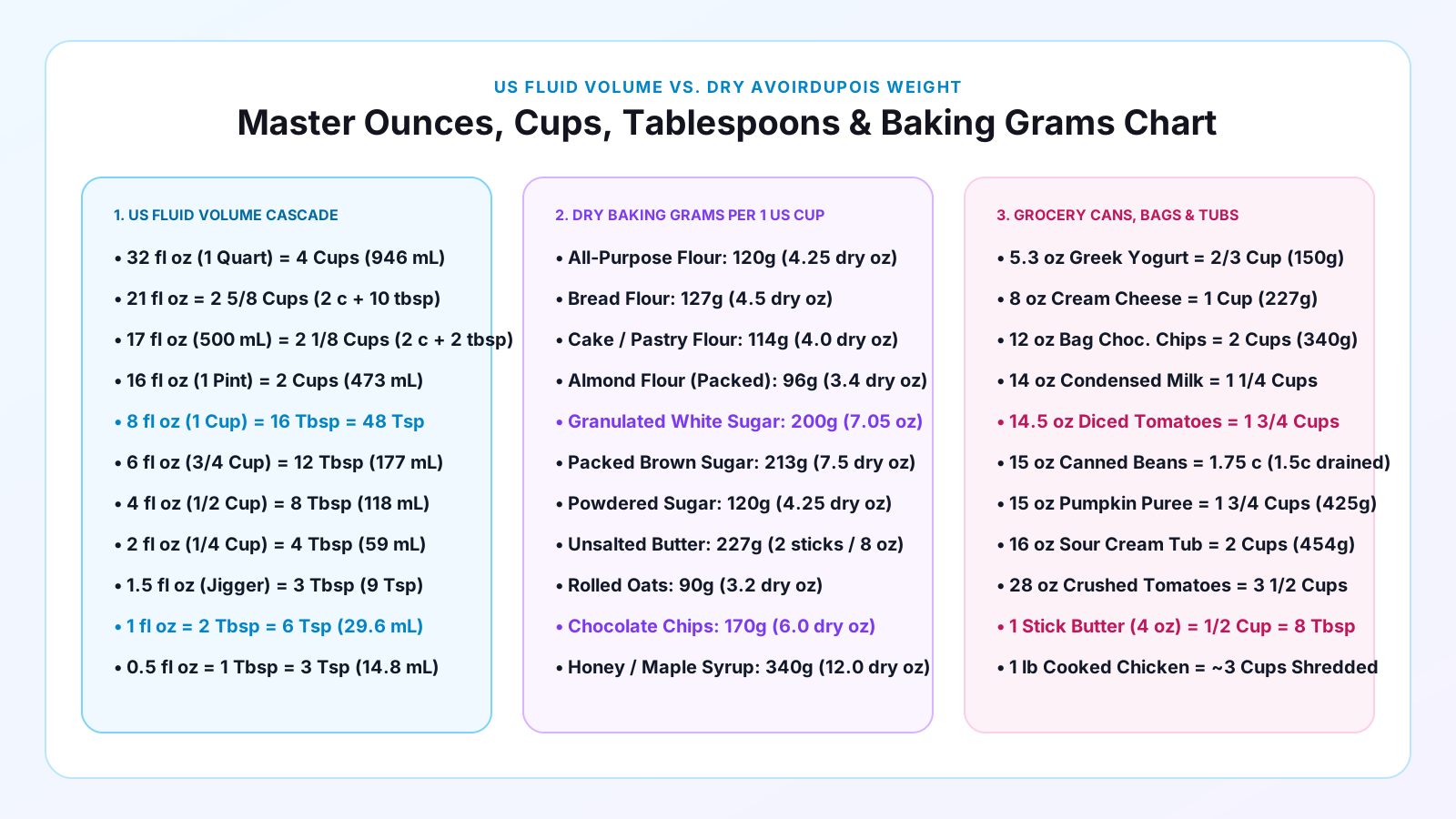
32 fl oz = 4 cups (946 mL); 17 fl oz = 2.125 cups (2 c + 2 tbsp = 503 mL); 21 fl oz = 2.625 cups (2 c + 10 tbsp = 621 mL).
OUNCES ⇄ CUPS ⇄ TABLESPOONS ⇄ GRAMS • FLUID VS. DRY DENSITY
Kitchen Unit Converter: Ounces, Cups, Tbsp & Grams
Convert between fluid ounces (fl oz), dry weight ounces (oz), US cups, tablespoons, teaspoons, milliliters, pounds, and grams using true USDA ingredient densities.
4 US Cups (4 cups) · 64 Tbsp
Instant Kitchen Conversion Lookup (Click Any Card to Load in Calculator)
COMPLETE FLUID OZ, DRY WEIGHT OZ, CUPS, TBSP & GRAMS GUIDE
What Is a Kitchen Unit Converter & How Do Ounces, Cups & Tbsp Convert?
Whether you are asking 'how many cups is 32 oz, 17 oz, or 21 oz', 'how many tablespoons in 1.5 oz or 2 oz', or 'how many cups in a 14.5 oz can or 5.3 oz yogurt', our culinary unit converter separates fluid volume from dry ingredient weight.
A kitchen unit converter—commonly searched as an oz to cups converter, fluid ounces to tablespoons calculator, cups to grams baking converter, or can size to cups chart—bridges the two measurement systems used in modern kitchens: US Customary Volume (cups, fluid ounces, tablespoons, teaspoons, pints, quarts, gallons) and Weight/Mass (dry ounces, pounds, grams, kilograms). The single biggest trap in home cooking is the word 'ounce', which can refer either to 1 US fluid ounce of volume (29.57 mL) or 1 avoirdupois ounce of weight (28.35 grams).
For water and thin liquids (milk, broth, coffee, juice, vinegar), 1 US cup equals exactly 8 fluid ounces (8 fl oz = 16 tablespoons = 48 teaspoons = 236.59 mL). That makes liquid ounce-to-cup math straightforward: divide fluid ounces by 8 to get cups, or multiply fluid ounces by 2 to get tablespoons. Thus, 32 fl oz equals 4 cups (1 quart), 17 fl oz equals 2 1/8 cups (2 cups + 2 tbsp), 21 fl oz equals 2 5/8 cups (2.625 cups = 2 cups + 10 tbsp), 1.5 fl oz equals 3 tablespoons, and 2 fl oz equals 4 tablespoons (1/4 cup).
For dry baking ingredients, however, dry weight ounces (oz) do NOT equal fluid ounces (fl oz) because every dry ingredient has a different bulk density (grams per cup). One US cup (8 fl oz of volume) holds only 4.25 dry ounces (120 grams) of spooned-and-leveled all-purpose flour, 3.2 dry ounces (90 grams) of rolled oats, 6.0 dry ounces (170 grams) of chocolate chips, 7.05 dry ounces (200 grams) of granulated sugar, and 12.0 dry ounces (340 grams) of honey!
Our interactive converter solves both sides at once: you can convert pure volumetric units (fl oz, cups, tbsp, tsp, mL, pints, quarts) OR select from 25+ specific kitchen ingredients—plus common grocery containers like a 14.5 oz can of diced tomatoes (1 3/4 cups), a 15 oz can of beans (1 3/4 cups total / 1.5 cups drained), a 28 oz can of crushed tomatoes (3 1/2 cups), a 12 oz bag of chocolate chips (2 cups), or a 5.3 oz single-serve Greek yogurt cup (2/3 cup / 150g).
Worked Ounce, Cup, Tablespoon & Container Conversions
See how our converter handles the most frequently searched liquid, dry, and grocery-container conversions:
Every 1 US fluid ounce equals 2 tablespoons (6 teaspoons / 29.57 mL). A standard 1.5 fl oz jigger equals exactly 3 tablespoons.
A 14.5 oz can of tomatoes/broth holds ~1 3/4 cups (411g); a 5.3 oz (150g) Greek yogurt cup holds 2/3 cup (~10.6 tbsp).
DIRECT ANSWERS & WORKED BENCHMARKS
How to Use a Kitchen Scale & Quick-Answer Ounces to Cups / Tbsp Tables
To use a digital kitchen scale, place your empty mixing bowl on the platform, press the 'Tare' (or 'Zero') button so the screen reads 0g, and pour in your first ingredient until you reach the target gram weight; press 'Tare' again to reset to 0g before adding the next ingredient into the same bowl. For liquid volume conversions without a scale, remember two core rules: 1 US fluid ounce equals 2 tablespoons (6 teaspoons), and 8 fluid ounces equal 1 US cup (so 32 oz is 4 cups, 17 oz is 2 1/8 cups, and 21 oz is 2 5/8 cups).
Worked Example: Converting 17 oz, 21 oz, 32 oz, 0.75 Cup & 9 Tbsp
To convert any fluid ounce measurement into US cups, divide by 8 (and multiply any decimal remainder by 16 to get tablespoons): 32 fl oz ÷ 8 = 4 cups; 17 fl oz ÷ 8 = 2.125 cups (2 cups + 2 tablespoons); 21 fl oz ÷ 8 = 2.625 cups (2 cups + 10 tablespoons); 36 fl oz ÷ 8 = 4.5 cups; 46 fl oz ÷ 8 = 5.75 cups; and 50 fl oz ÷ 8 = 6.25 cups. Going from tablespoons to fluid ounces, divide tablespoons by 2: 1.5 tbsp = 0.75 fl oz; 3 tbsp = 1.5 fl oz; 5 tbsp = 2.5 fl oz; 7 tbsp = 3.5 fl oz; and 9 tbsp = 4.5 fl oz (1/2 cup + 1 tbsp). Meanwhile, 0.75 cup (3/4 cup) equals 6 fl oz (12 tablespoons).
Quick-Answer Numeric Lookup: Ounces to Cups & Tablespoons to Ounces
| Exact Search Conversion | US Cups Equivalent | Tablespoons & Teaspoons | Fluid Ounces (fl oz) | Milliliters (mL) |
|---|---|---|---|---|
| How many tbsp is an ounce (1 fl oz) | 1/8 cup (0.125 cup) | 2 tablespoons (6 tsp) | 1.0 fl oz | 29.6 mL |
| 1.5 tbsp to oz / 3 tbsp how many oz | 1.5 tbsp = 3/32 c • 3 tbsp = 3/16 c | 1.5 tbsp (4.5 tsp) • 3 tbsp (9 tsp) | 0.75 fl oz • 1.5 fl oz | 22.2 mL • 44.4 mL |
| 5 tbsp to oz / 7 tablespoons to oz | 5 tbsp = 5/16 c • 7 tbsp = 7/16 c | 5 tbsp (15 tsp) • 7 tbsp (21 tsp) | 2.5 fl oz • 3.5 fl oz | 73.9 mL • 103.5 mL |
| 9 tbsp to oz (9 tablespoons) | 9/16 cup (1/2 cup + 1 tbsp) | 9 tablespoons (27 tsp) | 4.5 fl oz | 133.1 mL |
| 0.75 cup to oz (75 cup to oz) | 3/4 cup (0.75 cup) | 12 tablespoons (36 tsp) | 6.0 fl oz (weight varies) | 177.4 mL |
| 13.5 oz to cups / 14.5 oz to cups | 13.5 oz = 1.69 c • 14.5 oz = 1 3/4 c | 27 tbsp • 29 tbsp | 13.5 fl oz • 14.5 fl oz | 399 mL • 429 mL |
| 17 oz to cups (17 ounces to cups) | 2 1/8 cups (2.125 cups) | 34 tbsp (2 cups + 2 tbsp) | 17.0 fl oz | 502.8 mL |
| 20 oz to cups / 21 oz to cups | 20 oz = 2 1/2 c • 21 oz = 2 5/8 c | 40 tbsp • 42 tbsp (2c + 10 tbsp) | 20.0 fl oz • 21.0 fl oz | 591.5 mL • 621.0 mL |
| 32 oz is how many cups (32 fl oz) | 4 US cups (1 US quart) | 64 tablespoons (192 tsp) | 32.0 fl oz | 946.4 mL |
| 35 ounces to cups / 36 ounces to cups | 35 oz = 4 3/8 c • 36 oz = 4 1/2 c | 70 tbsp • 72 tbsp | 35.0 fl oz • 36.0 fl oz | 1,035 mL • 1,065 mL |
| 46 oz to cups / 50 oz to cups | 46 oz = 5 3/4 c • 50 oz = 6 1/4 c | 92 tbsp • 100 tbsp | 46.0 fl oz • 50.0 fl oz | 1,360 mL • 1,479 mL |
| 5.3 oz of yogurt is how many cups | ~2/3 cup (0.61–0.66 cup) | 10 tablespoons + 2 teaspoons | ~5.3 fl oz volume | 150 g net weight |
| 16 ounces of sour cream is how many cups | 2 full US cups (1 pint tub) | 32 tablespoons | 16.0 fl oz volume | 454 g (1 lb tub) |
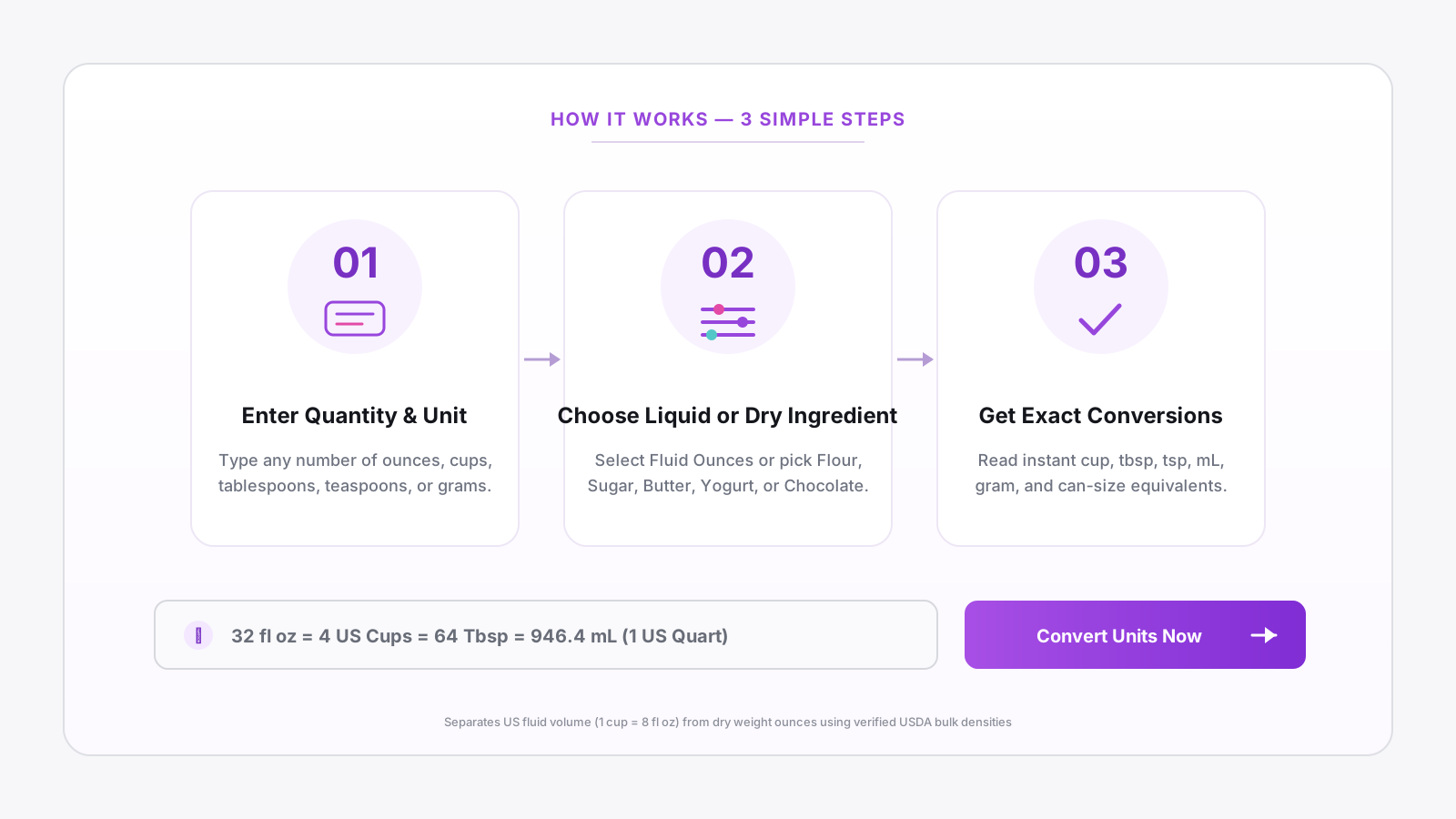
HOW IT WORKS — 3 SIMPLE STEPS
How Our Kitchen Unit Converter Works in 3 Simple Steps
Convert between US cups, fluid ounces, tablespoons, teaspoons, milliliters, dry ounces, pounds, and grams in real time.
Enter Your Quantity & Unit
Type any measurement value (such as 32, 21, 17, 14.5, 5.3, 1.5, or 0.75) and select your starting unit (fl oz, dry oz, cup, tbsp, tsp, g, mL, or lb).
Pick Liquid or Specific Ingredient
Keep 'Water / Standard Liquid (1 fl oz = 29.57 mL)' for pure volume, or choose All-Purpose Flour, Sugar, Butter, Chocolate Chips, Oats, Honey, or Greek Yogurt.
Read All Equivalent Units
View the complete conversion grid showing clean kitchen fractions (cups + tablespoons), exact decimals, milliliters, grams, and container equivalents.
Scooping a measuring cup directly into a flour bag compacts the flour and can pack 150g–160g into a single cup instead of the standard 120g—adding 30% extra flour to your dough.
WHY THIS CALCULATOR IS DIFFERENT
What Makes Our Culinary Unit Converter Different
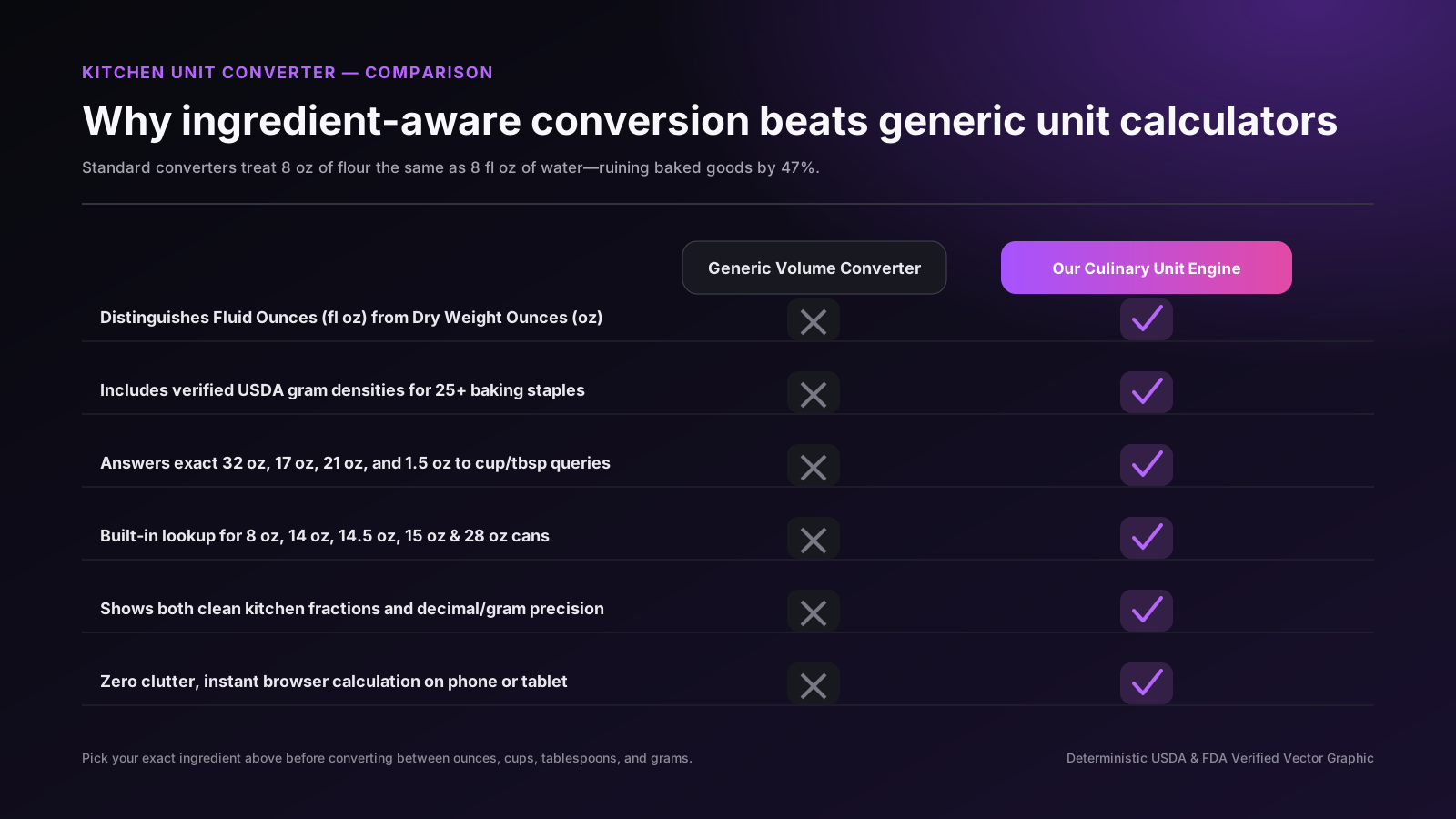
Generic unit converters treat dry ounces and fluid ounces as identical. Ours is built specifically for real kitchen ingredients and grocery package sizes.
Separates Fluid Ounces (fl oz) from Dry Weight Ounces (oz)
Prevents the classic baking mistake of measuring 8 dry ounces of flour in an 8 fl oz liquid Pyrex jug (which yields nearly 2 cups of flour instead of 1 cup!).
Verified USDA bulk densities for 25+ ingredients
Includes exact grams-per-cup densities for all-purpose flour (120g), bread flour (127g), cake flour (114g), powdered sugar (120g), brown sugar (213g), and cocoa (85g).
Direct answers for 32 oz, 21 oz, 17 oz & 1.5 oz queries
Displays both decimal cups (e.g., 2.625 cups for 21 fl oz) and practical kitchen spoon combinations (2 cups + 10 tablespoons) so you can measure immediately.
Grocery can & tub size quick-lookup
Built-in benchmarks for 8 oz, 10.75 oz, 14 oz, 14.5 oz, 15 oz, and 28 oz cans, 5.3 oz and 32 oz yogurt tubs, and 12 oz chocolate chip bags.
Butter stick, tablespoon & gram cross-reference
Converts seamlessly between US butter sticks (1 stick = 1/2 cup = 8 tbsp = 4 oz = 113.4g) and European gram recipes.
Clean kitchen fractions + metric precision
Outputs both human-friendly fractions (1/4, 1/3, 1/2, 2/3, 3/4) and 0.1-gram / 0.1-mL laboratory precision.
VERIFIED CULINARY & NUTRITION METHODOLOGY
The Physics of Bulk Density: Fluid Ounces vs. Dry Weight Ounces
Why does 1 US cup equal 8 fluid ounces, yet 1 US cup of all-purpose flour weighs only 4.25 dry ounces (120 grams)? Because a fluid ounce (fl oz) is a unit of spatial volume equal to 1/128th of a US liquid gallon (29.5735 milliliters), whereas a dry ounce (oz) is a unit of mass equal to 1/16th of an avoirdupois pound (28.3495 grams). Even for pure water at 4°C, 8 fluid ounces (236.59 mL) weighs 236.59 grams, which is 8.345 dry weight ounces—not 8.0 dry ounces!
For dry particulate ingredients like flour, oats, cocoa powder, and chocolate chips, air pockets between particles lower the bulk density (ρ = mass ÷ volume) well below water's 1.00 g/mL. Sifted cake flour has a bulk density of ~0.48 g/mL (114g per cup = 4.0 dry oz), rolled oats sit at ~0.38 g/mL (90g per cup = 3.17 dry oz), and semi-sweet chocolate chips sit at ~0.72 g/mL (170g per cup = 6.0 dry oz).
Conversely, dense syrups absorb zero air space and pack heavy sugar molecules into a small volume: 1 US cup (8 fl oz) of honey, molasses, or corn syrup weighs 340 grams—which is 12.0 dry weight ounces on a scale. That is why a 12-ounce squeeze bear of honey holds only 1 US cup (8 fluid ounces) by volume!
What the deterministic engine verifies on every calculation
- Applies exact US Customary volume ratios: 1 gal = 4 qt = 8 pt = 16 cups = 128 fl oz = 256 tbsp = 768 tsp = 3,785.41 mL.
- Applies exact US-to-Metric factors: 1 fl oz = 29.5735 mL, 1 cup = 236.588 mL, 1 tbsp = 14.7868 mL, 1 tsp = 4.9289 mL.
- Applies exact mass factors: 1 lb = 16 dry oz = 453.592 g, and 1 dry oz = 28.3495 g.
- Multiplies volumetric cups by ingredient-specific USDA bulk density (g/cup) when converting dry ingredients to weight.
- Breaks decimal cup remainders into exact whole tablespoons and teaspoons (1 cup = 16 tbsp = 48 tsp).
- Maps standard commercial can and container net weights to both drained and undrained cup equivalents.
Note on US vs. UK/Commonwealth cups and spoons: A US legal/customary cup is 236.6 mL (240 mL on FDA nutrition labels) and a US tablespoon is 14.8 mL (15 mL metric), whereas an Australian tablespoon is 20 mL (4 teaspoons).
MODES, FORMATS & BENCHMARKS
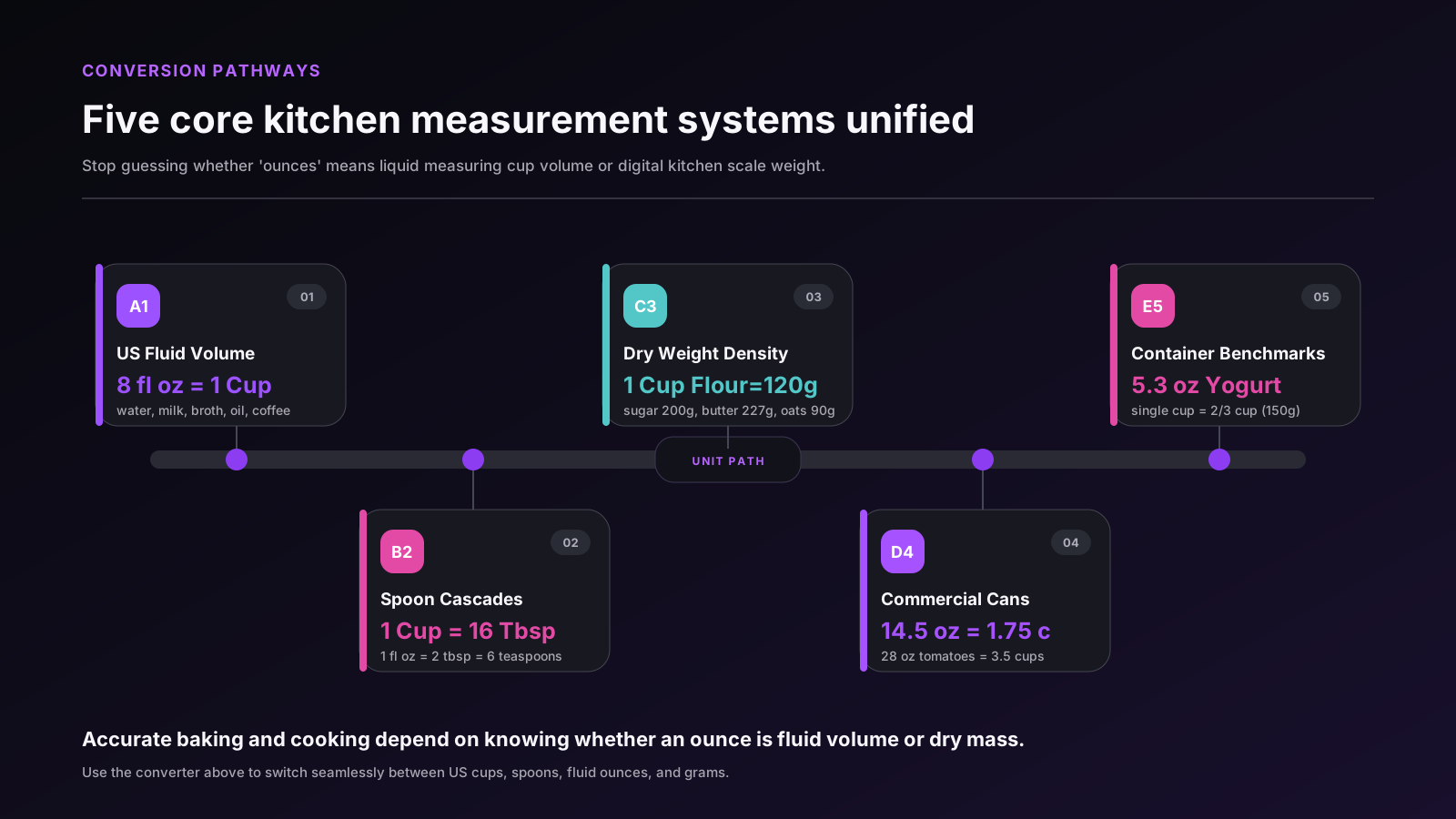
Five Core Kitchen Measurement Systems Unified
Every recipe uses one or more of these five measurement systems. Our converter translates across all five simultaneously:
US Fluid Ounce & Cup Volume (8 fl oz = 1 Cup)
Used for water, milk, cream, broth, juice, coffee, and cooking oils. Divide fluid ounces by 8 for cups, or multiply by 2 for tablespoons.
32 fl oz = 4 Cups • 17 fl oz = 2 1/8 Cups • 21 fl oz = 2 5/8 CupsTablespoon & Teaspoon Cascades (1 Cup = 16 Tbsp)
Essential for small-batch scaling, cocktails, and dressings. 1 fl oz = 2 tbsp = 6 tsp; 1/4 cup = 4 tbsp; 1/3 cup = 5 tbsp + 1 tsp.
1.5 fl oz = 3 Tbsp (9 Tsp) • 2 fl oz = 4 Tbsp (1/4 Cup)Dry Baking Ingredient Densities (Grams & Dry Oz)
Converts volumetric cups into exact digital scale grams and dry ounces using verified USDA and King Arthur Baking weights.
1 Cup Flour = 120g (4.25 oz) • 1 Cup Sugar = 200g (7.05 oz)Grocery Cans, Bags & Yogurt Containers
Translates supermarket net weights on cans, chocolate chip bags, and yogurt tubs into recipe-ready measuring cups.
14.5 oz Can = 1 3/4 Cups • 5.3 oz Yogurt = 2/3 Cup (150g)REAL-WORLD APPLICATIONS
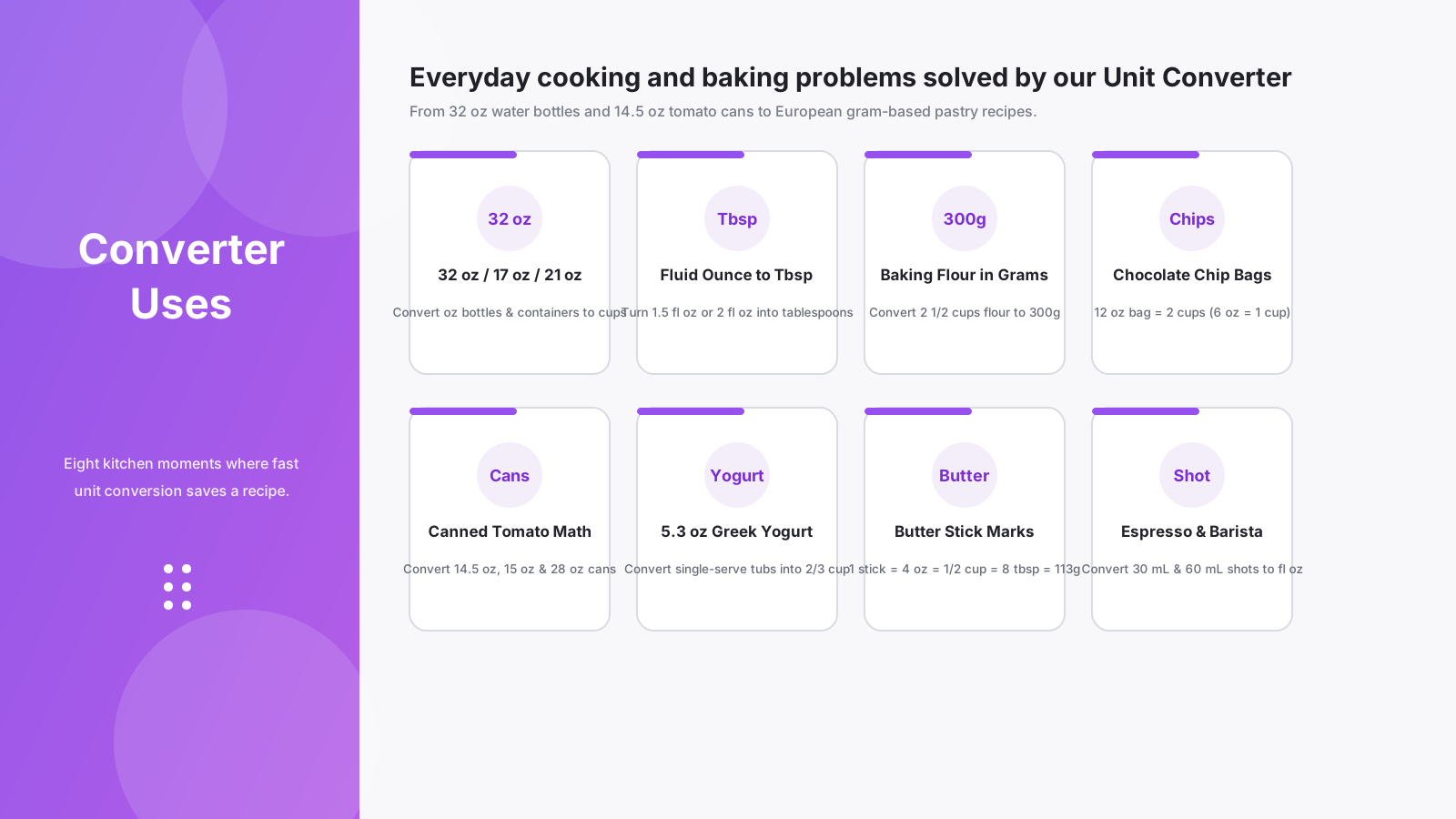
Eight Everyday Kitchen Tasks Solved by Our Unit Converter
From converting water bottle sizes and cocktail jiggers to weighing sourdough flour and chocolate chips, here are eight high-frequency uses:
Converting 32 oz, 21 oz & 17 oz containers to cups
See immediately that 32 fl oz is 4 cups (1 quart), 21 fl oz is 2 5/8 cups (2 cups + 10 tbsp), and 17 fl oz (500 mL bottle) is 2 1/8 cups.
Fluid ounces to tablespoons (1.5 oz, 2 oz, 3 oz)
Convert salad dressings, lemon juice, espresso, and cocktail jiggers at 2 tablespoons (6 teaspoons) per fluid ounce.
Converting cups of flour & sugar into grams
Switch American cup-based cookie, bread, and cake recipes into precise digital-scale grams (120g/cup flour, 200g/cup sugar).
Chocolate chip bag & baking bar math
Know that 6 dry ounces of semi-sweet chocolate chips equals 1 US cup (170g), so a standard 12 oz toll-house bag yields 2 full cups.
Canned tomatoes, beans & pumpkin puree
Convert a 14.5 oz or 15 oz can into 1 3/4 cups (411g–425g) and a large 28 oz crushed tomato can into 3 1/2 cups.
Single-serve 5.3 oz Greek yogurt tubs
When a baking or smoothie recipe calls for cups of yogurt, one 5.3 oz (150g) single-serve cup equals 2/3 US cup (~10.6 tablespoons).
Butter sticks to cups, tablespoons & grams
Translate 1 stick of butter (4 oz / 8 tbsp / 1/2 cup / 113.4g) into any fraction or metric weight.
International mL & liter recipe conversion
Convert European and UK milliliter and gram recipes into US cups, tablespoons, and ounces accurately.
VERIFIED DATA BENCHMARKS
Master Kitchen Volume, Ounce, Can Size & Gram Density Table
Use this complete kitchen reference chart to look up exact fluid conversions, container yields, and dry ingredient gram weights:
| Kitchen Measurement / Query | US Cups Equivalent | Tablespoons & Teaspoons | Fluid Ounces (fl oz) | Metric Volume (mL) | Dry Weight (Grams / Oz) |
|---|---|---|---|---|---|
| 1 Tablespoon (US) | 1/16 cup (0.0625 c) | 1 tbsp = 3 tsp | 0.5 fl oz | 14.8 mL | 14.2g butter / 15g water |
| 1 Fluid Ounce (1 fl oz) | 1/8 cup (0.125 c) | 2 tbsp = 6 tsp | 1.0 fl oz | 29.6 mL | 29.6g water / 28.35g dry oz |
| 1.5 Fluid Ounces (Jigger) | 3/16 cup (0.1875 c) | 3 tbsp = 9 tsp | 1.5 fl oz | 44.4 mL | 44.4g water |
| 2 Fluid Ounces (1/4 Cup) | 1/4 cup (0.25 c) | 4 tbsp = 12 tsp | 2.0 fl oz | 59.1 mL | 59.1g water / 30g flour |
| 1/3 US Cup | 1/3 cup (0.333 c) | 5 tbsp + 1 tsp (16 tsp) | 2.67 fl oz | 78.9 mL | 40g flour / 67g sugar |
| 4 Fluid Ounces (1/2 Cup) | 1/2 cup (0.50 c) | 8 tbsp = 24 tsp | 4.0 fl oz | 118.3 mL | 60g flour / 113.4g butter (1 stick) |
| 5.3 oz Greek Yogurt Cup | 2/3 cup (0.66 c) | 10 tbsp + 2 tsp | ~5.3 fl oz volume | 157 mL | 150 g (5.3 dry oz net wt) |
| 6 oz Chocolate Chips | 1 cup chips | 16 tbsp chips | 8.0 fl oz volume | 236.6 mL | 170 g (6.0 dry oz net wt) |
| 8 Fluid Ounces (1 US Cup) | 1 cup (1.0 c) | 16 tbsp = 48 tsp | 8.0 fl oz | 236.6 mL | 236.6g water / 120g AP flour / 200g sugar |
| 12 oz Bag Chocolate Chips | 2 cups chips | 32 tbsp chips | 16.0 fl oz volume | 473.2 mL | 340 g (12.0 dry oz net wt) |
| 14 oz Can Sweetened Cond. Milk | 1 1/4 cups (1.25 c) | 20 tbsp | 10.0 fl oz volume | 296 mL | 396 g (14.0 dry oz net wt) |
| 14.5 oz / 15 oz Standard Can | 1 3/4 cups (1.75 c) | 28 tbsp | 14.0 fl oz volume | 414 mL | 411 g – 425 g net weight |
| 16 Fluid Ounces (1 US Pint) | 2 cups (2.0 c) | 32 tbsp = 96 tsp | 16.0 fl oz | 473.2 mL | 473g water / 1 lb (453.6g) butter |
| 17 Fluid Ounces (500 mL Bottle) | 2 1/8 cups (2.125 c) | 34 tbsp (2 c + 2 tbsp) | 17.0 fl oz | 502.8 mL | 503 g water |
| 21 Fluid Ounces | 2 5/8 cups (2.625 c) | 42 tbsp (2 c + 10 tbsp) | 21.0 fl oz | 621.0 mL | 621 g water |
| 28 oz Large Tomato Can | 3 1/2 cups (3.5 c) | 56 tbsp | 28.0 fl oz volume | 828 mL | 794 g net weight |
| 32 Fluid Ounces (1 US Quart) | 4 cups (4.0 c) | 64 tbsp = 192 tsp | 32.0 fl oz | 946.4 mL | 946 g water (2 pints) |
USEFUL TERMINOLOGY & SEARCH PHRASES
Other Names People Use for a Kitchen Unit Converter
Home bakers, chefs, and bartenders search for kitchen unit conversions under several specialized terms:
Ounces to cups calculator (oz to cups)
Converts 32 oz, 24 oz, 21 oz, 17 oz, 16 oz, and 8 oz into exact US cups.
Fluid ounces to tablespoons converter
Multiplies fluid ounces by 2 (and teaspoons by 6) for dressings, extracts, and bar measures.
Baking cups to grams converter
Uses ingredient bulk density to convert volumetric cups of flour, sugar, and oats into grams.
Grocery can size to cups chart
Translates #300 (14.5–15 oz), #2.5 (28 oz), and #10 institutional cans into cups.
Dry ounce vs. fluid ounce calculator
Explains and computes the density difference between mass ounces and liquid volume ounces.
Butter stick to gram & tbsp converter
Converts US quarter-pound butter sticks into tablespoons, cups, and grams.
Yogurt & chocolate chip cup converter
Answers how many cups are in a 5.3 oz yogurt cup or a 12 oz bag of chocolate chips.
CLIENT-SIDE PRIVACY & DATA SECURITY
How Your Kitchen Conversion Queries Are Handled
Our Kitchen Unit Converter performs every calculation locally inside your browser:
- Zero server round-trips—every ounce, cup, spoon, and gram conversion updates in under 1 millisecond.
- No registration or personal data collection is required to use any conversion table or calculator.
- Works cleanly on smartphones and tablets propped on the kitchen counter.
- Read our Privacy Policy and Cookies Policy for full details on site-wide analytics and zero-server recipe storage.
EXPERT KITCHEN & NUTRITION TIPS
Six Pro Kitchen Measurement Tips for Foolproof Results
Follow these six culinary standards to keep your baking and cooking measurements 100% consistent:
Use spouted glass jugs for liquids, flat-rim cups for dry
Liquid measuring jugs let you read the meniscus at eye level without spilling, while dry measuring cups are meant to be swept level across the rim with a straight edge.
Spoon and level flour—never scoop from the bag
Fluff flour with a fork, spoon it lightly into your dry cup, and level with a knife to hit the true 120g per cup standard.
Pack brown sugar firmly, but never powdered sugar
Light and dark brown sugar are calibrated packed into the cup (~213g/cup), whereas powdered confectioners' sugar should be spooned lightly or sifted (~120g/cup).
Memorize the 1 Cup = 8 fl oz = 16 Tbsp triad
Once you know 1 cup is 16 tablespoons, you immediately know 3/4 cup is 12 tbsp, 1/2 cup is 8 tbsp, 1/4 cup is 4 tbsp, and 1/8 cup is 2 tbsp (1 fl oz).
Check whether canned recipes use drained weight
A 15 oz can of black beans or chickpeas holds 1 3/4 cups with liquid, or 1 1/2 cups (about 250g) once rinsed and drained.
Tare your digital kitchen scale between ingredients
Place your mixing bowl on a digital gram scale, press Tare/Zero, pour in 120g flour, press Tare again, and add 200g sugar—zero measuring cups to wash!
HIGH-VOLUME OUNCES TO CUPS, TABLESPOONS & SHREDDED CHICKEN TABLE
How Many Cups Are in 32 oz, Tablespoons in an Ounce & Chicken Cup Equivalents
For the top liquid and dry kitchen conversions: how many cups are in 32 oz (and 32 oz is how many cups)? Exactly 4 US cups (1 US quart / 946.35 mL), because 1 US cup equals 8 fluid ounces (32 / 8 = 4 cups). And how many tbsp is an ounce (or tbsp in fl oz)? Exactly 2 US tablespoons equal 1 fluid ounce (29.57 mL). Below is the verified conversion table for every high-volume container size, tablespoon count, and cooked chicken yield.
| Exact Kitchen Conversion Query | Verified US Cups / Fluid Ounces / Grams | Culinary & Can / Package Context |
|---|---|---|
| How many cups are in 32 oz (32 oz is how many cups) | 4 US cups (64 tbsp / 1 quart / 946.4 mL) | Standard 32 oz carton of chicken broth, stock, or whole milk equals 4 cups. |
| How many cups in 14.5 ounces (How many cups in 14.5 oz / How many cups are in a 14.5 oz can) | 1.81 US cups (~1 3/4 to 1 4/5 cups / 29 tbsp / 429 mL) | Standard 14.5 oz grocery can of diced tomatoes, broth, or green beans; two 14.5 oz cans = 29 oz (3.63 cups). |
| 13.5oz to cups / How many cups are in 20oz / 46 oz is how many cups / How many cups in 50 oz / 0.75 in cups | 13.5 oz = 1.69 cups (~1 2/3 cups) • 20 oz = 2.5 cups • 46 oz = 5.75 cups • 50 oz = 6.25 cups • 0.75 cup = 3/4 cup (6 fl oz / 12 tbsp) | A 13.5 oz can is standard for coconut milk (~1 2/3 cups); a 46 oz can is standard for tomato juice (5 3/4 cups). |
| How many ounces in 5 tablespoons / How many oz in 3 tbs / How many ounces is 9 tablespoons / How many ounces in 10 tablespoons | 3 tbsp = 1.5 fl oz • 5 tbsp = 2.5 fl oz • 9 tbsp = 4.5 fl oz • 10 tbsp = 5.0 fl oz | Divide US tablespoons by 2 to get fluid ounces (Tbsp / 2 = fl oz). |
| How many cups is 5.3 oz yogurt (5.3 oz of yogurt is how many cups) | ~2/3 US cup (0.61 to 0.66 cup / 150g / ~10.5 tbsp) | Standard single-serve Greek yogurt cup (150g net weight). |
| How many cups of chicken are in a rotisserie chicken (How many cups of chicken in a rotisserie chicken) | 3.5 to 4 cups of shredded cooked meat (~18 to 20 oz / 510 to 565g) | One 2.5–3 lb store-bought rotisserie chicken yields ~2 cups white breast meat + ~1.75 cups dark meat. |
| How many pounds of chicken are in a cup (How many lbs of chicken in a cup / How many pounds of chicken in a cup / How many ounces of chicken in a cup / How many oz of chicken in a cup / Chicken 1 cup) | 1 cup diced/shredded cooked chicken = 5 oz (0.31 lb / 140g) • 1 cup raw diced chicken = 5.6 oz (0.35 lb / 160g) | For how many chicken breasts is 2 cups (or how many pounds of chicken is 2 cups): 2 cups cooked chicken (10 oz cooked) requires ~13.3 oz (0.83 lb) raw chicken, or about 2 medium chicken breasts. For 1 lb chicken how many cups (how many cups of shredded chicken in a pound): 1 lb raw chicken yields ~2.4 cups cooked shredded chicken (1 lb already-cooked chicken = 3.2 cups). |
| Is a cup 8oz? / How many cups in 4 oz of chocolate chips? | 1 US cup = 8 fluid oz (236.6 mL) • 4 oz chocolate chips = 2/3 US cup (113.4g) | Fluid ounces measure volume (8 fl oz = 1 cup water/milk), while dry ounces measure weight (1 cup semi-sweet chocolate chips weighs 6 oz / 170g; a 12 oz bag holds 2 cups). |
| .5oz to tbsp / 3 oz in tbs / How many ounces is 20 tablespoons | 0.5 fl oz = 1 tbsp (3 tsp) • 3 fl oz = 6 tbsp (3/8 cup) • 20 tbsp = 10 fl oz (1.25 cups) | 1 fluid ounce = 2 US tablespoons (29.57 mL). When learning how to use a scale, 1 fl oz of water weighs 29.57g. |
| How much is 2 cups of chicken / How many chicken breasts is 3 cups / How many chicken breasts is 4 cups / 4 cups of chicken is how many ounces / How many chicken breasts in a cup | 1 cup = 5 oz cooked (~1 small breast) • 2 cups = 10 oz (~2 breasts) • 3 cups = 15 oz (~3 breasts) • 4 cups = 20 oz (1.25 lbs cooked / ~3.5–4 breasts) | 1 cup chicken breast (or 1 cup of chicken breast) weighs 140g (5 oz) diced or shredded cooked. |
| How many ounces of meat in a pound & How to use a food scale | 16 ounces = 1 pound (453.59 grams) | When learning how to use a food scale (or how to use a kitchen scale), place your bowl on the platform, press Tare to zero to 0g, and weigh directly in grams or ounces. |
AUTHORITATIVE SOURCES & REFERENCES
Primary USDA, FDA & Scientific Sources
- NIST Handbook 44 — Specifications, Tolerances, and Other Technical Requirements for Weighing and Measuring Devices — Official U.S. volumetric and mass calibration standards for kitchen and commercial scales.
- USDA FoodData Central — Bulk Density & Cup-to-Gram Equivalents — Empirical gram weights per US cup and tablespoon across baking flours, sugars, dairy, and fats.
How to Use the Kitchen Unit Converter: Fluid Oz, Dry Oz, Cups, Tbsp & Grams (Step-by-Step Workflow)
Scaling recipes, generating FDA-compliant nutrition facts labels, and converting between volume (cups, tablespoons, fluid ounces) and weight (grams, dry ounces, pounds) requires accounting for ingredient density and cooking moisture loss. Follow these four steps:
- Enter Your Original Yield & Ingredients: Input the recipe's current number of servings (the yield) and paste or select your ingredient list in standard kitchen units (cups, tbsp, tsp, oz, lbs, cans, or grams).
- Select Your Conversion Factor or Baking Pan Ratio: Click a quick preset (
1/2x Cut in Half,1/3x,2x Double,3x Triple), type your desired target servings, or use the Baking Pan Size Converter to scale by pan surface area. - Verify Kitchen Fractions & Gram Equivalents: Review both the rounded culinary fraction (such as converting
0.375 cupsinto6 tbsp) and the density-adjusted metric gram weight for precision on a digital kitchen scale. - Generate Labels, Macros, or Catering Lists & Export: Star your favorite calculations to local browser storage or export your scaled recipe, nutrition panel, or food cost breakdown as a
.txt,.csv, or.jsonfile.
Who This Tool Is For: Practical Kitchen, Nutrition & Food Business Use Cases
Different culinary tasks require different mathematical rules. Halving a cake batter involves pan area geometry, whereas tracking macros for fat loss requires raw-to-cooked weight conversion and the 4-4-9 Atwater energy formula:
- Home Cooks & Bakers Scaling Recipes: Use the Recipe Converter & Doubler and Kitchen Unit Converter to halve, double, or triple recipes and convert between ounces, cups, tablespoons, and metric grams without awkward decimal measurements.
- Cottage Food Bakers, Meal Preppers & Supplement Brands: Use the FDA Nutrition Facts & Supplement Label Maker to generate vertical, horizontal/tabular, dual-column cereal box, and supplement facts panels with automatic
% Daily Value (%DV)calculations. - Fitness, Weight-Loss & Macro Trackers: Use the Recipe Calorie, Macro & TDEE Calculator and Visual Portion Size Guide to calculate homemade food calories, net carbs, 4-4-9 macro splits, and visual hand comparisons (such as what 4 oz of chicken or 3 oz of steak looks like).
- Holiday Hosts, Event Planners & BBQ Caterers: Use the Meat Per Person & Thanksgiving Turkey Calculator to determine exact raw purchase weights for 10 to 100+ guests across whole turkey, pulled pork, brisket, ribs, ribeye steak, chicken breasts, and deli cold cuts.
- Restaurant Chefs, Custom Cake Bakers & Households: Use the Food Cost, Cake Pricing & Grocery Budget Calculator to compute recipe food cost percentage (28%–33% target), custom wedding cake pricing, and USDA monthly grocery budgets.
The Science Behind Our Calculators: USDA Densities, Atwater 4-4-9 & FDA 21 CFR 101.9
Every calculator on Recipe Calculator Pro uses verified reference constants from USDA FoodData Central and U.S. Food and Drug Administration (FDA 21 CFR 101.9) Nutrition Labeling Standards:
- Fluid Ounces (Volume) vs. Avoirdupois Ounces (Weight): A fluid ounce (
fl oz) measures volume (1 fl oz = 2 tablespoons = 29.57 mL;8 fl oz = 1 US cup;32 fl oz = 4 cups). A dry ounce (oz) measures mass (1 oz = 28.35 grams;16 oz = 1 pound). Because dry ingredients have different bulk densities, 1 cup of all-purpose flour weighs 4.25 oz (120g), 1 cup of chocolate chips weighs 6 oz (170g), and 1 cup of peanut butter weighs 9.1 oz (258g). - The Atwater 4-4-9 Macronutrient Energy System: Dietary energy (kilocalories) is determined by macronutrient oxidation: 1 gram of Protein = 4 kcal, 1 gram of Carbohydrate = 4 kcal, 1 gram of Fat (Lipids) = 9 kcal (making fat the most energy-dense macronutrient), and 1 gram of Alcohol = 7 kcal. Dietary fiber and sugar alcohols are subtracted from total carbohydrates when computing net carbs.
- Raw-to-Cooked Moisture & Fat Retention Yields: Meat, poultry, and fish lose approximately 20% to 25% of their raw weight as water and rendered fat during cooking. Consequently, 4 oz of raw boneless chicken breast or steak (113g) yields ~3 oz cooked (85g), while dry grains like rice and oats absorb water and expand to 2.5x–3.0x their dry weight.
Common Kitchen Calculation Mistakes vs. Verified Culinary Math
| Kitchen Task | Common Mistake (Before) | Verified Calculation (After) | Culinary / Nutritional Reason |
|---|---|---|---|
| 4 oz Chocolate Chips to Cups | 1/2 cup (confusing weight oz with 8 fl oz cup) | 2/3 cup (113g) | 1 US cup of chocolate chips weighs 6 oz (170g), so 4 oz by weight is 4/6 = 2/3 cup. |
| Weighing Chicken or Rice for Macros | Logging 4 oz cooked chicken as 4 oz raw entry | 4 oz cooked = 5.3 oz raw (35g protein) | Chicken loses ~25% water weight when cooked, concentrating protein from 22.5g/100g raw to 31g/100g cooked. |
| Menu Pricing at 30% Food Cost | Adding 30% markup ($4.50 × 1.30 = $5.85) | $4.50 ÷ 0.30 = $15.00 Menu Price | Food Cost % equals Ingredient Cost divided by Menu Selling Price, leaving 70% gross margin for labor and overhead. |
| BBQ Pulled Pork for 20 Guests | Buying 10 lbs raw pork butt for 10 lbs cooked | 15–16 lbs raw butt → ~8.5 lbs cooked | Pork shoulder loses ~45% weight to bone, fat rendering, and bark evaporation during smoking. |
OUNCES, CUPS, TABLESPOONS & KITCHEN SCALE FAQS
Frequently Asked Questions About Kitchen Unit Conversions
How many tbsp is an ounce (1 oz to tbsp), and how many ounces in 3, 5, 7, or 9 tablespoons?
There are 2 tablespoons (6 teaspoons) in 1 US fluid ounce (29.57 mL). Conversely, 1 tablespoon equals 0.5 fluid ounces. Therefore: 1.5 tbsp = 0.75 fl oz; 3 tbsp = 1.5 fl oz; 4 tbsp = 2 fl oz (1/4 cup); 5 tbsp = 2.5 fl oz; 7 tbsp = 3.5 fl oz; 8 tbsp = 4 fl oz (1/2 cup); and 9 tbsp = 4.5 fl oz.
32 oz is how many cups, and how many cups are in 17 oz, 21 oz, 35 oz, 36 oz, 46 oz, and 50 oz?
Divide US fluid ounces by 8 to get US cups: 32 fl oz = 4 cups (1 quart / 946 mL); 17 fl oz = 2 1/8 cups (2.125 cups = 2 cups + 2 tbsp); 21 fl oz = 2 5/8 cups (2.625 cups = 2 cups + 10 tbsp); 35 fl oz = 4 3/8 cups (4.375 cups); 36 fl oz = 4 1/2 cups (4.5 cups); 46 fl oz = 5 3/4 cups (5.75 cups); and 50 fl oz = 6 1/4 cups (6.25 cups).
How to use a kitchen scale for baking and meal prep?
Place your empty mixing bowl or plate on the flat digital scale platform, press the 'Tare' or 'Zero' button so the display resets to 0, and select 'g' (grams) or 'oz' (ounces) with the Unit button. Pour in your first ingredient until the target weight appears, press 'Tare' again to reset to 0, and add the next ingredient right into the same bowl.
What is 0.75 cup to oz (75 cup to oz) and 13.5 oz to cups?
For liquids, 0.75 cup (3/4 US cup) equals 6 fluid ounces (12 tablespoons / 177.4 mL). For dry all-purpose flour, 0.75 cup weighs 3.18 dry ounces (90 grams). Meanwhile, 13.5 fluid ounces (the standard size of a can of coconut milk) equals 1.69 US cups (about 1 2/3 cups, or 1 cup + 11 tablespoons / 400 mL).
How many cups in a 14.5 oz can, and how many cups is 5.3 oz of yogurt or 16 oz of sour cream?
A standard 14.5 oz or 15 oz can of diced tomatoes, broth, or beans holds 1 3/4 US cups (1.75 cups / ~411g–425g). A single-serve 5.3 oz (150g) Greek yogurt cup holds ~2/3 US cup (10 tablespoons + 2 teaspoons). A 16 oz (1 lb / 454g) tub of sour cream or cottage cheese holds 2 full US cups.
How many cups is 4 oz of ground beef or 1 lb of chicken?
Four ounces (113g) of cooked crumbled ground beef measures ~0.83 cup (just over 3/4 cup), while 4 oz of raw ground beef is 1/2 cup packed (1 cup of cooked ground beef weighs ~4.8 oz / 136g). One pound (16 oz) of raw boneless chicken cooks down to ~2.5 to 3 cups of shredded or diced chicken (1 cup cooked chicken = ~5 oz / 140g).
How many cups is 4 oz, 6 oz, or 12 oz of chocolate chips?
One US cup of semi-sweet chocolate chips weighs 6 dry ounces (170 grams). Therefore, 4 oz of chocolate chips equals 2/3 cup (113g), 6 oz equals 1 cup (170g), 10 oz equals 1 2/3 cups (283g), and a standard 12 oz bag of chocolate chips equals 2 full US cups (340g).
Why are dry weight ounces different from fluid ounces?
A fluid ounce (fl oz) measures spatial volume (1/8 of a cup, or 29.57 mL), whereas a dry ounce (oz) measures weight on a scale (1/16 of a pound, or 28.35 grams). Because dry ingredients like flour (120g/cup = 4.25 dry oz) and oats (90g/cup = 3.17 dry oz) are lighter than water, 8 fluid ounces of flour weighs only 4.25 dry ounces.
Convert Ounces, Cups, Tablespoons & Grams Now
You have seen why separating US fluid ounces (8 fl oz = 1 cup) from dry weight ounces (1 cup all-purpose flour = 120g) prevents dense cakes and failed sauces.
Enter any measurement—from 32 oz, 17 oz, or 21 oz containers to 14.5 oz tomato cans and 5.3 oz Greek yogurt tubs—to get verified cup, spoon, and gram equivalents.
Convert Kitchen Units Now