UK Fan Oven, Conventional & Cast-Iron Range Converter

Last updated: · Maintained by Lee Harsh (Full-Stack Developer)

Direct Answer & Core Culinary Formula

A UK Fan (convection) oven circulates hot air across the baking tin, increasing convective heat transfer so you set the dial 20°C lower than a Conventional (static) oven: Fan °C = Conventional °C − 20. For British Gas Marks 1 through 9, Gas Mark 1 equals 135°C (275°F) and each additional Gas Mark adds 14°C (25°F). On a cast-iron AGA range, map 200°C–230°C recipes to the Roasting Oven and 160°C–190°C cakes to the Baking Oven.

Formula: Fan Oven (°C) = Conventional (°C) − 20 | Fahrenheit (°F) = (Conventional °C × 1.8) + 32 | Gas Mark (Marks 1–9) = ((Conventional °C − 135) ÷ 14) + 1
All-in-One 2000+ Keyword Chef & Recipe Database (100% PDF + GSC + Martha Stewart + Famous Dave's) (2197 matching endpoints):
Top Ranked Slugs:
Active Conversion Factor: 1x
Quick Recipe Scale:
Chef Physics & Setting Note: Mary Berry Crumb & Spread Rule: Rub cold butter in lightly, pat dough to 2.5cm thickness, stamp straight down without twisting the cutter, and bake at 220°C (200°C Fan) for 12–14 mins.
Scaled Recipe Output (1x)

Mary Berry Apple and Cinnamon Scones (12 Servings)

Total Scaled Batch Mass
770 g (27.2 oz)
Calibrated Appliance Temp
200°C UK Fan / Convection (392°F)
Cook Time & Method
12 mins (Mary Berry All-in-One 1-Bowl)
450 g self-raising flour plus 2 level tsp baking powder ≈ 450 g
Original: 450 g self-raising flour plus 2 level tsp baking powder · Direct 1x proportion (450 g).
100 g cold unsalted butter (cubed) and 75 g caster sugar ≈ 100 g
Original: 100 g cold unsalted butter (cubed) and 75 g caster sugar · Direct 1x proportion (100 g).
120 g diced Braeburn apple & cinnamon, sultanas, or mature Cheddar cheese ≈ 120 g
Original: 120 g diced Braeburn apple & cinnamon, sultanas, or mature Cheddar cheese · Direct 1x proportion (120 g).
2 large free-range eggs beaten with whole milk or buttermilk to make 250 ml total liquid ≈ 100 g
Original: 2 large free-range eggs beaten with whole milk or buttermilk to make 250 ml total liquid · Direct 1x proportion (100 g).
Complete Step-by-Step InstructionsQuery Solved: “mary berry apple and cinnamon scones”Mary Berry • lined baking sheet • 245 kcal/serving

How to Make Mary Berry Apple and Cinnamon Scones (12 Servings · 200°C UK Fan / Convection (392°F))

Progress: 0 / 6 Steps Checked
Step 1
[Scale: 1x → 12 Servings | 200°C UK Fan / Convection (392°F)] Preheat Oven & Line Trays: Preheat oven to 220°C (200°C Fan / 425°F) and line 2 heavy baking sheets with non-stick parchment paper.
Step 2
Weigh Dry Ingredients & Fat: Measure flour, leavening, and butter accurately on a digital gram scale so gluten hydration stays balanced.
Step 3
Rub Cold Butter & Fold Liquid Gently: Rub cubed cold butter into flour with your fingertips until fine crumbs form, stir in sugar and fruit/cheese, and fold in egg-milk liquid with a palette knife. (Mary Berry 1-Bowl All-in-One Method Active: Measure all room-temperature sponge/base ingredients into a single mixing bowl and beat for 90 seconds until satin-smooth.)
Step 4
Stamp Without Twisting & Egg-Wash Tops: Pat dough to 2.5cm thick, stamp rounds with a sharp cutter without twisting (so scones rise straight), and brush tops only with egg wash.
Step 5
Bake to Golden Edges (12–14 mins): Bake on the center shelf until risen and golden at the edges while centers remain tender.
Step 6
Cool on Wire Rack: Rest on the warm baking sheet for 5 minutes before transferring to a wire rack.
Instant UK / US Kitchen Unit & Density Converter (Oz ⇄ Cups ⇄ Tbsp ⇄ Grams)

32 fl oz of All-Purpose Wheat Flour (Spooned & Leveled) equals 4 cups (4 cups), 32 fl oz (64 tbsp), and weighs 16.92 oz (480 g / 1.058 lb).

Worked Example & Verified Reference Table

Worked Example: Baking a lasagne or tray of roast potatoes written for 200°C Conventional (400°F / Gas Mark 6) converts to 180°C in a UK Fan oven, or goes onto the 3rd or 4th runner of the AGA Roasting Oven for 30–35 minutes (sliding the Cold Plain Shelf above if the cheese browns before the center bubbles).

Conventional Oven (°C / °F)UK Fan Oven (-20°C)British Gas Mark4-Oven AGA Placement2-Oven AGA Placement (with Cold Shelf)
220°C / 425°F (Scones, Yorkshire Puddings)200°C FanGas Mark 7Roasting Oven · 2nd or 3rd RunnerRoasting Oven · 2nd or 3rd Runner
200°C / 400°F (Pastry Tarts, Baked Lasagne)180°C FanGas Mark 6Roasting Oven · 4th RunnerRoasting Oven · 4th Runner + Cold Shelf
180°C / 350°F (Sandwich Sponges, Cookies)160°C FanGas Mark 4Baking Oven · 3rd RunnerRoasting Oven · 4th Runner + Cold Shelf on 2nd
160°C–165°C / 320°F–325°F (2lb Loaf, Braises)140°C–145°C FanGas Mark 3Baking Oven · 4th RunnerRoasting Oven · Grid Shelf on Floor + Cold Shelf
110°C–120°C / 230°F–250°F (Pavlova, Meringues)90°C–100°C FanGas Mark 1/4–1/2Simmering Oven · Middle RunnerSimmering Oven · Middle Runner
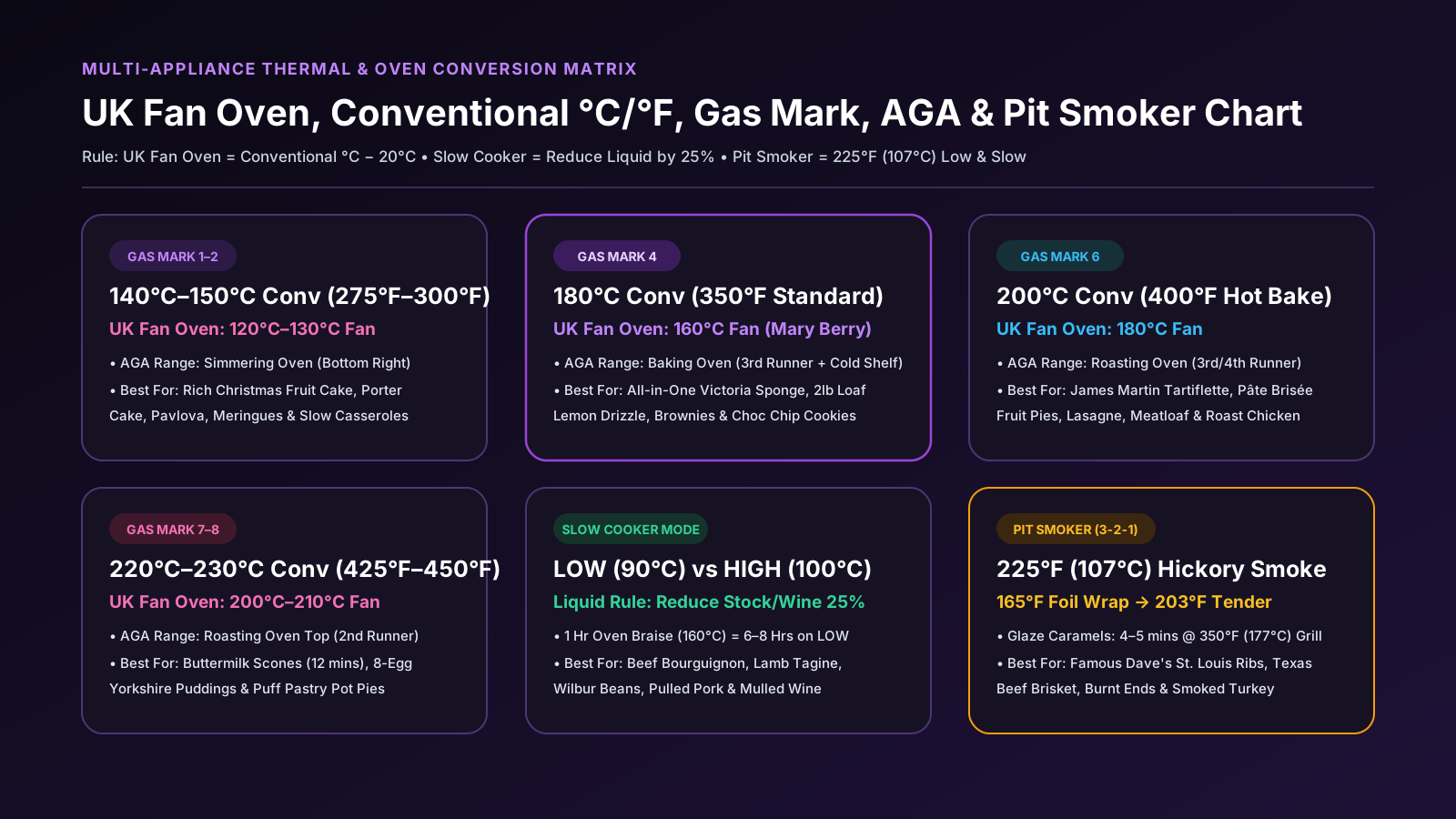
Multi-appliance oven, UK Fan, Gas Mark, cast-iron AGA runner, Slow Cooker, and 225°F Pit Smoker temperature conversion chart
Multi-appliance thermal conversion chart comparing UK Fan Ovens (-20°C), Conventional Ovens, Gas Marks, AGA cast-iron runners, Slow Cookers, and 225°F Pit Smokers.

1. Convective Boundary-Layer Physics: Why UK Fan Ovens Subtract 20°C

In a Conventional (static) electric or gas oven, natural thermal buoyancy creates a protective stagnant boundary layer of cooler air around your baking tin. Switching on a UK Fan (convection) oven blows heated air across the tin at 1 to 2 metres per second, stripping away that insulating air film and accelerating convective heat transfer into the food.

To prevent cake edges from setting too fast and cracking, set a UK Fan oven exactly 20°C (35°F) lower than the Conventional temperature stated in a recipe: Fan °C = Conventional °C − 20 (so 180°C Conventional becomes 160°C Fan, and 200°C Conventional becomes 180°C Fan).

2. Exact Celsius, Fahrenheit & British Gas Mark 1–9 Equations

Converting between American Fahrenheit recipes and British Celsius or Gas Mark dials follows two linear equations: Fahrenheit (°F) = (Conventional °C × 1.8) + 32, and for British Gas Marks 1 through 9, Gas Mark = ((Conventional °C − 135) ÷ 14) + 1. Gas Mark 1 starts at 135°C (275°F), and each full Gas Mark step adds 14°C (25°F).

For quick kitchen reference: Gas Mark 1/4–1/2 (110°C–120°C / 230°F–250°F, 90°C–100°C Fan) dries crisp pavlovas and meringues; Gas Mark 3 (160°C–165°C / 320°F–325°F, 140°C–145°C Fan) bakes rich fruit cakes and 2lb loaves; Gas Mark 4 (180°C / 350°F, 160°C Fan) bakes sandwich sponges and cookies; Gas Mark 6 (200°C / 400°F, 180°C Fan) bakes pastry tarts and lasagne; and Gas Mark 7 (220°C / 425°F, 200°C Fan) bakes scones and Yorkshire puddings.

3. Radiant Cast-Iron Heat: Mapping Recipes to 2-Oven & 4-Oven AGAs

Unlike thermostat-cycled Fan ovens, a traditional cast-iron AGA range stores thermal energy in heavy iron barrels and transfers heat primarily by multi-directional black-body radiation from the roof, floor, and walls. Because radiant heat does not blow moisture off food surfaces, meats roast with less shrinkage and sponges develop a tender crust.

On a 4-oven AGA, map 200°C–230°C (Gas Mark 6–8) recipes to the Roasting Oven, 160°C–190°C (Gas Mark 3–5) cakes and biscuits to the Baking Oven, and 100°C–140°C casseroles and meringues to the Simmering Oven.

4. Using the AGA Cold Plain Shelf & Runner Positions

On a 2-oven AGA (which has only a Roasting Oven and a Simmering Oven), you create a moderate 'Baking Oven' zone inside the hot Roasting Oven by sliding the heavy steel Cold Plain Shelf onto the 2nd runner directly above your cake tin on the 4th runner (or grid shelf on the oven floor).

The Cold Plain Shelf blocks downward radiant heat from the cast-iron roof, allowing a Victoria sponge, lasagne, or traybake to cook evenly at an effective 180°C without scorching the top before the middle rises.

5. Oven Thermometer Calibration, Door Discipline & Context

Domestic electric and gas oven thermostats frequently drift by 10°C to 15°C over years of use: hang an inexpensive stainless-steel dial thermometer or probe clip in the center of your middle shelf to verify whether your 160°C Fan setting actually holds 160°C. On a cast-iron AGA range, keep oven doors open for as few seconds as possible when loading trays so stored radiant heat in the iron barrel stays balanced for the next course.

All Celsius, Fahrenheit, British Gas Mark 1–9, and cast-iron runner conversions on this page are independent thermodynamics references with no corporate tie to AGA Rangemaster.

Related Search Queries & Calculator Presets Covered by This Hub
Mary Berry AGA Lasagne Recipe (mary berry aga lasagne recipe)Mary Berry AGA Lasagne Recipe
Primary Scientific & Regulatory Sources: USDA FoodData Central · FDA 21 CFR 101.9 Nutrition Labeling · USDA FSIS Safe Minimum Internal Temperature Chart · NIST SI Units & Volumetric Standards

Frequently Asked Questions: UK Fan Oven, Conventional & Cast-Iron Range Converter

How do I convert a Conventional oven temperature to a UK Fan (convection) oven?

Subtract 20°C (35°F) from the Conventional oven temperature: Fan °C = Conventional °C − 20 (for example, 180°C Conventional / 350°F / Gas Mark 4 converts to 160°C Fan, and 200°C Conventional / 400°F / Gas Mark 6 converts to 180°C Fan).

What is the formula for converting Celsius and Fahrenheit to British Gas Marks 1 through 9?

Gas Mark 1 equals 135°C (275°F), and each full Gas Mark step adds 14°C (25°F): Gas Mark = ((Conventional °C − 135) ÷ 14) + 1. Thus 165°C (325°F) is Gas Mark 3, 180°C (350°F) is Gas Mark 4, 200°C (400°F) is Gas Mark 6, and 220°C (425°F) is Gas Mark 7.

Which AGA oven corresponds to 200°C–220°C vs 160°C–180°C on a 4-oven cast-iron range?

On a 4-oven AGA, use the Roasting Oven for high-heat 200°C–230°C bakes (Yorkshire puddings, scones, roast potatoes, lasagne), the Baking Oven for moderate 160°C–190°C sponges and cookies, and the Simmering Oven for 100°C–140°C meringues and slow braises.

How do I bake a 180°C sponge cake or lasagne in a 2-oven AGA without a separate Baking Oven?

Place your cake tin or lasagne dish on the 4th runner of the Roasting Oven and slide the heavy steel Cold Plain Shelf onto the 2nd runner directly above it to shield the top from intense downward cast-iron radiation.

Why do meats and cakes lose less moisture in a cast-iron AGA than in a UK Fan oven?

A cast-iron AGA heats food via multi-directional radiant heat from its iron walls rather than blowing dry forced air across the food surface, preserving surface moisture while browning evenly.

Is this oven and AGA temperature converter affiliated with AGA Rangemaster or any celebrity cook?

No—all temperature conversion formulas and runner guides on this page are independent kitchen thermodynamics references and are not affiliated with AGA Rangemaster or any named chef.

Explore our 7 core culinary and nutrition calculators, 18 archetype scaling hubs, and primary scientific reference databases:

Recipe Calculator, Pan Converter & Kitchen Unit ScalerFDA 21 CFR 101.9 Nutrition Facts Label MakerRecipe Calorie, 4-4-9 Macro & Net Carb CalculatorKitchen Unit Converter (Oz, Cups, Tbsp & USDA Grams)Visual 4 oz Portion Size & Cooked Meat Yield GuideMeat Per Person, BBQ Catering & Turkey Size CalculatorFood Cost Percentage, Cake Pricing & Grocery Calculator2lb Loaf Tin & Sponge Cake Scaling Calculator Hub8-Inch to 10-Inch & Tiered Cake Pan Scaling HubJam, Marmalade & Chutney 105°C Pectin Scaling HubSwiss & Italian Meringue Buttercream Ratio HubScone, Shortbread & Tea Biscuit Batch Scaling HubCookie Dough Flour-to-Fat & Yield Calculator HubShortcrust, Pâte Brisée & Pie Crust Weight HubFruit Crumble, Crisp & Cobbler Topping Ratio HubBBQ Dry Rub & Molasses Glaze Batch Scaling HubSmoked Ribs, Brisket & Pulled Pork Yield HubBBQ Feast Platter, Pit Beans & Mac & Cheese HubSoup, Potage & Stock Batch Scaling Calculator HubOven-to-Slow-Cooker & Braised Casserole Converter HubMeatloaf Panade, Roast Meat & Safe Probe HubLasagne, Risotto & Potato Gratin Batch Scaling HubBerry Coulis, Posset, Cheesecake & Trifle HubGluten-Free, Reduced-Sugar & Low-Cholesterol Hub
Verified Scientific & Regulatory Sources: USDA FoodData Central — Ingredient Densities & Nutrients · FDA 21 CFR 101.9 — Nutrition Labeling Regulations · USDA FSIS — Safe Minimum Internal Temperature Chart · NIST — SI Units & Volumetric Measurement Standards

All-in-One Recipe Calculator Pro vs. Static Recipe Blogs

Static food blogs lock every recipe to a single yield, a single cake tin size, and a single oven type—leaving you to guess when converting an 8-inch sponge to a 2lb loaf tin, boiling blackberry jam to 105°C, or smoking Famous Dave's ribs at 225°F.

Our deterministic calculator applies verified UK/US gram densities, pan surface-area ratios, AGA/Smoker/Slow Cooker offsets, and Mary Berry All-in-One method simplifications automatically in one place.

Scale your ingredients, convert cake tins and appliances, and export your recipe checklist with confidence.

Start Scaling & Converting