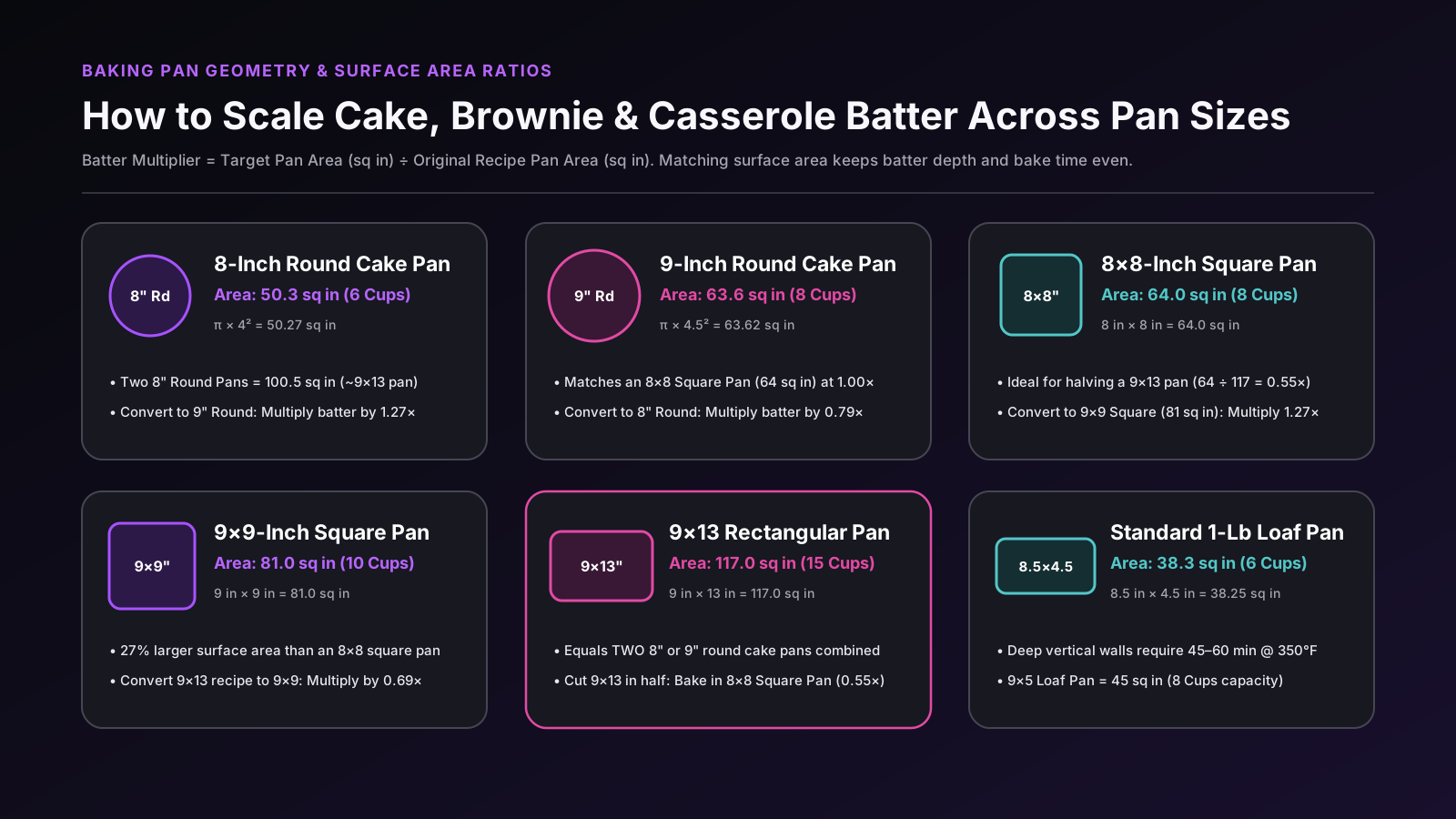
1. Circular Area Math (πr²) for Round & Square Cake Tins
Round cake pans scale by the square of their radius (Area = π × r²), meaning a modest 2-inch increase in diameter requires far more batter than most bakers expect. An 8-inch (20cm) round tin has a 4-inch radius and 50.27 square inches of surface area, whereas a 10-inch (25cm) round tin has a 5-inch radius and 78.54 square inches—an area multiplier of 78.54 ÷ 50.27 = 1.5625×.
Moving from an 8-inch round tin to a 9-inch (23cm) round tin (63.62 sq in) requires 1.26× the batter; moving to an 8-inch square tin (64.0 sq in) requires 1.27×; and scaling up to a 12-inch (30cm) celebration tin (113.10 sq in) requires 2.25×. Applying these multipliers keeps batter depth constant so cake layers bake level.
2. Scaling Boiled Porter, Fruit & Celebration Sponge Cakes
When scaling dense celebration recipes such as mary berry porter cake, mary berry 10 inch chocolate cake, or mary berry classic rich fruit cake from an 8-inch round tin to a 10-inch tin (1.56×), multiply every component by weight before rounding whole eggs to the nearest practical count. A 3-egg 8-inch boiled stout fruit cake (1,000g dried vine fruit, 300mL stout, 225g butter, 225g dark muscovado sugar, 275g plain flour) scales to 1,560g dried fruit, 470mL stout, 350g butter, 350g sugar, 430g flour, and 5 large eggs.
For lighter sponge tiers, an 8-inch 4-egg base (225g flour, sugar, and butter) scales to 5 eggs (285g base) in a 9-inch tin, 6 eggs (350g base) in a 10-inch tin, and 9 eggs (505g base) in a 12-inch tin. If a 6-inch top tier (28.27 sq in) is needed, multiply the 8-inch 4-egg recipe by 0.56× (2 large eggs and 125g each of flour, sugar, and butter).
3. Oven Temperature Drops & Parchment Collars for Wide Tins
As pan diameter widens from 8 inches to 10 or 12 inches, the outer ring of batter receives conductive heat from the metal wall long before heat reaches the center of the pan. Without a temperature adjustment, the perimeter dries out while the middle remains sunken and gummy.
For a 10-inch sponge cake, lower the oven by 5°C to 10°C (baking at 150°C–155°C Fan / 170°C–175°C Conventional) and add 20%–30% to the bake time. For a 10-inch rich Christmas or Simnel fruit cake, tie a double band of brown paper around the outside of the tin, line the interior with two layers of parchment, and bake at 130°C Fan (150°C Conventional / 300°F / Gas Mark 2) for 2 hours 30 minutes to 3 hours.
4. Marzipan, Almond Paste & Royal Icing Coverage Ratios
Covering a larger cake tier requires scaling almond paste (marzipan) and fondant by combined top-plus-side surface area. An 8-inch round cake (4 inches tall) has ~151 square inches of top and side area and takes ~450g–500g of marzipan; a 10-inch round cake (4 inches tall) has ~204 square inches of top and side area (1.35×) and requires ~650g–700g of marzipan rolled to 5mm thickness.
Brush boiled apricot jam sieved at 80°C over the cooled cake before laying down the marzipan sheet so the almond paste adheres cleanly, and allow 24 hours of air drying before applying royal icing.
5. Multi-Tier Dowel Support, Maturing Fruit Cakes & Context
When stacking a 6-inch top tier over an 8-inch middle tier and a 10-inch base cake, drive 4 to 6 hollow polypropylene dowels into each lower tier and snip them flush with a spirit level so the upper cake boards rest on rigid columns rather than crushing the sponge. Rich 10-inch Christmas and boiled porter cakes can be wrapped in double parchment and fed 15mL Irish whiskey or brandy every fortnight for up to 8 weeks.
Our radius-squared pan multipliers and celebration cake weights come directly from circular geometry equations and public food-composition tables, with zero sponsorship or authorship connection to any named cookbook writer.