CULINARY & NUTRITION GUIDE
How Many Chicken Breasts in a Pound? Raw vs. Cooked Weight & Visual 4 oz Guide
Step-by-step guide on how to use a kitchen scale: using the tare/zero button, weighing in grams vs. ounces, reverse-taring peanut butter jars, and meat portioning.
1. Direct Answer: How to Use a Kitchen Scale in 4 Simple Steps
To use a digital kitchen scale, place the scale on a flat, hard countertop, set your empty mixing bowl or plate on the center of the platform, and press the Power/Tare (or Zero) button so the screen displays 0. Next, press the Unit (Mode) button to select grams (g) or dry ounces (oz), and slowly add your ingredient until you reach the target weight; press Tare again to reset the display to 0 before adding the next ingredient into the same bowl.
Unlike volumetric measuring cups—which can vary by 20% to 35% depending on how tightly you pack flour or brown sugar—a digital food scale measures mass directly to 1-gram (0.04 oz) precision. That eliminates dry, crumbly cakes, inconsistent sourdough hydration, and hidden calorie creep in meal prep.
- Step 1 (Surface): Always place your food scale on a hard, level counter—never on a soft towel, cutting mat, or uneven stove grate, which distorts the four corner load cells.
- Step 2 (Tare/Zero the Container): Put your empty bowl, plate, or meal-prep container on the scale first and press Tare so the container weight is subtracted to 0g.
- Step 3 (Select Grams or Ounces): Use grams (g) for baking, coffee, and nutrition label tracking (1 oz = 28.35g; 4 oz = 113g; 1 lb = 454g).
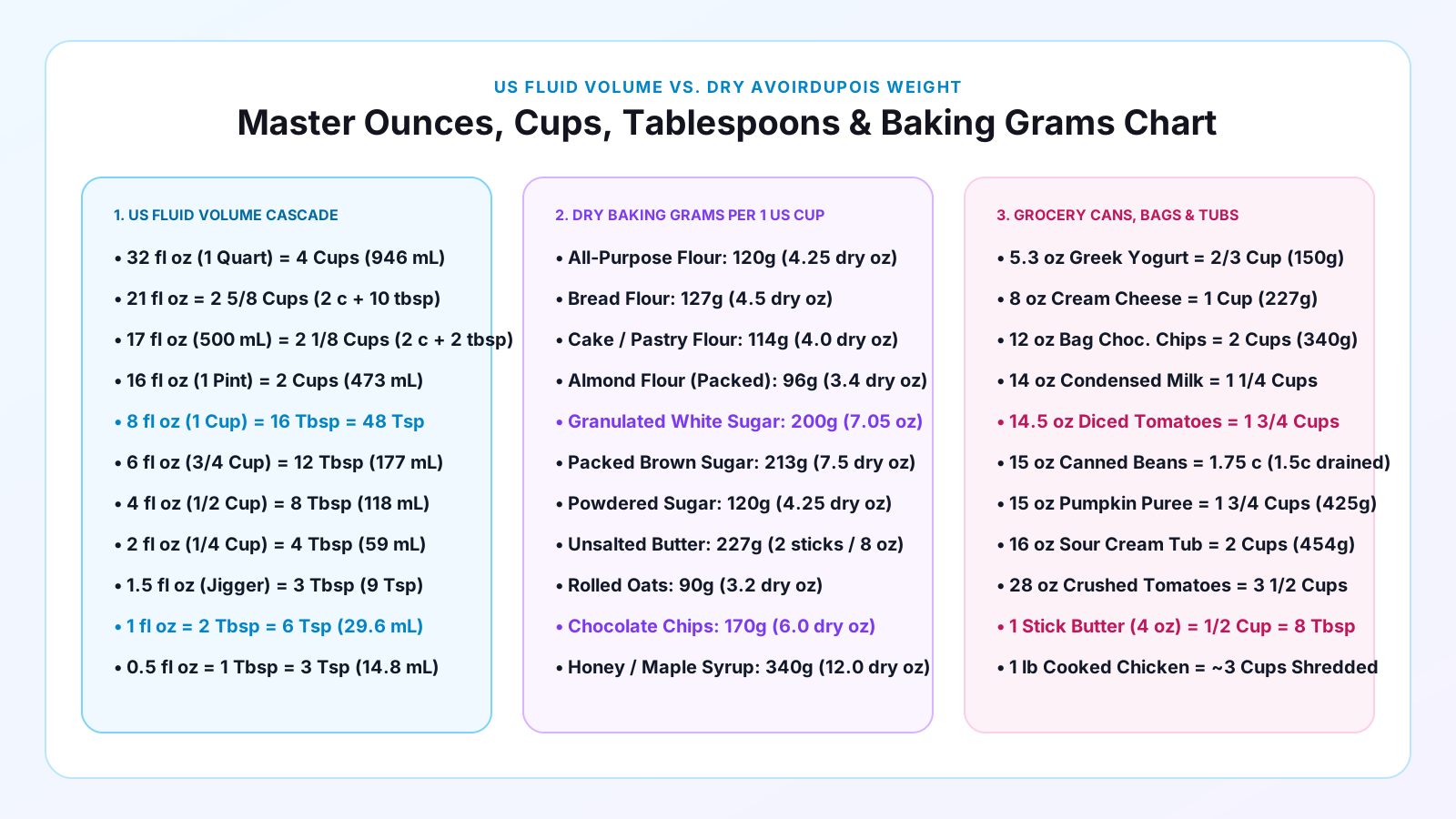
- Step 4 (Sequential Bowl Weighing): Press Tare between flour (120g/cup), sugar (200g/cup), cocoa (85g/cup), and salt (6g/tsp) to build an entire recipe in one bowl.
2. What Does the Tare Button Do on a Food Scale (And How Reverse Taring Works)?
The word 'tare' comes from commercial shipping and means the weight of an empty container. Pressing Tare instructs the scale's microprocessor to store the current weight on the platform as a new zero baseline so you only measure the net weight of the food you add next.
You can also use the Tare button in reverse—known as 'reverse taring' or 'negative weighing'—for sticky ingredients like peanut butter, honey, mayonnaise, or sourdough starter. Place the full jar of peanut butter on the scale, press Tare so the display reads 0g, and scoop out peanut butter with a normal dinner spoon until the scale reads −32g (the exact weight of 2 level tablespoons / 190 Calories). You get 100% accuracy without scraping a measuring spoon!
3. Grams vs. Fluid Ounces vs. Dry Weight Ounces on a Kitchen Scale
Many digital kitchen scales cycle through four units: grams (g), dry ounces (oz), fluid ounces (fl oz), and milliliters (mL). Understanding the difference prevents a classic kitchen mistake: a scale can only measure weight (mass), not spatial volume.
When you set a digital scale to 'fl oz' or 'mL', the scale simply assumes the liquid has the density of pure water (1 mL = 1 gram; 1 fl oz = 29.57 grams). That works well for water, broth, coffee, milk, and vinegar, but if you weigh honey, oil, or dry flour on the 'fl oz' setting, the reading will be wrong because their densities differ from water. Always use the 'g' (grams) or dry 'oz' setting and consult our Kitchen Unit Converter for verified USDA gram-per-cup densities.
- All-Purpose Flour: 1 US cup = 120 grams (4.25 dry oz) • 1/2 cup = 60g • 1/4 cup = 30g • 1 tbsp = 7.5g
- Granulated White Sugar: 1 US cup = 200 grams (7.05 dry oz) • 1/2 cup = 100g • 1/4 cup = 50g • 1 tbsp = 12.5g
- Packed Brown Sugar: 1 US cup = 213 grams (7.5 dry oz) • 1/2 cup = 106.5g • 1/4 cup = 53g
- Unsalted Butter: 1 US cup (2 sticks) = 227 grams (8.0 dry oz) • 1 stick (1/2 cup) = 113.4g • 1 tbsp = 14.2g
- Rolled Oats: 1 US cup = 90 grams (3.17 dry oz) • 1/2 cup = 45g
- Semi-Sweet Chocolate Chips: 1 US cup = 170 grams (6.0 dry oz) • 12 oz bag = 340g (2 cups)
4. How to Weigh Raw vs. Cooked Meat & Divide Batch Meal Prep on a Scale
When using a food scale for macro tracking or portion control, always check whether your nutrition entry refers to raw or cooked weight. Boneless chicken breast, steak, pork loin, and ground beef lose approximately 25% of their raw weight as steam and drippings during cooking: 5.3 oz (150g) of raw chicken breast cooks down to 4.0 oz (113g) of cooked chicken breast (delivering 35g protein and 187 Calories).
To divide a one-pot meal (like chili, curry, or pasta bake) into 5 equal meal-prep containers without guessing cup sizes: weigh your empty cooking pot in grams before you start (for example, 920g) and write that number down. Once the dish is cooked, weigh the full pot on the scale (say, 3,170g). Subtract the empty pot weight (3,170g − 920g = 2,250g total cooked food) and divide by 5 servings = 450g per meal-prep container.
5. How to Check and Calibrate Your Kitchen Scale With Everyday Coins
If you suspect your food scale is drifting or reading inconsistently, replace weak batteries first and test calibration using United States Mint coin specifications: one clean US Nickel weighs exactly 5.00 grams (so 4 nickels weigh 20.0 grams), and one clean US Penny minted after 1982 weighs 2.50 grams (so 2 pennies weigh 5.0 grams). If 4 nickels read 20g on your display, your kitchen scale is spot-on.