CULINARY & NUTRITION GUIDE
Counting Macros & the 4-4-9 Rule: Calories Per Gram of Protein, Carbs & Fat
Learn how many calories are in 1 gram of protein, carbohydrate, and fat, why lipids are the most energy-dense macronutrient, and how to calculate net carbs and TDEE.
1. How many calories per gram of protein, carbohydrates, and fat?
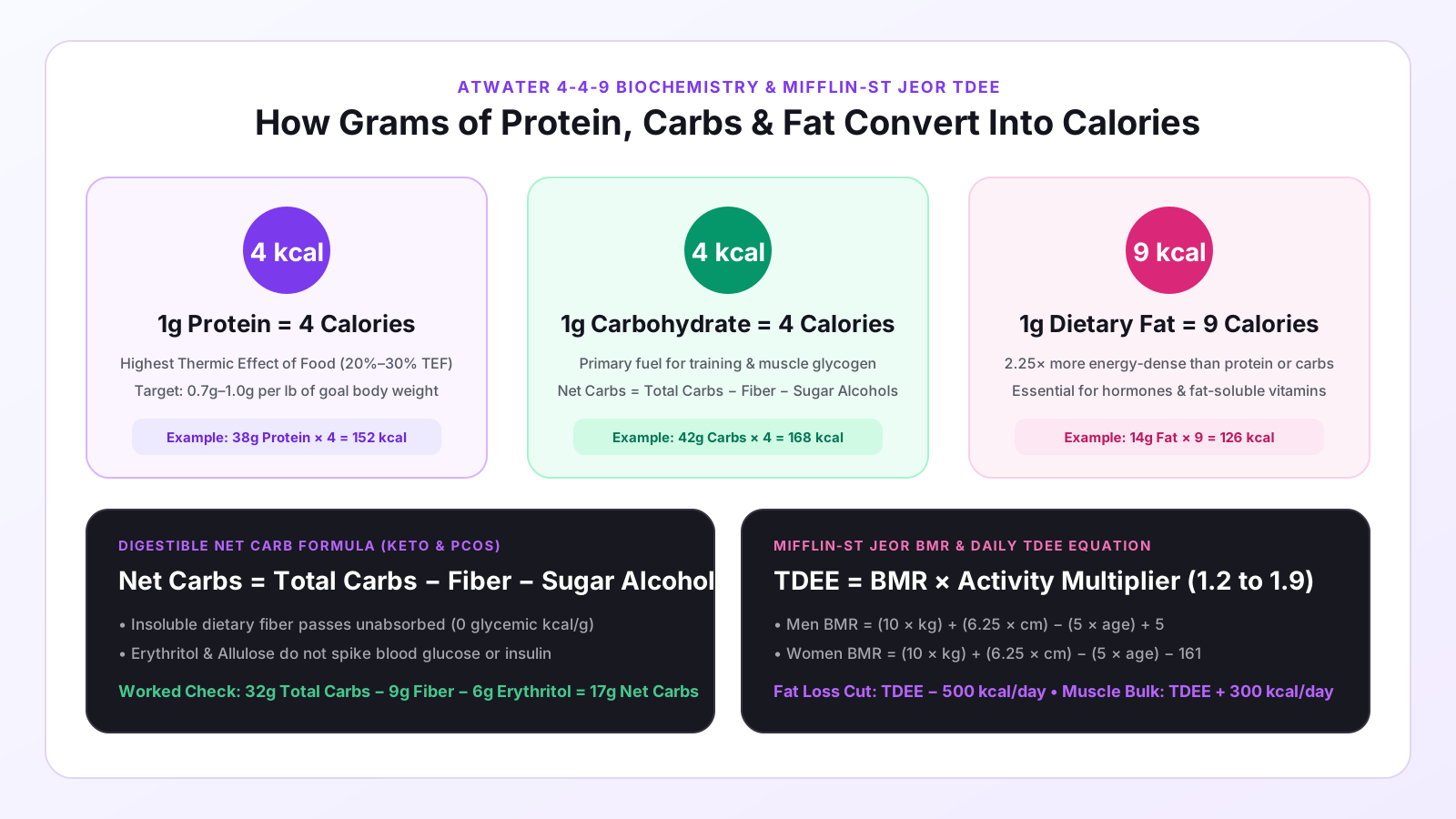
Macronutrients are the three chemical nutrient classes that supply dietary energy (measured in kilocalories, or kcal). Established by nutrition chemist Wilbur Olin Atwater, the 4-4-9 rule states that 1 gram of protein contains 4 calories, 1 gram of carbohydrate contains 4 calories, and 1 gram of fat (lipids) contains 9 calories.
Because fat supplies 9 kcal per gram—more than double the 4 kcal/g of protein or carbs—fat is the most energy-dense macronutrient. Vitamins, minerals (micronutrients), and water supply 0 calories per gram.
2. Difference between carbs and calories, plus how to calculate net carbs
Calories measure total heat/energy content, while carbohydrates are one of the three macronutrient sources of those calories. When tracking a low-carb, keto, diabetic, or PCOS diet, subtract indigestible fiber and non-glycemic sugar alcohols from total carbohydrates: Net Carbs = Total Carbohydrates − Dietary Fiber − Sugar Alcohols.
3. TDEE vs. BMR and the three components of Total Energy Expenditure
Total Energy Expenditure (TEE / TDEE) consists of three physiological components: Basal Metabolic Rate (BMR, accounting for 60%–70% of daily burn and representing the largest component), Physical Activity (exercise plus daily step NEAT, 20%–30%), and the Thermic Effect of Food (TEF, ~10%).