CULINARY & NUTRITION GUIDE
What Are Macros? 4-4-9 Grams to Kcal Math & Best Macros for Weight Loss
Complete guide to counting macros: what macros are, how many calories per gram of protein (4), carbs (4), and fat (9), difference between carbs and calories, and best macros for weight loss.
1. Direct Answer: What Is Macros and What Does Counting Macros Mean?
Macros (short for macronutrients) are the three foundational nutrient categories that provide caloric energy and structural building blocks in the human diet: protein, carbohydrates, and dietary fat. Counting macros means tracking the daily gram totals of protein, carbohydrates, and fat you consume rather than tracking total calories in isolation.
While a pure calorie deficit determines whether you lose weight on the scale, the macronutrient composition of those calories—especially your daily protein intake—determines whether the weight you lose comes from stored body fat or valuable lean muscle tissue.
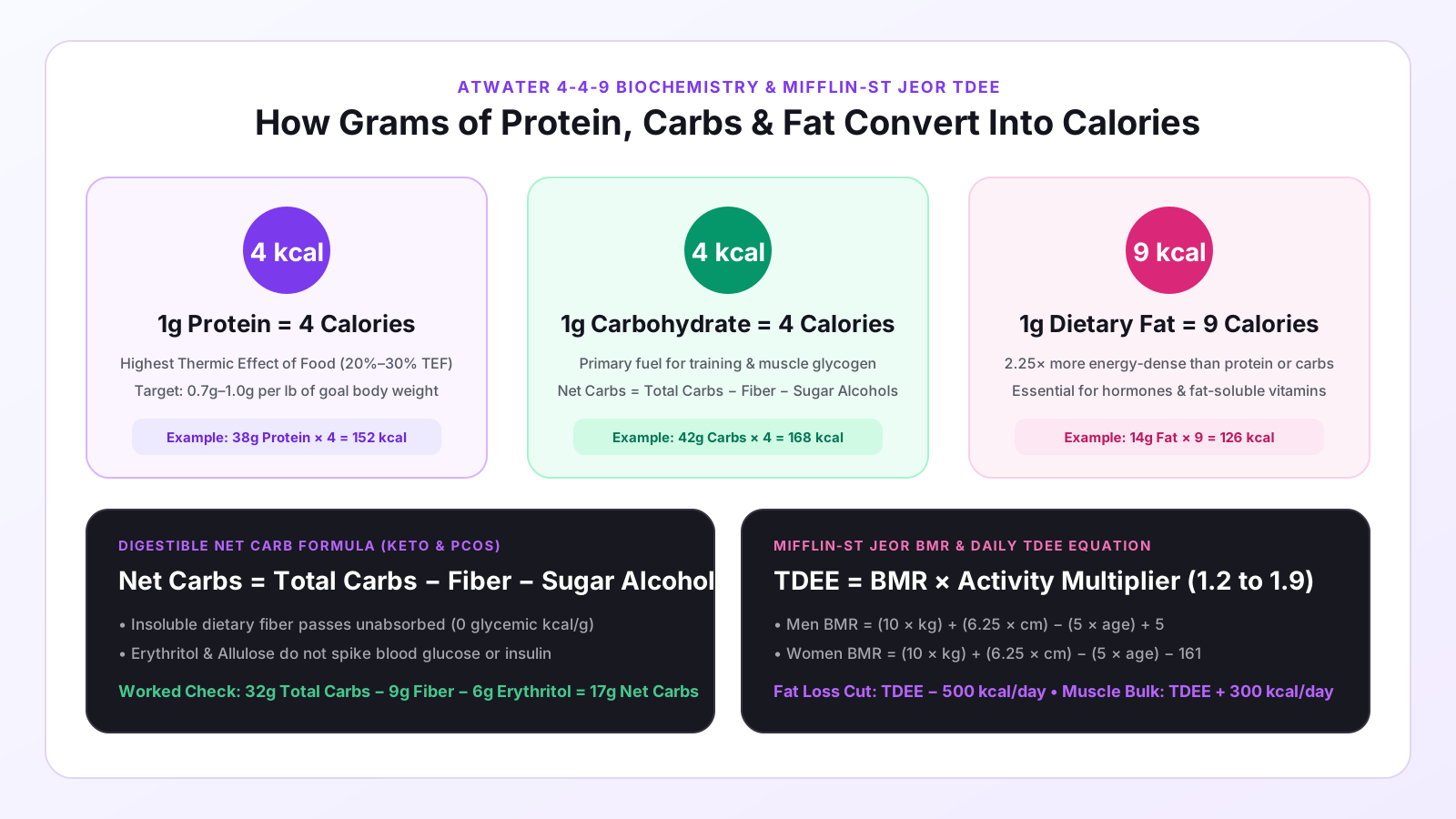
- Protein (4 calories per gram): Repairs muscle fibers, supports immune enzymes, and has the highest Thermic Effect of Food (burning 20%–30% of its own calories during digestion).
- Carbohydrates (4 calories per gram): Supplies glucose and intramuscular glycogen to fuel brain function, high-intensity exercise, and daily steps.
- Dietary Fat (9 calories per gram): Supports steroid hormone synthesis, cell membranes, and absorption of fat-soluble vitamins A, D, E, and K.
- Micronutrients vs. Macros: Vitamins and minerals (iron, calcium, vitamin D, potassium) are micronutrients—measured in milligrams or micrograms—that contain 0 calories but regulate metabolic pathways.
2. 1 gm of Fat, Protein & Carbs Is How Many Calories? (Grams to Kcal Math)
Agricultural chemist Wilbur Olin Atwater established the 4-4-9 physiological energy system used by the USDA and FDA on every Nutrition Facts panel. Specifically: each gram of protein is 4 calories (kcal), 1 gram of carbohydrate is 4 calories (kcal), and 1 gm of fat is 9 calories (kcal). Alcohol (ethanol), while not an essential macronutrient, supplies 7 calories per gram.
To convert grams to kcal for any homemade recipe or nutrition label, multiply Protein (g) × 4, Total Carbohydrates (g) × 4, and Total Fat (g) × 9, then sum the three numbers. Conversely, to convert daily calorie targets into macro grams (calories to grams), multiply your daily calories by your desired percentage for each macro and divide by 4 (for protein and carbs) or by 9 (for fat).
- Worked Grams-to-Kcal Example: A homemade salmon rice bowl with 40g protein, 55g carbohydrates, and 16g fat provides (40 × 4) + (55 × 4) + (16 × 9) = 160 + 220 + 144 = 524 kcal.
- Worked Kcal-to-Grams Example: On a 2,000-calorie diet with a 35% protein / 35% carb / 30% fat split: Protein = (2,000 × 0.35) ÷ 4 = 175g; Carbs = (2,000 × 0.35) ÷ 4 = 175g; Fat = (2,000 × 0.30) ÷ 9 = 67g.
3. What Is the Difference Between Carbs and Calories?
Beginners often ask about the difference between carbs and calories because both numbers appear prominently on diet plans. Carbohydrates are a physical substance—starches, sugars, and fibers—weighed in grams, whereas calories (kilocalories) are a measurement of energy across all foods.
One gram of digestible starch or sugar always equals 4 calories, but foods that contain 0 grams of carbohydrates—such as olive oil (120 calories per tablespoon from 14g fat) or ribeye steak—still contain substantial calories from fat and protein. Furthermore, insoluble dietary fiber is classified under Total Carbohydrates on US food labels, yet it passes through the digestive tract unabsorbed (0 digestible calories), which is why low-carb and ketogenic trackers calculate Net Carbs (Total Carbs minus Dietary Fiber and Sugar Alcohols).
4. Best Macros for Weight Loss, Muscle Gain & Body Recomposition (TDEE vs. BMR)
Before picking macro percentages, calculate your BMR (Basal Metabolic Rate—the resting energy your body burns in 24 hours) and multiply by your activity factor (1.2 to 1.9) in our Recipe Macro & TDEE Calculator to find your maintenance TDEE (Total Daily Energy Expenditure). Never eat below your BMR without clinical supervision; instead, subtract 400 to 500 kcal from your TDEE for a sustainable ~0.8 to 1.0 lb/week fat loss pace.
Once your calorie target is set, anchor protein first at 0.7 to 1.0 grams per pound of goal body weight (1.6 to 2.2g per kg), then choose the macro ratio that matches your goal and lifestyle:
- Best Macros for Weight Loss (Cutting): 35% Protein / 35% Carbohydrates / 30% Fat at TDEE − 450 kcal/day. High protein preserves lean muscle and blunts hunger.
- Best Macros to Gain Muscle and Lose Fat (Recomposition): 35% Protein / 40% Carbohydrates / 25% Fat at TDEE − 150 kcal/day paired with 3–4 days/week of progressive resistance training.
- Best Macros for Lean Muscle Gain (Bulking): 30% Protein / 45%–50% Carbohydrates / 20%–25% Fat at TDEE + 250 to 300 kcal/day.
- PCOS & Blood-Sugar Steady Split: 30%–35% Protein / 30%–35% Low-GI High-Fiber Carbohydrates / 35% Healthy Fats, aiming for ≥30g protein and ≥8g fiber per meal.